
Shopify Inventory Sync: ERP, WMS, 3PL, and the Source of Truth
Shopify inventory sync explained for enterprise catalogs. Learn how to design ERP, WMS, and 3PL integrations that prevent race conditions and stock drift.

Published
Shopify Inventory Sync: ERP, WMS, 3PL, and the Source of Truth
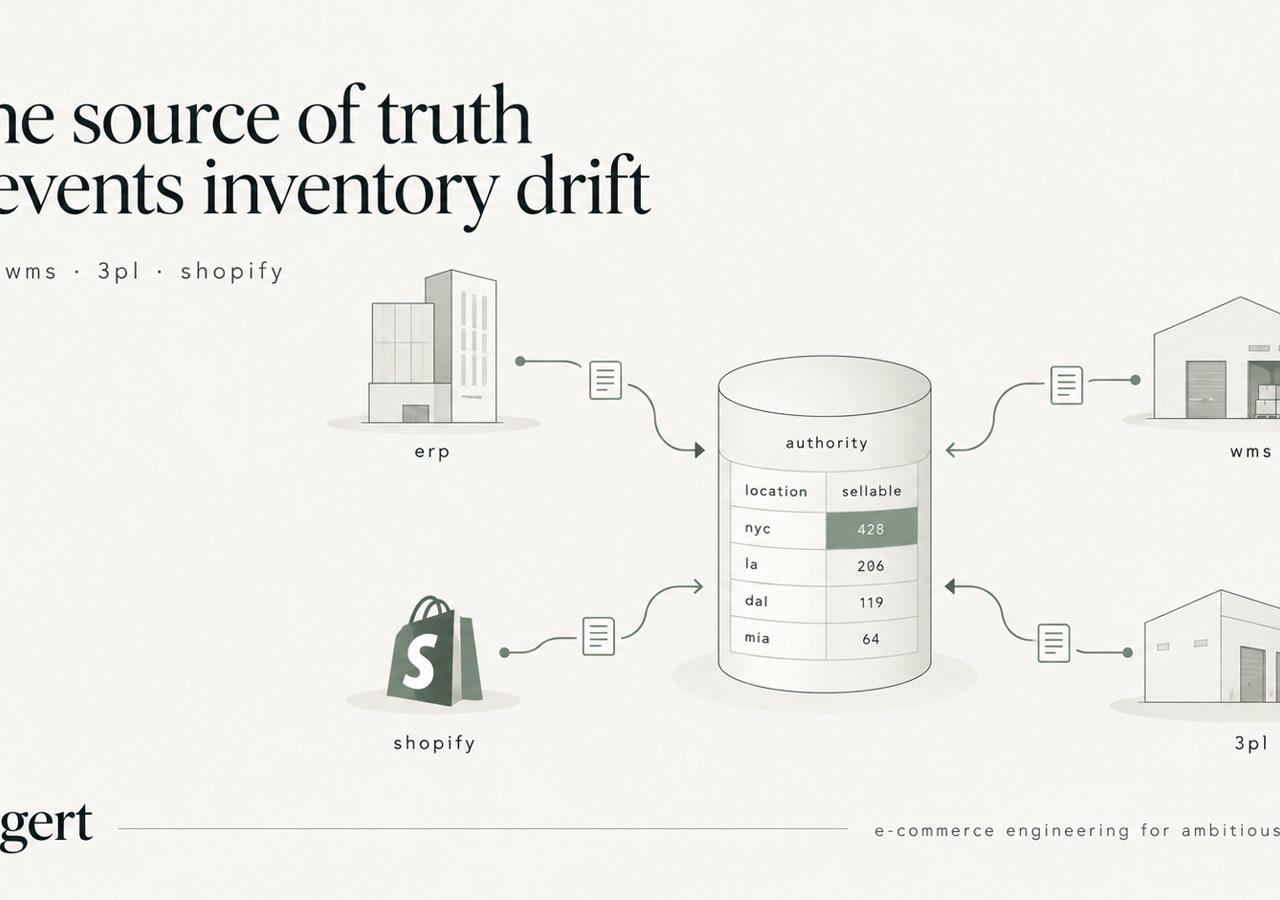
Faster sync does not fix bad inventory data. It propagates bad inventory data faster. A common failure mode in Shopify inventory sync is conflicting ownership: an ERP, warehouse system, 3PL, and Shopify each publish quantities without a shared inventory contract. Reliable synchronization starts with state ownership, location mapping, event processing, and reconciliation—not connector speed.
Quick answer: Choose one authoritative writer for each inventory quantity and location. Use Shopify's location-specific inventory states, guard absolute updates against stale writes, make event processing idempotent, and reconcile discrepancies on a schedule. ERP, WMS, 3PL, and marketplace integrations can exchange events in both directions without all independently writing the same sellable quantity.
Table of Contents
- Why Inventory Sync Breaks Before the API Does
- How Shopify Actually Models Inventory
- Four Sync Architectures and When Each One Fits
- The Race Condition That Causes Phantom Stock
- Where Drift Actually Comes From
- Reconciliation, Observability, and the Monitoring Stack
- Multi-Location, Bundles, and Channel Reservations
- A Decision Framework for Choosing Your Sync Approach
- Shopify Inventory Sync FAQ
Why Inventory Sync Breaks Before the API Does
Many Shopify inventory integration projects begin with a reasonable-sounding request. Connect Shopify to the ERP, keep stock updated in both directions, and make the updates as close to real time as possible. That request hides the decisions that determine whether the integration survives peak traffic, a 3PL change, a bundle launch, or a warehouse count correction.
A stock number is not one fact. Physical stock, sellable stock, reservations, damaged units, inbound units, and channel allocations answer different business questions. An ERP may own business availability, a WMS may own shelf counts, a 3PL may own picked and packed status, and Shopify may own committed units created by orders. If every system publishes absolute totals back to Shopify without concurrency and ownership controls, a stale update can overwrite a newer business state.
Ownership Comes Before Tooling
Reliable Shopify stock sync requires a source of truth for each field and workflow. Shopify does not automatically own inventory because it owns checkout. A merchant with a mature ERP usually treats the ERP as authoritative for sellable quantity. A merchant with a single 3PL and no ERP may treat the WMS as authoritative for physical stock and calculate Shopify availability from rules in a middleware layer.
Practical rule: one writer owns one inventory concept at one location. Other systems may read, reserve through defined events, or request changes. They do not independently overwrite the same value.
Unclear ownership produces operational costs that finance teams notice late. Oversells become cancellations and refunds. Undersells hide good stock behind conservative buffers. Warehouse teams absorb manual recounts. Customer service absorbs explanations. Finance absorbs write offs and correction work during close.
The connector question is downstream. An app, a custom application, or middleware can implement a good design. None can rescue a design where SKU ownership is disputed, locations are mapped casually, and every platform is allowed to publish a full quantity snapshot. Shopify inventory management integration succeeds when data contracts define who changes what, in which state, at which location, and with which event evidence.
Bidirectional sync deserves particular skepticism. Shopify order events must flow outward. Warehouse receipts and adjustments must flow inward. Those are different flows with different owners. Calling the combined design bidirectional often obscures that distinction and invites circular updates, duplicate decrements, and phantom replenishment.
How Shopify Actually Models Inventory
Shopify does not store one universal quantity for a SKU. The model is location based. An InventoryItem represents the tracked item, and an InventoryLevel connects that item to one specific location. A product stocked at five locations has five separate inventory relationships to read, update, and reconcile, as described in Shopify's InventoryLevel resource documentation.
That structure changes integration design for brands migrating from Magento, WooCommerce, a legacy ERP, or a warehouse system built around a single stock field. The integration must map external SKUs or variant identifiers to Shopify inventory item IDs. It must also map external warehouses, stores, and 3PL facilities to Shopify location IDs. Teams planning catalog cleanup before replatforming should resolve those identifiers early, a point covered in guidance on Shopify catalog modeling before migration.
States Are Not Labels
Each inventory level can expose separate states. Physical quantity and sellable quantity diverge whenever orders are committed, goods sit in quality control, units are damaged, or a safety buffer protects another channel. Treating every shelf unit as immediately available creates oversells. Treating committed units as available destroys the meaning of an order reservation.
| State | Meaning | Sync Implication |
|---|---|---|
| Available | Sellable at that location | Derived from the authoritative availability policy, accounting for allocations and withheld units |
| On-hand | Total physical quantity at that location | Useful for warehouse reconciliation, not a direct storefront promise |
| Incoming | Stock on its way, not yet received | Should not become sellable until receipt rules are satisfied |
| Committed | Allocated to orders | Must be preserved rather than overwritten by external snapshots |
| Reserved | Held for a defined purpose | Requires an explicit owner and release rule |
| Damaged | Physically present but unsellable | Must stay out of available quantity |
| Safety stock | Buffer withheld from sale | Protects channels or locations, depending on policy |
| Quality control | Held pending inspection | Becomes sellable only after an accepted receipt event |
Shopify defines incoming stock as unavailable for sale until it is received, and calculates on-hand from available, committed, reserved, damaged, safety stock, and quality control quantities. In the merchant admin, reserved, damaged, safety-stock, and quality-control units are grouped under Unavailable; the API exposes their separate quantity states. See Shopify's GraphQL InventoryLevel object and Shopify's inventory state definitions. That distinction is why matching a single total between systems cannot prove sellable accuracy.
The durable technical base is the Shopify inventory API through GraphQL, with location scoped reads, activation of items at locations, and mutations that set or adjust quantities by state. A new Shopify ERP inventory sync should be evaluated against that model from the start.
Four Sync Architectures and When Each One Fits
Architecture follows system maturity, not fashion. The right topology depends on where stock knowledge is most reliable, how many destinations consume inventory, and whether transformations must occur before Shopify receives a sellable value.
| Architecture | Best fit | Who determines sellable stock? | Main control |
|---|---|---|---|
| ERP → Shopify | ERP-led commerce operations | ERP after warehouse and order events | Prevent stale full snapshots |
| WMS → ERP → Shopify | Multiple warehouses and allocation policies | ERP, based on WMS movements | Reconcile handoffs and location maps |
| WMS → Shopify | Simpler 3PL fulfillment | WMS or a defined integration rule | Model reservations, returns, and buffers |
| Middleware → Shopify and channels | Multiple ERP, 3PL, POS, and marketplace connections | One designated authority; middleware enforces the contract | Idempotency, ordering, replay, and monitoring |
ERP to Shopify fits brands where the ERP consolidates purchasing, warehouse feeds, channel rules, and financial stock valuation. The ERP owns business availability and publishes sellable quantity to Shopify by location. Shopify sends order and fulfillment events back for allocation and invoicing. Risk concentrates in ERP publishing discipline. Full snapshots, batch windows, and manual ERP adjustments need ordering controls, just as complex enterprise data programs benefit from Kagool's SAP integration insights on disciplined system integration.
WMS to ERP to Shopify fits multi-warehouse operations where shelf truth and business truth differ. The WMS owns physical movements such as receipts, picks, putaway, damage, and cycle counts. The ERP converts those movements into available-to-sell quantity after reservations, channel policy, safety stock, and inbound logic. Shopify receives the resulting sellable quantity. This chain adds latency and handoffs, but it gives each system a defensible job.
WMS to Shopify directly fits simpler operations with one fulfillment logic owner and limited channel allocation. It's defensible only when the WMS can express sellable stock, not merely shelf stock, and when Shopify orders reliably create reservations or decrements in the warehouse flow. Without an ERP buffer, damaged goods, returns grading, preorders, and B2B allocations often force business rules into the connector.
Where Middleware Earns Its Cost
Middleware or an integration layer fits merchants connecting Shopify with an ERP, WMS, 3PL, POS, PIM, and marketplace feeds at the same time. It provides transformation, queuing, retries, idempotency keys, logging, quarantine for unknown SKUs, and scheduled reconciliation. That overhead isn't decoration. Reliable synchronization requires clear ownership, data contracts, retries, reconciliation, and observability rather than connecting two APIs, which is the scope addressed by Shopify integration services for ERP, WMS, and 3PL systems.
Bidirectional quantity writing remains dangerous in all four models. Event exchange can be bidirectional. Authority over the same state at the same location can't be. A Shopify WMS integration should state which side may set available, which side may adjust on-hand evidence, and which side owns manual corrections. If those answers depend on the situation, the architecture isn't finished.
The Race Condition That Causes Phantom Stock
A race condition needs no outage, no broken API, and no careless employee. It needs two systems writing plausible values in the wrong order. Peak promotions make the sequence easier to trigger because orders, warehouse confirmations, and batch exports overlap.
- Shopify receives an order for the last unit at a location.
- Shopify reduces available inventory and commits the unit to that order.
- The ERP sends an older stock snapshot created before the order decrement reached it.
- Shopify inventory increases again because the integration treats the snapshot as a target quantity.
- Another customer buys the phantom unit, and fulfillment discovers the shelf is empty.
The failure sits in update semantics. A set operation establishes a target quantity. An adjust operation applies a delta. Delta updates suit event driven warehouse movements because a receipt of ten units remains a receipt of ten units when processed once. Target setting suits controlled reconciliation from the authoritative system. Mixing both patterns without sequencing rules lets stale targets erase valid deltas.
Controls That Prevent Stale Writes
Source gating is the strongest control. If the ERP owns available quantity, Shopify orders must reach the ERP fast enough, or the integration layer must account for committed Shopify orders before accepting an ERP target. If Shopify owns committed quantity, external writers must not flatten states into one available number.
Ordering metadata gives the integration a way to reject old work. Useful designs store source timestamps, sequence numbers, event IDs, and the inventory version observed before a write. A worker can compare expected state with current state before applying a change. Stale payloads enter a quarantine queue instead of the storefront.
Duplicate delivery is normal in distributed systems. Duplicate application is a design defect.
Idempotency protects retries. Each command needs a stable key tied to the source event, inventory item, location, state, and intended delta or target. The integration must deduplicate a retried adjustment rather than apply the delta twice. Compare-and-swap behavior adds another guard by refusing a write when the quantity has changed since the writer read it.
API implementation detail (Shopify Admin GraphQL 2026-10): inventorySetQuantities sets an absolute target and is intended for an authoritative inventory system. In versions 2026-04 and later, each quantity input must include changeFromQuantity; a mismatched expected value rejects the stale write. The mutation also requires an idempotency key through @idempotent. Use inventoryAdjustQuantities for incremental changes and follow the current inventorySetQuantities reference when implementing absolute corrections. An API idempotency key protects a request; the integration still needs its own event deduplication and reconciliation policy.
Where Drift Actually Comes From
Inventory drift is easier to fix when teams classify it by layer. A single mismatch count doesn't tell operations whether a webhook failed, a SKU map broke, or a store manager edited stock in Shopify admin. Triage starts by separating transport failures from identity failures and human process failures.
Event and API Layers
Missing webhooks leave Shopify unaware of warehouse receipts or external systems unaware of orders. Duplicate events double apply a movement when handlers aren't idempotent. Out-of-order events let an older adjustment land after a newer one. Partial API failures create a subtler problem: some locations update, others don't, and the retry payload may no longer describe current reality.
Detection requires event receipts, processing logs keyed by source event ID, dead letter queues, and replay tools that preserve original ordering metadata. Retry logic should use bounded attempts and escalating delays. Infinite retries against a permanently invalid SKU block healthy inventory behind poison messages unless queues separate failures by cause.
Data and Operations Layers
SKU mismatches are usually master data failures. Variant restructuring during a Shopify Plus migration, duplicated SKUs across markets, case differences, or bundle SKUs treated as physical items all break mapping. Location mismatches occur when a 3PL facility, returns center, or retail store is mapped to the wrong Shopify location, or when a new location goes live before the integration activates items there.
Operational drift comes from ordinary work routed around the integration. Manual admin edits, spreadsheet imports, warehouse cycle counts entered only in one system, cached marketplace feeds, and batch jobs using old extracts all create divergence. Returns and canceled orders add timing ambiguity. A returned unit might be sellable, damaged, in quality control, or still in transit. Publishing it as available at carrier scan time misstates stock.
Bundle component inventory belongs in the data layer too. A bundle can look available while one component is exhausted. Channel delay compounds the error when marketplaces cache an earlier quantity. Each cause needs a specific detector: unknown SKU alerts, unmapped location reports, manual change audit review, component availability checks, and scheduled comparisons against the authoritative stock record.
Reconciliation, Observability, and the Monitoring Stack
Real-time events reduce latency. They don't prove correctness. A dependable Shopify 3PL inventory sync assumes an event will eventually be missed, duplicated, delayed, or applied against a mapping that changed. Scheduled reconciliation is therefore a primary workload, not an emergency cleanup script.
Reconciliation compares Shopify quantity by inventory item, location, and state against the authoritative system. It should classify differences before correcting them. Expected in-flight differences expire naturally. Unknown SKUs need master data work. Persistent location drift needs process investigation. Blind auto-correction can import errors from the external system at larger scale, especially when managing inventory across sales channels with different allocation rules.
Capacity planning belongs in reconciliation design. Shopify lists GraphQL Admin API restore rates of 100 points per second for Standard, 200 for Advanced Shopify, 1,000 for Shopify Plus, and 2,000 for Commerce Components; a single GraphQL query cannot exceed 1,000 cost points, according to Shopify's GraphQL Admin API rate limit documentation. Shopify can temporarily change rate limits, so workers should follow the extensions.cost.throttleStatus values returned by the API. Large catalogs need bounded pagination, queue rate limits based on returned cost metadata, and bulk operations for full comparisons. Separate read and write workers prevent a catalog reconciliation burst from starving urgent sellable updates.
Metrics That Need an Owner
- Last successful sync timestamp: tracked per source, destination, and location flow, not as one global heartbeat.
- Failed updates and retry count: grouped by error type so mapping defects don't hide inside API timeouts.
- Inventory mismatches: counted by item, location, and state, with age and absolute unit difference.
- Unknown SKUs and missing locations: routed to data owners with the source payload attached.
- API errors and webhook failures: alerted when delivery gaps threaten an agreed latency target.
- Sync latency: measured from source event time to confirmed downstream write.
- Oversell incidents: linked back to the event sequence that exposed the quantity.
Observability means any value can be explained. Which system changed it? When did the change occur? What event triggered it? Did Shopify accept the write? Was it retried? What is the authoritative value now? Customer-visible risks deserve paging alerts. Expected reconciliation noise belongs in a reviewed report. Silence in a dashboard is not evidence that inventory is correct.
Multi-Location, Bundles, and Channel Reservations
Mapping every physical facility directly to a Shopify location looks precise. It can produce a storefront that promises stock fulfillment can't use. A retail store may support pickup but not ship-from-store. A 3PL may hold client owned overflow that shouldn't serve DTC orders. A returns center may receive units that need grading. A virtual location may represent marketplace allocation rather than a shelf.
Location mapping must follow the fulfillment model. Merchants need rules for routing priority, split shipments, partial fulfillment, backorders, preorders, store pickup, international duty zones, and B2B commitments. Exposing regional warehouse stock to the wrong market can create cancellations even when total global quantity looks sufficient. Conversely, pooling locations without exposing their separate constraints can force expensive transfers after checkout.
Bundles Need Calculated Availability
A bundle often has no independent physical inventory. Its availability comes from the limiting component at an eligible location, after component reservations and single unit channel allocations are considered. Selling one kit must consume components in the warehouse flow. Selling a component individually must reduce kit availability. A parent SKU quantity copied from an ERP without decomposition logic will drift as soon as component sales patterns diverge.
Channel reservations create the same semantic problem. Shopify, marketplaces, POS, subscriptions, and wholesale orders may share a shelf but not the same promise rules. One channel may receive a safety buffer. Another may sell into inbound stock as a preorder. Wholesale may reserve against a future ship window. Returns may re-enter only after inspection. Faster publication of a wrong available-to-sell formula only makes wrong listings current.
The important design question is not how quickly a number moves. It's which business rule created the number.
Hybrid timing usually fits these constraints best. Order commits and low stock thresholds deserve event driven handling. Purchase order changes, cycle counts, channel allocation refreshes, and full comparisons can run on schedules with approval thresholds. Shopify inventory integration should assign each flow a latency target based on customer risk, not impose real time as a slogan.
A Decision Framework for Choosing Your Sync Approach
Evaluation should start with decisions that no vendor can make for the merchant. Who owns physical stock? The answer identifies the system whose receipts, counts, damage records, and transfer evidence control on-hand corrections. Who owns sellable stock? That answer identifies the only writer allowed to determine Shopify available quantity after allocations and buffers. Who owns reservations? Order commits, B2B holds, subscription holds, and marketplace buffers need one accounting model.
Three decisions should be locked before connector code begins.
- Define the authority matrix. Assign one owner for physical stock, sellable stock, reservations, SKU definitions, locations, and manual corrections. Shopify's location scoped inventory query model reinforces that each write targets an inventory item and location pair, as shown in Shopify's inventoryLevel query documentation.
- Define failure behavior. Failed updates need queues, retry limits, dead letter review, and an operational owner. Duplicate and out-of-order events need idempotency keys, ordering data, and quarantine rules.
- Define reconciliation and change control. Scheduled comparisons, mismatch thresholds, manual edit approval, and audit records turn drift into a managed exception. Custom middleware or Shopify app development for integration workflows becomes justified when standard connectors can't express those rules.
The remaining choice is timing per flow. Commitments merit events. Corrections merit controlled reconciliation. Reference data merits governed batches. Total cost of ownership includes monitoring, API version maintenance, mapping stewardship, and exception labor, not only implementation fees. A design that answers ownership, failure, and reconciliation questions can survive a connector replacement. A design that doesn't will recreate the same drift on new software.
Shopify Inventory Sync FAQ
What is the best source of truth for Shopify inventory?
There is no universal default. Use the ERP when it owns available-to-sell business rules across channels; use a WMS or 3PL system for physical counts when it is the authoritative warehouse record. Define one writer per location and state, and document how Shopify orders affect availability.
Can Shopify synchronize inventory with an ERP and a 3PL?
Yes. Shopify's Admin GraphQL API supports location-specific inventory quantities, and webhooks can notify integrations about relevant Shopify events. Reliable workflows must also handle missing and repeated events, location mapping, retries, and reconciliation.
How do you prevent overselling during inventory synchronization?
Account for orders and reservations before publishing availability, reject stale absolute updates, deduplicate quantity adjustments, and reconcile Shopify quantities against the authoritative source. No design can guarantee zero oversells when fulfillment and external services can fail.
Is real-time inventory sync better than scheduled reconciliation?
They solve different problems. Event-driven updates reduce delay for orders and low stock, while scheduled reconciliation detects missed events, bad mappings, and persistent quantity drift. Most multi-system designs need both, with latency targets based on customer risk.
For established brands dealing with ERP, WMS, 3PL, POS, or PIM inventory drift, Shugert designs and maintains Shopify integrations built around source-of-truth ownership, idempotent event handling, queues, reconciliation, and operational monitoring. The work starts with an authority and location mapping review before connector decisions are locked. Explore the approach at Shugert.
Keep exploring this topic
Deeper references from the Shugert library and the service that turns this work into a fixed scope.
Related services
Keep reading

Shopify Theme Architecture in 2026: When Liquid Should Win Over JavaScript
JavaScript is essential for interaction, but many Shopify themes ask it to do work that Liquid and HTML can deliver earlier, more reliably and with less main-thread cost.
Why We Duplicate the Live Shopify Theme Before Every Engineering Change
A duplicate theme is a simple safety boundary: it separates implementation and QA from the storefront customers are using right now.
Shopify Plus Agency RFP Checklist for Complex Commerce Projects
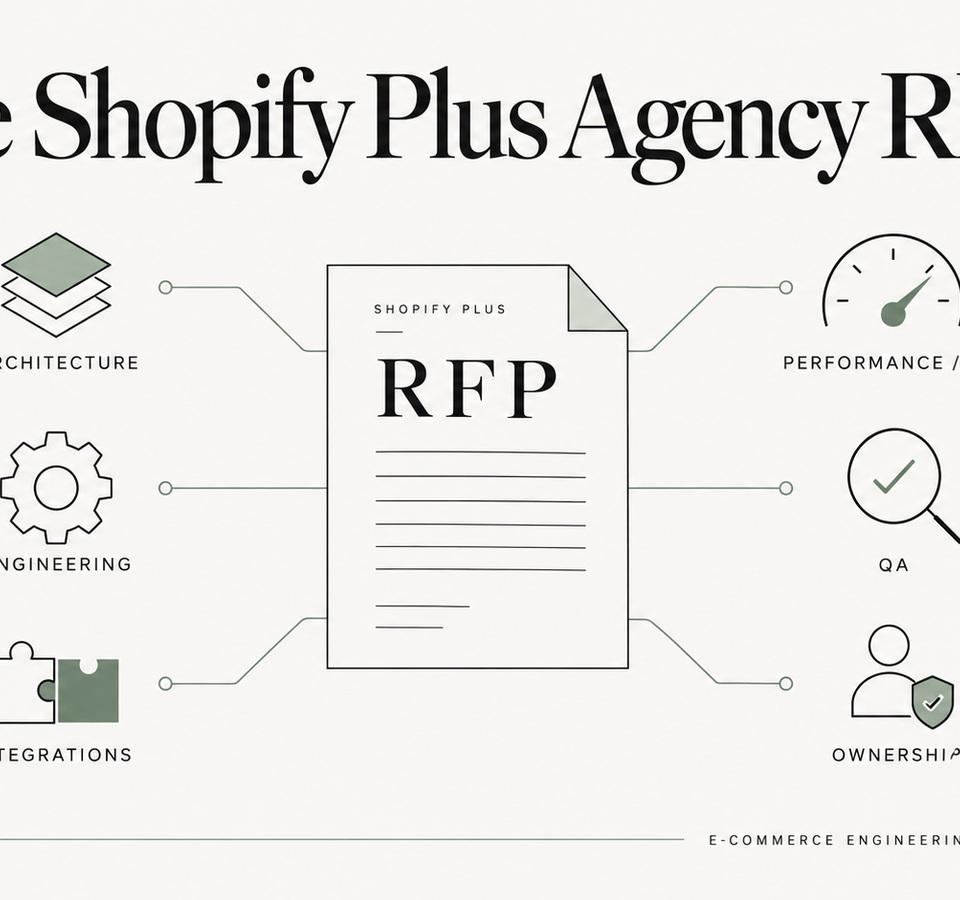
What established DTC and B2B teams should put in a Shopify Plus RFP so agency proposals are comparable on architecture, delivery risk and ownership.