
Shopify Plus Agency RFP Checklist for Complex Commerce Projects
What established DTC and B2B teams should put in a Shopify Plus RFP so agency proposals are comparable on architecture, delivery risk and ownership.

Published
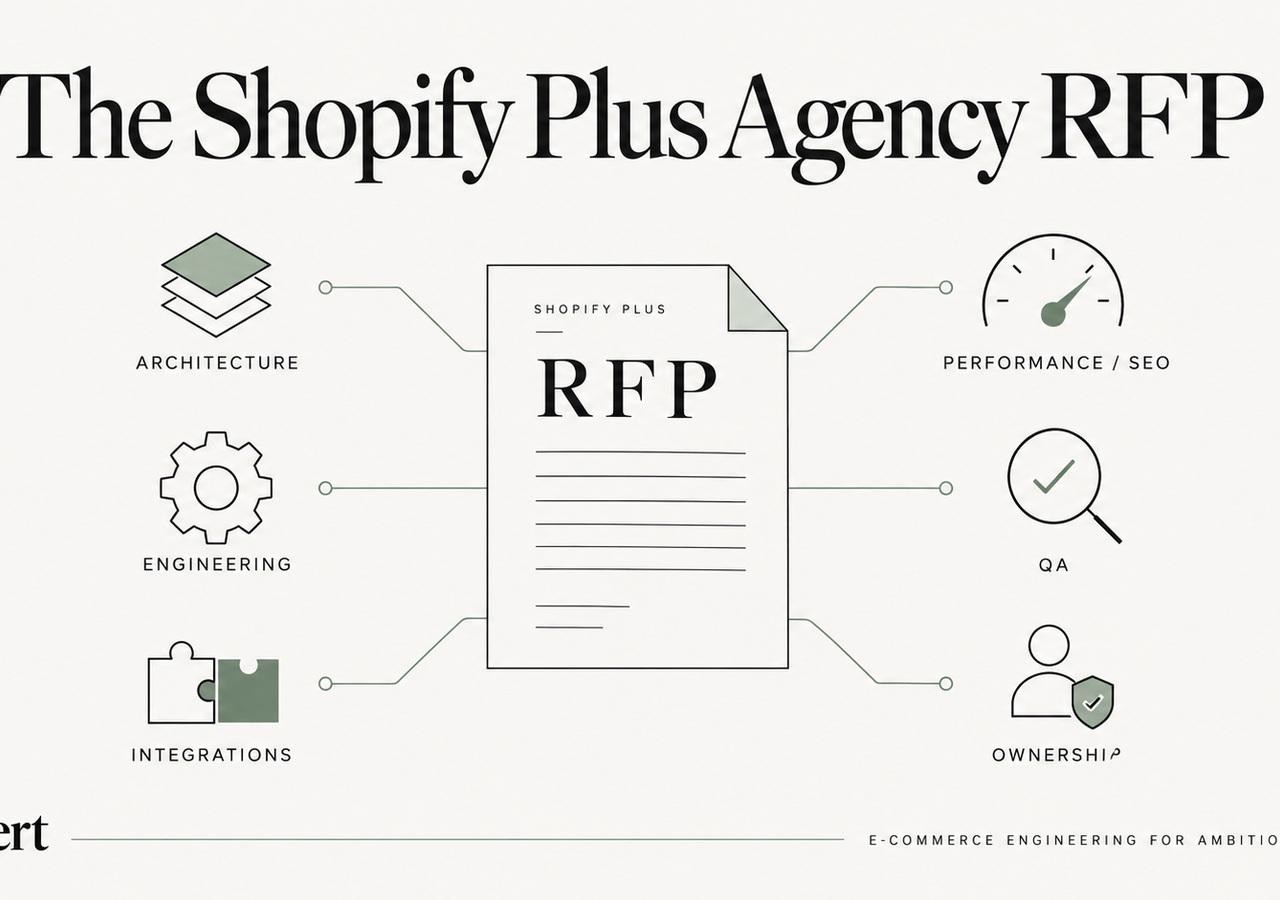
Shopify Plus Agency RFP Checklist for Complex Commerce Projects
A Shopify Plus RFP should help you discover whether an agency can operate your commerce system, not just whether it can design a polished storefront.
For established DTC and B2B brands, the hard parts of a Plus project often sit behind the interface: data ownership, ERP and PIM synchronization, B2B catalogs, checkout rules, international markets, analytics, deployment discipline, performance, and post-launch support. If those requirements are absent from the RFP, agencies are forced to estimate different projects—and the proposals become impossible to compare fairly.
This guide shows what to include before you ask Shopify Plus agencies for proposals, how to evaluate the answers, and which questions expose delivery risk early.
Define the Business Problem Before the Platform Scope
Start by writing the reason the project exists.
"Move to Shopify Plus" is not a business problem. A useful brief sounds more like:
- replace an expensive or fragile legacy platform;
- consolidate multiple regional storefronts;
- support B2B company accounts and customer-specific pricing;
- reduce release friction and app dependency;
- connect a new ERP, PIM, OMS, or 3PL;
- improve storefront performance;
- rebuild checkout customizations on supported extension points;
- create a maintainable international operating model;
- give the ecommerce team more control without losing engineering discipline.
The dominant problem should influence who you invite. A migration-heavy project needs different evidence from a design-led rebrand. A B2B implementation needs different architecture experience from a DTC CRO program.
If your project is specifically a replatform, our Shopify migration agency comparison can help build the shortlist. For broader development work, the Shopify development agency selection guide covers general partner evaluation.
1. Describe the Current Commerce Architecture
Do not make agencies reverse-engineer the basics during a sales call.
Include:
- current ecommerce platform and version;
- number of storefronts and domains;
- approximate product and variant counts;
- customer and historical-order requirements;
- markets, currencies, languages, and tax regions;
- B2B versus DTC mix;
- ERP, PIM, OMS, WMS, CRM, 3PL, subscription, loyalty, search, and analytics systems;
- current checkout customizations;
- headless or custom frontend components;
- internal teams that will own content, data, design, or integrations;
- known technical debt and systems scheduled for replacement.
A good agency will still perform discovery. The purpose of this section is to make early proposals comparable.
2. Separate Required Outcomes From Preferred Solutions
An RFP becomes fragile when it dictates implementation before the problem has been validated.
For example, instead of requiring "replace every custom rule with an app," describe the behavior that must survive:
- wholesale customers receive contract pricing;
- selected buyers can pay on net terms;
- products are restricted by company or region;
- inventory comes from the ERP;
- certain carts require delivery restrictions;
- specific customer segments see different content;
- finance needs historical order access;
- the retention team needs subscription continuity.
Then ask the agency to recommend where each behavior should live in Shopify.
This matters because Shopify's capabilities change. Current Shopify documentation shows that B2B features such as companies, catalogs, net payment terms, self-serve ordering, and Flow automations are available across several plans, while Shopify Plus adds capabilities such as unlimited B2B catalogs, direct catalog assignment to companies and locations, and advanced payment options. Review the current Shopify B2B features by plan when defining requirements rather than relying on an old RFP template.
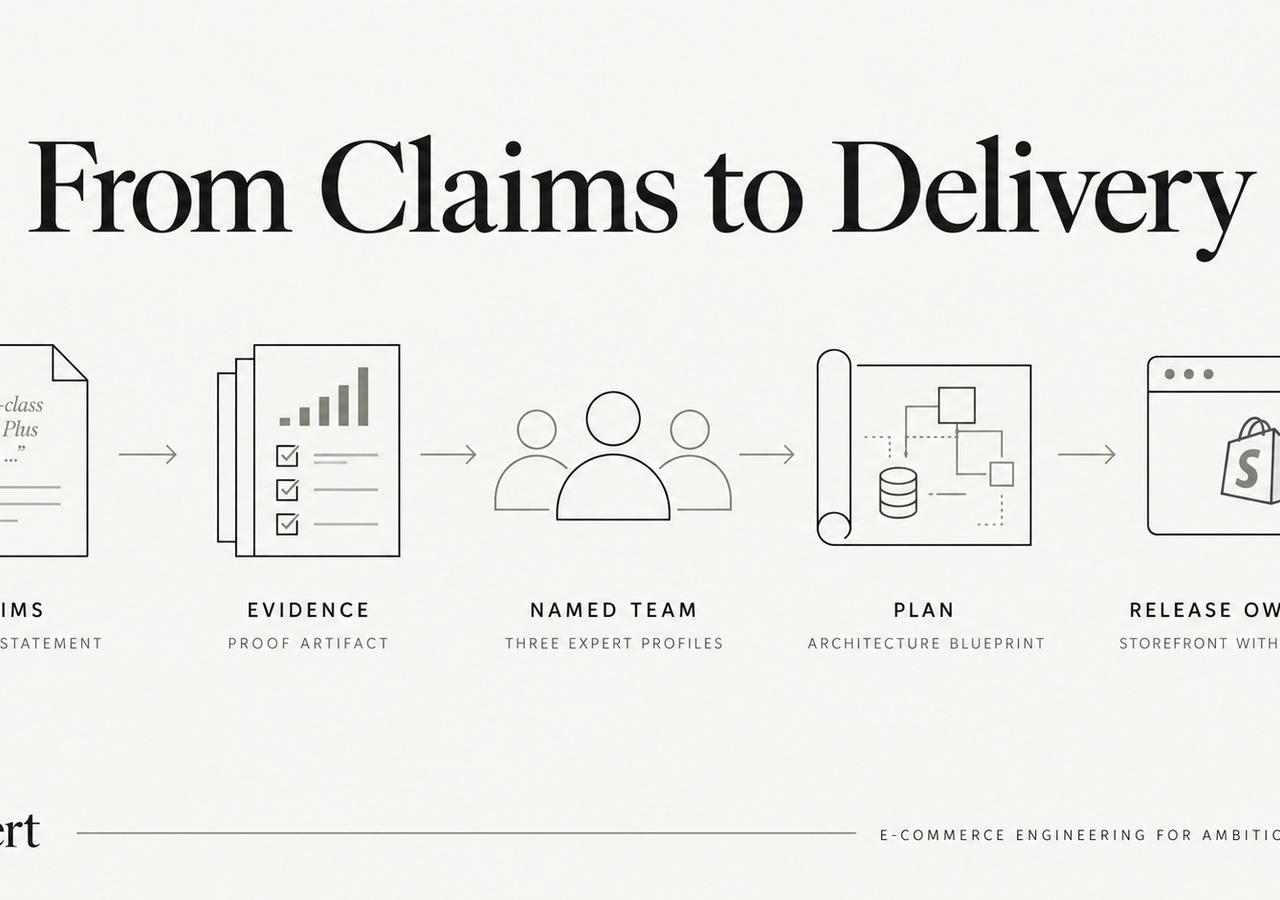
3. Define Data Ownership and Migration Requirements
For a replatform or major rebuild, list the records that matter and where they are expected to live after launch.
Common examples include:
- products, variants, options, collections, and metafields;
- company accounts and B2B locations;
- customers, addresses, tags, consent, and segmentation;
- historical orders and refunds;
- reviews, loyalty balances, gift cards, and store credit;
- subscriptions and recurring billing relationships;
- regional content and translations;
- product media and documents;
- redirects and legacy URL ownership.
Then ask the agency to describe its reconciliation method.
A credible answer should distinguish between transferring data, transforming data, validating counts, sampling difficult records, and proving that the destination still supports the intended business workflow.
4. Make Integration Boundaries Explicit
Every integration needs a source of truth, direction of travel, failure mode, and owner.
For each ERP/PIM/OMS/CRM/3PL dependency, include:
- which records move between systems;
- which system owns each record;
- expected sync frequency;
- whether updates are event-driven, scheduled, or manual;
- what happens if a call fails;
- how retries and duplicate events are handled;
- where support teams can see failures;
- who resolves mismatches after launch.
Ask agencies to diagram the proposed flow for the two or three most important workflows.
A generic statement such as "integrate NetSuite" is too vague to price or test.
5. Specify B2B Behavior in Workflows
If B2B is in scope, do not use "B2B functionality" as a catch-all requirement.
Describe complete buying scenarios:
- a buyer signs in for a specific company location;
- the correct catalog and pricing are applied;
- purchasing permissions are enforced;
- quantity rules or volume pricing behave correctly;
- payment terms are available to the right account;
- an approval or draft-order process works where required;
- the order reaches downstream systems with the correct company identifiers.
Shopify's current B2B documentation is detailed enough that an agency should be able to map each requirement to native platform behavior, configuration, extensions, or custom integration work.
6. Document Checkout Requirements by Business Rule
Legacy checkout customizations often contain years of implementation history that should not be copied literally.
Ask the agency to classify each checkout requirement as:
- native Shopify configuration;
- Shopify Functions;
- checkout UI extension;
- app capability;
- external service;
- custom workflow outside checkout;
- behavior that should be removed rather than rebuilt.
Shopify's current checkout customization technologies describe the supported extension model, and Shopify Functions provide backend customization points for supported commerce logic. The important RFP requirement is that the agency justify the architecture and test the business outcome—not simply reproduce old code.
7. Include SEO Requirements Only Where They Belong
SEO should be a first-class workstream for migrations, domain changes, information-architecture changes, or large content rebuilds.
If the project is a migration, request:
- pre-launch crawl and URL inventory;
- redirect mapping;
- canonical and robots validation;
- sitemap review;
- internal-link updates;
- structured-data checks;
- metadata and content parity where required;
- international URL and hreflang review;
- post-launch Search Console and crawl monitoring.
If the project is not changing URLs or information architecture, do not inflate the RFP with a full migration-SEO scope. Define the actual change surface.
8. Require an Analytics and Measurement Plan
The RFP should name the business events that must be trusted after launch.
At minimum, describe:
- analytics platform;
- advertising platforms;
- consent platform;
- server-side tracking, if used;
- purchase and refund events;
- subscription events;
- B2B or customer-specific measurement requirements;
- attribution or data-warehouse feeds;
- who owns validation.
Ask agencies to explain how they compare expected orders and revenue against the analytics output. A visually successful release is not complete if the business loses reliable measurement.
9. Put Performance Into Acceptance Criteria
"Fast" is not an acceptance criterion.
Provide the current baseline if you have it, then ask how the agency will control:
- third-party JavaScript;
- app scripts;
- image delivery;
- font loading;
- theme rendering;
- personalization;
- tag-manager behavior;
- interaction-heavy components;
- regressions between staging and production.
The goal is not to force a guaranteed Lighthouse number. It is to establish a measurement method, identify the components the agency can control, and define how performance regressions are handled.
10. Ask for the Delivery and Deployment Model
A Shopify Plus project is easier to manage when everyone knows how changes move from development to production.
Include questions about:
- repository ownership;
- branching and review;
- staging or development stores;
- theme duplication and release procedures;
- environment variables and secrets;
- app deployment;
- rollback;
- QA responsibility;
- merchant approval;
- urgent production fixes.
Ask who has authority to ship and who has authority to stop a release.
11. Name the Proposed Team
Request named roles, not only agency departments.
You should know:
- account or delivery lead;
- technical architect;
- senior Shopify engineer;
- integration engineer;
- data migration owner;
- QA owner;
- SEO owner if relevant;
- UX/design lead if relevant;
- post-launch support owner.
Then ask how much of their time is actually allocated and whether those people remain on the project through launch.
A senior discovery team followed by an unrelated delivery team creates avoidable context loss.
12. Define QA and Launch Gates
Your RFP should ask the agency to propose acceptance criteria before development is finished.
Typical launch gates include:
- data reconciliation within agreed tolerances;
- critical integrations passing end-to-end tests;
- checkout scenarios passing;
- payment, shipping, tax, and discount tests passing;
- redirects and canonicals validated where relevant;
- analytics purchase events reconciled;
- priority accessibility issues addressed;
- production monitoring and escalation path ready;
- rollback procedure documented.
A launch date is a planning constraint. It should not replace readiness criteria.
13. Make Post-Launch Ownership Part of the Proposal
Ask what happens after go-live.
Important questions include:
- How long is the stabilization window?
- What counts as a defect versus new scope?
- Who monitors integrations and storefront errors?
- What response expectation applies to checkout or revenue-blocking issues?
- How are SEO and analytics anomalies reviewed?
- Does the same team remain involved?
- How does the project transition into a retainer or internal handoff?
This is especially important for complex migrations. The first production week exposes edge cases that staging rarely reproduces perfectly.
14. Make Commercial Assumptions Comparable
Ask every finalist to show:
- fixed-scope versus time-and-materials components;
- discovery fee, if separate;
- assumptions and exclusions;
- change-control process;
- third-party app and software costs;
- travel or onsite costs if relevant;
- payment schedule;
- warranty or stabilization terms;
- ongoing support options;
- what happens when source data or documentation is incomplete.
Do not compare only the headline price. Compare the work included at that price.
A Practical RFP Evaluation Scorecard
Score agencies against the risks in your project rather than using the same weighting for every merchant.
| Evaluation area | Suggested weight |
|---|---|
| Comparable project evidence | 15% |
| Architecture and senior technical ownership | 15% |
| Data and integration approach | 15% |
| B2B/checkout capability where relevant | 10% |
| Migration and SEO controls where relevant | 10% |
| QA, release, and rollback discipline | 10% |
| Analytics and performance approach | 10% |
| Proposed team continuity | 10% |
| Commercial clarity and post-launch support | 5% |
Adjust the weights. A B2B distributor may increase B2B and integration weighting. A global DTC replatform may increase migration, SEO, markets, and data. A design-led Plus rebuild may give more weight to UX, merchandising, and frontend delivery.
The scorecard is there to make trade-offs visible, not to create a fake mathematical answer.
Questions That Reveal More Than a Portfolio
Ask these during finalist interviews:
- Which project is technically closest to ours, and who from that team is proposed here?
- Which requirements would you challenge or remove?
- What do you need to learn before you can commit to scope?
- Which system should own product, price, inventory, customer, and order data?
- How do you handle integration failures and retries?
- Which checkout requirements belong in native Shopify, Functions, extensions, apps, or custom services?
- What will you automate in QA, and what will remain manual?
- What would make you delay our launch?
- How do you validate analytics in production?
- Who responds if the first production orders reveal a critical edge case?
- Which parts of the project depend on merchant decisions or access?
- What is specifically not included in your proposal?
Specific answers are more useful than confident answers.
Red Flags in a Shopify Plus Proposal
Be cautious when:
- the agency recommends architecture before reviewing requirements;
- every requirement is solved with another app;
- senior technical staff disappear after the sales process;
- data migration has no reconciliation method;
- ERP/PIM/OMS integrations have no failure-handling plan;
- B2B is described without company, catalog, permission, or payment workflows;
- checkout customization is described using obsolete implementation patterns;
- performance is promised without a measurement method;
- QA starts after all development is complete;
- analytics is owned by "marketing" with no technical acceptance tests;
- the project has no release or rollback process;
- post-launch support is undefined.
When Another Type of Partner May Be Better
A Shopify Plus agency is not automatically the right answer.
A specialist integration firm may be better when the storefront is stable and the real project is ERP replacement. A design studio may be better for a brand-led redesign with limited engineering risk. An internal team may be better for a tightly bounded project when the company already has strong Shopify architecture and release ownership.
The RFP should make that visible before procurement becomes committed to a delivery model.
Before You Send the RFP
A strong RFP does not need to be long. It needs to expose the systems, decisions, dependencies, and outcomes that materially affect delivery.
If you are still defining whether Shopify Plus is the right operating model, review our Shopify Plus migration resource. If you need an implementation partner for architecture, migrations, integrations, B2B, performance, or ongoing engineering, our Shopify Plus agency service explains the areas we typically own.
Keep exploring this topic
Deeper references from the Shugert library and the service that turns this work into a fixed scope.
Related resources
- Shopify PlusShopify Plus Migration: Cost, Timeline & ProcessPlan a Shopify Plus migration with realistic costs, timelines, SEO safeguards, checkout, integrations, testing, cutover and stabilization.
- ShopifyHow to Choose a Shopify Development Agency (2026)A buyer's guide for Shopify store owners. Plain-language framework: partner tiers, the 8 questions that surface real agencies in 20 minutes, six…
- Shopify PlusShopify Functions Explained: What They Do for Your StoreA technical explainer on Shopify Functions, the Wasm runtime, supported languages (Rust, JS, TS), the seven Function types, and how the architecture…
Related services
Keep reading
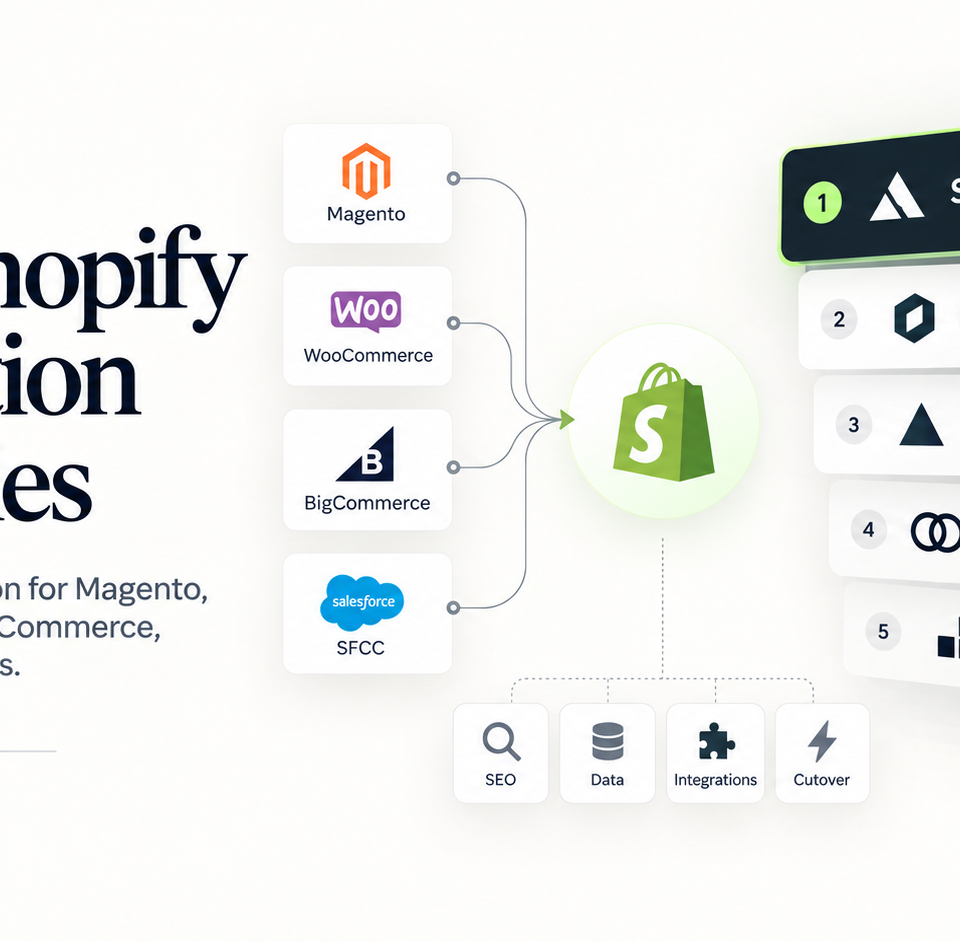
10 Best Shopify Migration Agencies in 2026: A Technical Comparison
An evidence-led comparison of 10 Shopify migration agencies for Magento, Adobe Commerce, WooCommerce, BigCommerce, Salesforce Commerce Cloud, large catalogs, ERP-heavy builds, and SEO-sensitive replatforming.
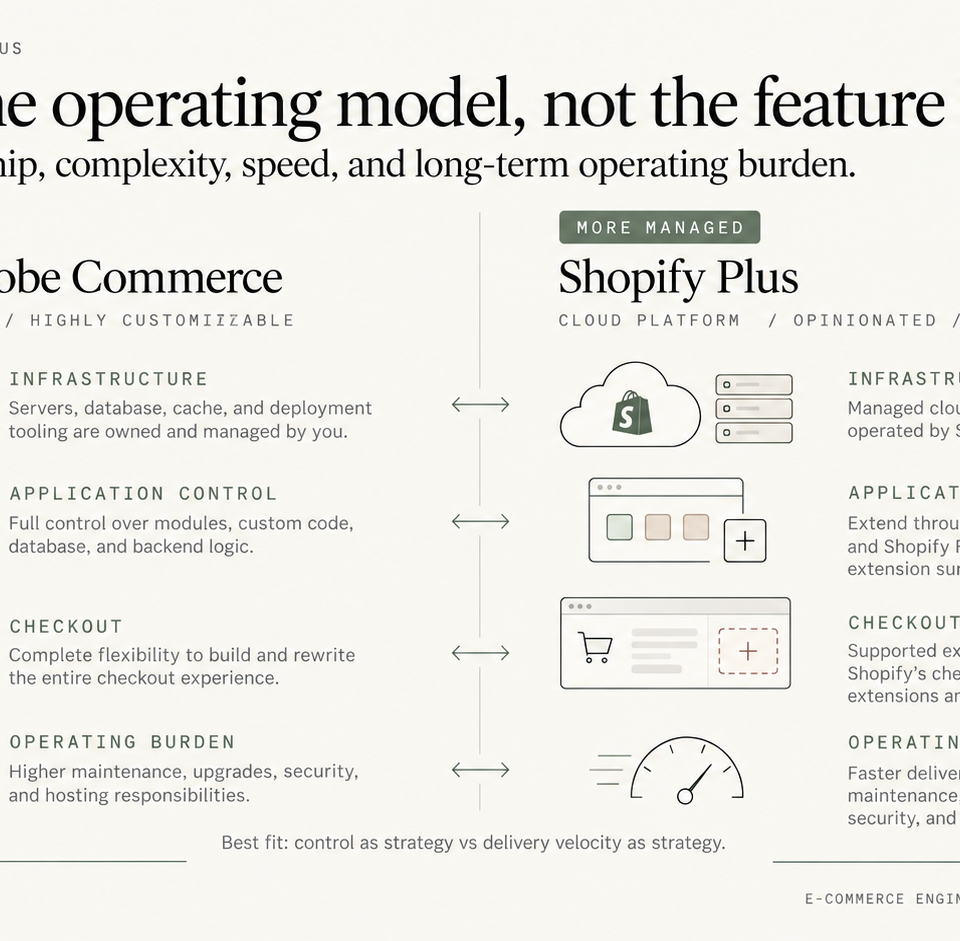
Magento vs Shopify Plus: The Engineering Trade-Offs That Matter
A CTO-level comparison of Magento and Shopify Plus through ownership, catalog complexity, B2B workflows, checkout boundaries, integrations, TCO, and migration risk.
Shopify Theme Architecture in 2026: When Liquid Should Win Over JavaScript
JavaScript is essential for interaction, but many Shopify themes ask it to do work that Liquid and HTML can deliver earlier, more reliably and with less main-thread cost.