
Shopify Theme Architecture in 2026: When Liquid Should Win Over JavaScript
JavaScript is essential for interaction, but many Shopify themes ask it to do work that Liquid and HTML can deliver earlier, more reliably and with less main-thread cost.

Published

A modern Shopify theme needs JavaScript. The architectural mistake is assuming that every dynamic-looking storefront feature should begin there.
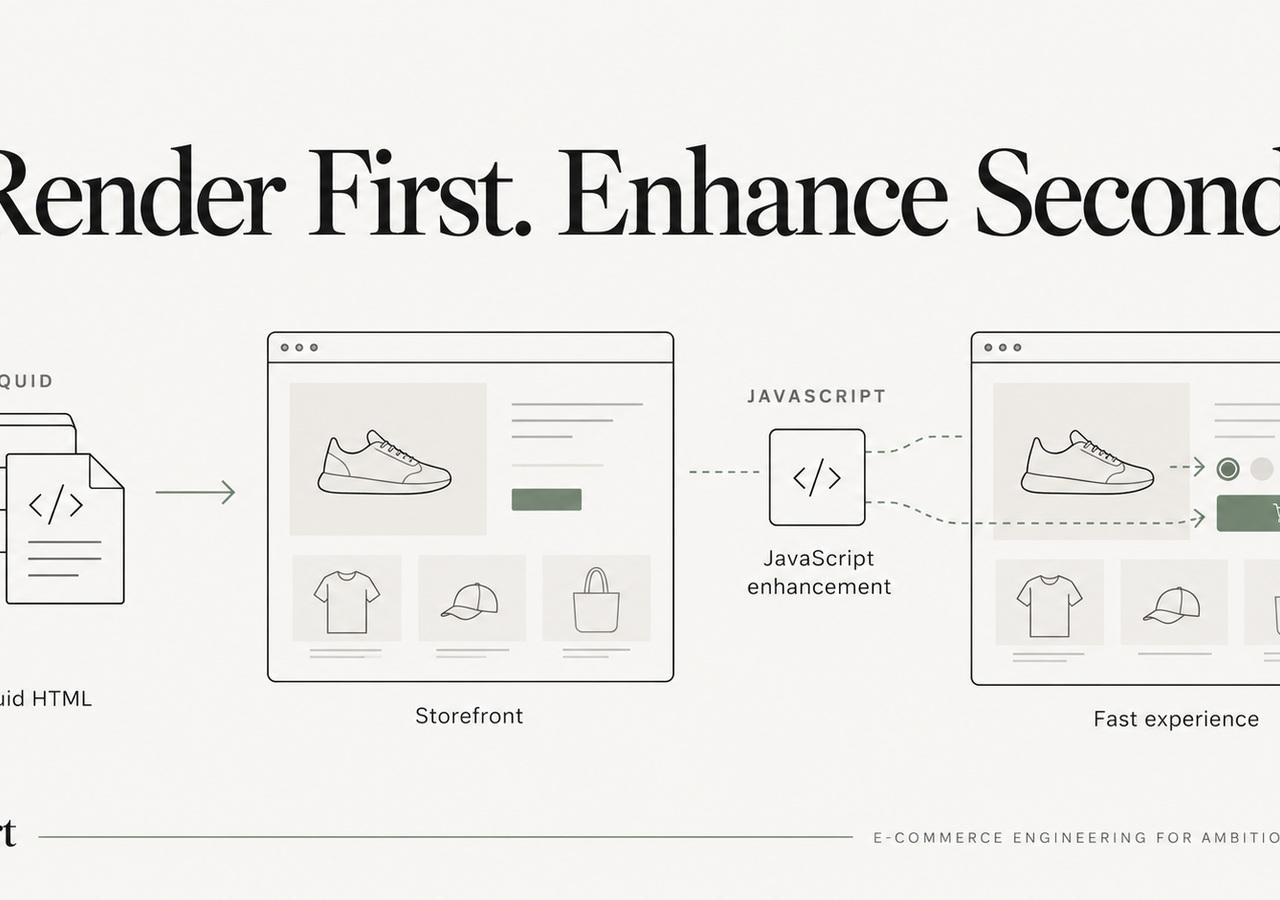
For content that can be known when Shopify renders the page, Liquid and HTML usually have an important advantage: the browser receives meaningful markup immediately. JavaScript can then enhance that state instead of being responsible for creating it from scratch.
This is not an anti-JavaScript argument. It is a sequencing argument.
The server already knows a lot
Shopify's theme system renders Liquid on the server. Product data, collection data, section settings, menus, metafields, localization values and much of the page structure can be present in the initial HTML.
Shopify's theme architecture documentation shows how JSON templates, sections, blocks, snippets and Liquid compose storefront pages. The platform is designed around server-rendered theme structure with client-side behavior layered on top.
When the server already knows the answer, rebuilding that answer in JavaScript often introduces extra work:
- another dependency before content appears;
- more script to download and evaluate;
- hydration or initialization logic;
- more failure states if JavaScript errors;
- potential layout changes after first paint.
Essential content should arrive as HTML
Shopify's current theme performance best practices recommend rendering essential storefront content with HTML and Liquid rather than depending on JavaScript for the initial render.
That applies especially to things such as:
- product title and primary media;
- price and availability already known at render time;
- navigation;
- section headings and copy;
- primary calls to action;
- collection content;
- structured links customers and crawlers need.
JavaScript can update these elements when state changes. It should not necessarily be the first mechanism that makes them exist.
Progressive enhancement gives us a useful boundary
We like a simple test:
What useful storefront remains if this JavaScript module does not execute?
The answer does not need to be “everything.” A sophisticated configurator or interactive bundle builder may fundamentally require JavaScript. But basic navigation, product understanding and a substantial amount of commerce content should usually remain legible and structurally sound.
That baseline improves resilience and often improves performance at the same time.
Where JavaScript clearly wins
Some interactions belong on the client.
Examples include:
- updating a selected variant without a full page navigation;
- drawers and modal interfaces;
- interactive filters;
- predictive search;
- rich product configurators;
- client-side validation and interaction feedback;
- behavior that depends on user events after initial render;
- integrating APIs whose state is not available in the initial Liquid render.
The question is not “Liquid or JavaScript?” It is “which layer should own the initial state, and which layer should own interaction?”
Avoid duplicating the same business state in two places
A common source of theme bugs is keeping one version of product or UI state in the HTML and another independently managed version in JavaScript.
Variant selection is a good example. If markup, data attributes and JavaScript each encode slightly different assumptions about option availability, the storefront can drift into inconsistent states.
We prefer a clear contract:
- Liquid renders the initial state from Shopify data;
- the page exposes only the structured data JavaScript needs;
- JavaScript updates the DOM from one state model;
- server and client code do not each invent separate pricing or availability logic.
That makes debugging much easier.
Do not turn section settings into a client-side application unnecessarily
Shopify's section architecture already gives merchants configurable content through schema settings and blocks.
For many marketing components, Liquid can render the configured structure directly and a small JavaScript module can handle only the interaction. Rebuilding the entire section from a JSON blob on the client adds complexity without giving the merchant a better editing experience.
This is particularly relevant for carousels, tabs, accordions and media galleries. The content can often exist in semantic HTML before the interactive behavior initializes.
JavaScript cost is not just file size
A tiny library can execute frequently. A larger module can be mostly idle.
For customer experience, we care about what runs on the main thread and when. web.dev's guidance on long tasks and script evaluation explains how script execution can block interaction even after the page visually appears loaded.
This is why reducing “unused JavaScript” is not merely a compression exercise. Architectural choices that eliminate unnecessary client-side rendering can remove whole classes of execution work.
Liquid can be slow too
Server rendering is not free.
Shopify warns against overly complex Liquid operations such as deeply nested loops. Expensive Liquid can increase server-rendering time, so “move it to Liquid” is not a universal performance fix.
We still profile the shape of the template and simplify data access where possible. The goal is to put work in the layer best suited to it, not to move all work to one side.
A practical decision framework
Before building a Shopify theme feature, we ask:
Is the initial value known at server render?
If yes, prefer rendering it in Liquid/HTML unless there is a strong reason not to.
Does the feature need to react to user input without navigation?
If yes, JavaScript likely owns the interaction layer.
Can the useful initial state exist before JavaScript initializes?
If yes, render that state first and enhance it.
Is the same rule implemented separately in Liquid and JavaScript?
If yes, look for a single source of truth or a clearer data contract.
Is a library solving a problem the platform or browser already solves?
If yes, remove the dependency before optimizing it.
The architecture we prefer
For most theme surfaces, the cleanest mental model is:
Liquid determines the initial document. CSS determines presentation. JavaScript handles interaction and state changes that actually require the client.
That boundary produces themes that are easier to crawl, easier to debug, more resilient to script failures and usually cheaper for the browser to execute.
For a broader overview of Shopify theme, app and storefront engineering, see our Shopify development guide. For a performance-specific example, read Shopify LCP Problems We Keep Finding in Production Themes.
Keep exploring this topic
Deeper references from the Shugert library and the service that turns this work into a fixed scope.
Related resources
- DevelopmentShopify Development Guide: Themes, Apps, HeadlessA practical map of where to build what on Shopify and Shopify Plus, when to use a theme section, when to write a Shopify Function, when to ship an app, and…
- PerformanceMoving Core Web Vitals on Shopify: LCP, INP & CLS in 2026What actually moves LCP, INP and CLS on a real Shopify store. For the broader speed framework, see our Shopify Performance Optimization Guide.
- ShopifyShopify Performance Checklist for $500k+ DTC Brands (Field-Tested)A field-tested audit checklist for established Shopify stores. For the full framework, start with our Shopify Performance Optimization Guide, this checklist is the tactical companion.
Related services
Keep reading
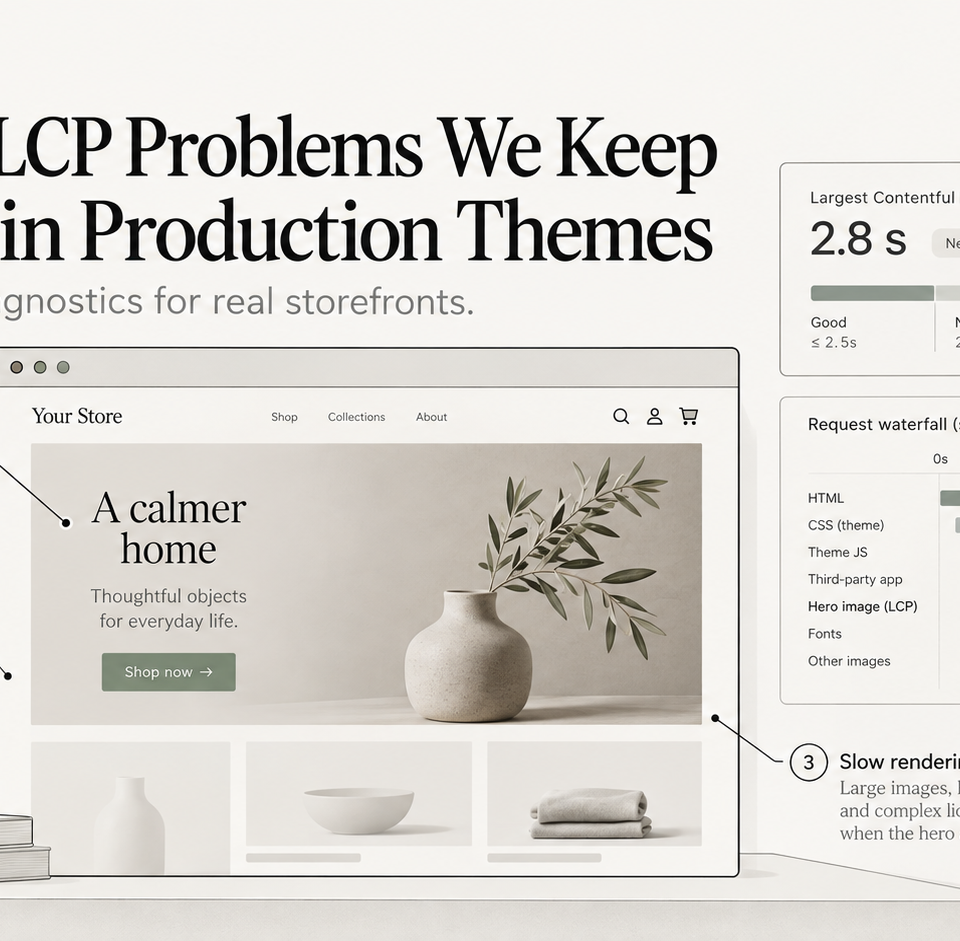
Shopify LCP Problems We Keep Finding in Production Themes
Why Shopify hero images, animations, JavaScript rendering and third-party code repeatedly turn into LCP problems—and what we check first.

Why We Duplicate the Live Shopify Theme Before Every Engineering Change
A duplicate theme is a simple safety boundary: it separates implementation and QA from the storefront customers are using right now.
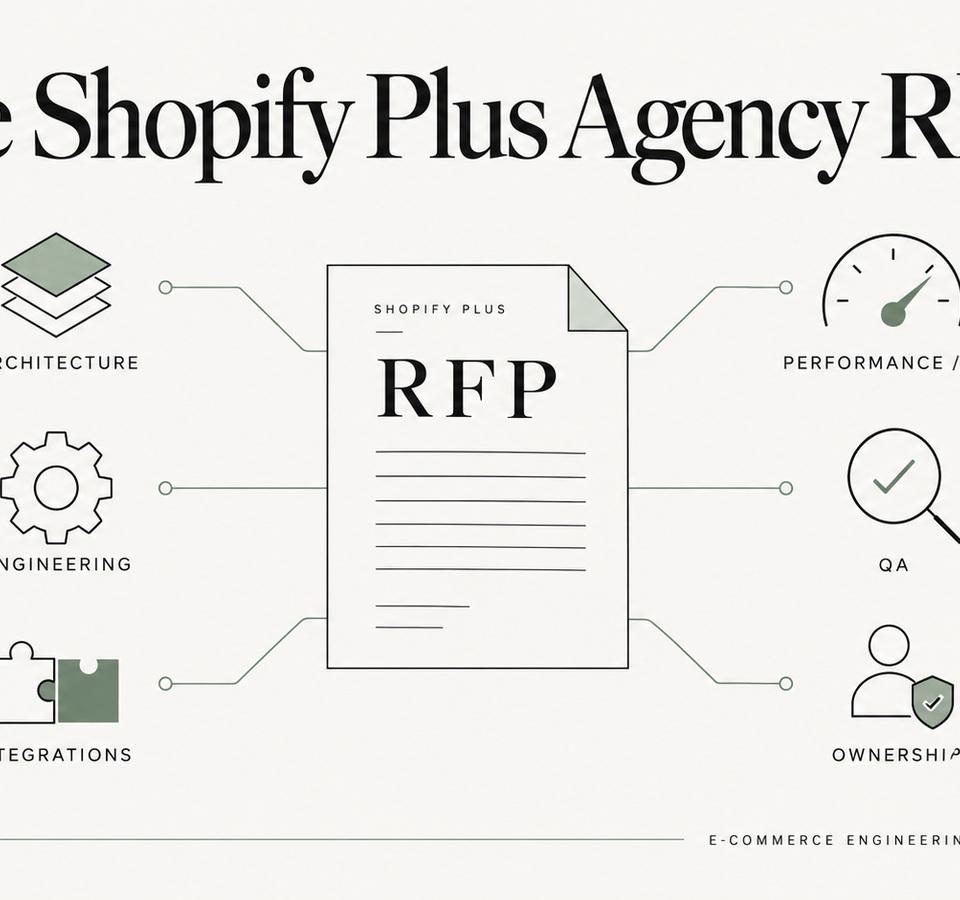
Shopify Plus Agency RFP Checklist for Complex Commerce Projects
What established DTC and B2B teams should put in a Shopify Plus RFP so agency proposals are comparable on architecture, delivery risk and ownership.