
Shopify A/B Testing: A Practical Playbook for Real Results
A practical Shopify A/B testing process: diagnose defects first, write hypotheses, plan sample sizes, measure experiments and turn results into CRO improvements.

Published

A/B testing is often presented as the default answer to a Shopify conversion problem. That advice is backwards. If checkout is broken, analytics is overstating button clicks, mobile pages are painfully slow, or shoppers can't find the right product, the responsible move is to fix the defect, not split traffic and study which broken experience loses less badly. Shopify A/B testing is valuable when a brand faces genuine uncertainty between two credible alternatives. It isn't a substitute for analytics validation, technical QA, UX research, or basic storefront maintenance.
For established DTC and B2B brands, that distinction protects both revenue and engineering capacity. A controlled experiment can clarify whether a product-page hierarchy, offer presentation, navigation pattern, or merchandising approach changes purchase behavior. It can't reliably explain a result when exposure is inconsistent, events are wrong, variants flicker into view, or a migration has changed several parts of the funnel at once. The strongest Shopify experimentation programs treat testing as one layer of a broader CRO, analytics, performance, and Shopify engineering process.
Why Most Shopify Stores Should Fix Before They Test
Many early CRO programs start with a button-color test because it feels measurable and safe. Meanwhile, the store may have missing add-to-cart events, an inconsistent cart drawer, a mobile product gallery that obscures the purchase control, or a checkout failure affecting a market that wasn't included in reporting. A test won't turn those defects into useful learning.
A diagnostic pass should come first. Reconstruct the funnel from product view through purchase, compare Shopify reporting with the analytics implementation, inspect the experience on real mobile devices, and review the technical conditions that affect every variant. Shopify's native performance guidance centers on real-user experience, which makes performance a commercial concern as well as an engineering concern. The documented Shopify issue and fixes resource is useful context for the kinds of storefront problems that deserve remediation before formal experimentation.
The pre-test defect check
The following issues generally have a preferred correction rather than two equally credible treatments:
- Checkout and cart behavior: Fix failed add-to-cart actions, incorrect quantities, broken discount application, and payment or shipping errors.
- Measurement integrity: Correct missing, duplicated, or incorrectly scoped events before using them as decision metrics.
- Accessibility: Resolve keyboard, focus, contrast, labeling, and interaction defects rather than testing whether shoppers tolerate them.
- Mobile usability: Repair clipped content, overlapping sticky controls, unusable selectors, and tap targets that fail on smaller screens.
- Performance: Investigate slow rendering, excessive JavaScript, image delivery, and layout instability before comparing page variants. Google's current Core Web Vitals guidance identifies LCP at or below 2.5 seconds, INP below 200 milliseconds, and CLS below 0.1 as targets for a good user experience. Those are acceptance criteria, not guaranteed conversion thresholds. Google's Core Web Vitals documentation explains what each metric measures.
A misconfigured CTA event can create a particularly dangerous illusion. If the event fires on page load, on an invisible element, or for every visitor rather than after a genuine interaction, the CTA may appear exceptionally successful while completed purchases remain unchanged. Tracking validation must happen before experiment analysis.
Practical rule: If the correct fix is obvious and nobody would defend the defective experience, ship the fix directly.
A Shopify CRO engagement should begin here for many established brands, with analytics, UX, experimentation, and engineering assessed together. Once the storefront is functional and instrumented, Shopify split testing can answer narrower commercial questions without confusing technical noise for customer preference.
When to A/B Test and When to Just Fix It
The cleanest decision framework uses three buckets. The first is fix directly, for defects with one credible answer. The second is queue for implementation, for worthwhile improvements that don't need experimental proof before release. The third is A/B test, for decisions where two viable approaches could plausibly win and the expected difference matters commercially.
| Category | Example Shopify Issue | Action | Reasoning |
|---|---|---|---|
| Fix directly | Broken cart behavior or checkout progression | Repair and validate | Customers shouldn't be randomized into a known failure |
| Fix directly | Incorrect analytics event or inaccessible control | Correct the implementation | Bad measurement or access barriers invalidate the comparison |
| Queue for implementation | A clearer product specification already approved by merchandising and UX | Ship through the normal release process | Testing adds delay without resolving meaningful uncertainty |
| A/B test | Two credible product-page information hierarchies | Randomize exposure and measure purchase behavior | Both treatments are viable and the commercial outcome is uncertain |
| A/B test | Two valid ways to present an offer or shipping threshold | Define a primary metric and guardrails | The message may alter both conversion and order economics |
| A/B test | Navigation or filtering alternatives | Test against a stable control | Behavioral evidence can resolve competing discovery models |
A simple classification test
Suppose a product page hides the purchase control below an oversized promotional block on mobile. That is a repair, not a hypothesis. If the page presents two defensible information hierarchies, such as imagery-first versus specifications-first, the decision becomes a test candidate.
A free-shipping message illustrates the same distinction. If the threshold is missing, contradictory, or displayed after the shopper commits to checkout, the issue should be corrected. If the threshold is clear and the team is choosing between persistent cart messaging and product-page messaging, Shopify conversion testing can establish which presentation supports completed orders without damaging margin.
A homepage hero usually belongs in the test bucket only when both versions serve the same commercial purpose and differ through a reasoned behavioral hypothesis. A new hero shouldn't be tested merely because it looks more modern. The question should be specific, such as whether leading with a product benefit improves qualified product discovery compared with leading with a lifestyle image.
Keep testing bandwidth scarce
Testing has an opportunity cost. It consumes design time, development capacity, QA effort, reporting time, and sometimes performance budget. A test is justified when the decision is consequential enough to investigate, the variants are technically stable, and the likely learning can change the roadmap.
The same logic applies to Shopify Plus migrations. A new theme, storefront architecture, or checkout implementation should not enter an experiment while redirects, customer accounts, market rules, subscriptions, or purchase events are still unstable. First establish a trustworthy baseline. Then test the decisions that remain open.
Building Hypotheses From Real Shopify Behavior
A useful hypothesis starts with observed behavior, not a list of page elements available to edit. Analytics can show where a funnel weakens, but it rarely explains why. Qualitative evidence, merchandising context, and technical inspection supply the missing interpretation.
A product page might receive strong traffic from a collection, yet show weak progression from product view to add to cart. That pattern doesn't automatically justify a sticky button test. It may indicate unclear sizing, insufficient product imagery, missing comparison information, variant confusion, or a delivery promise that appears too late.
Assemble the evidence
A disciplined research pass combines several inputs:
- Funnel analysis: Compare collection-to-product progression, product-to-cart progression, cart-to-checkout progression, and checkout completion. First verify that each event represents the intended action.
- Behavioral observation: Review scroll depth, interaction patterns, search refinements, rage clicks, dead clicks, and mobile versus desktop sessions. These signals suggest friction, but they aren't purchase outcomes by themselves.
- Customer language: Group support tickets, reviews, surveys, and return reasons by recurring uncertainty. “Which size should I choose?” leads to a different hypothesis than “I couldn't find the material details.”
- Merchandising evidence: Check product availability, variant depth, collection placement, price architecture, and return behavior. A low add-to-cart rate for one product family may reflect assortment or inventory rather than page layout.
- Technical review: Confirm that app scripts, personalization rules, consent behavior, and theme conditions expose the same eligible audience to each treatment.
Write the bet precisely
A strong hypothesis names the change, audience, expected direction, and primary metric. For example:
For mobile visitors viewing the high-consideration product range, placing sizing guidance beside the variant selector will increase purchase conversion rate because it reduces uncertainty before selection.
That statement can support several treatments, but the experiment should still isolate the meaningful change. If the page also receives a new image gallery, revised copy, and a new recommendation module, the result becomes difficult to attribute.
The primary metric might be purchase conversion rate or revenue per eligible visitor. Add-to-cart rate, selector interaction, and sizing-guide engagement can provide diagnostic context. They shouldn't automatically decide the winner. A higher interaction rate is not a successful conversion element if checkout completion and commercial value remain flat.
This process also helps distinguish an analytics problem from a customer problem. If the funnel shows an abrupt drop that conflicts with order records, the next action is event reconciliation. If the records agree and customer evidence points to uncertainty, the next action may be a controlled experiment. That discipline makes Shopify experimentation more economical because every test begins with a decision rather than a decorative change.
Metrics That Matter and the Statistical Traps to Avoid
Every experiment needs one primary success metric selected before launch. Secondary metrics explain movement, while guardrails identify damage that a headline result could conceal.
| Category | Purpose | Shopify Example |
|---|---|---|
| Primary metric | Decide whether the hypothesis met its main objective | Purchase conversion rate or revenue per eligible visitor |
| Funnel diagnostic | Explain where behavior changed | Add-to-cart rate, checkout-start rate, or checkout completion rate |
| Commercial metric | Check order economics | Revenue per visitor, AOV, discount use, or contribution margin |
| Guardrail metric | Detect unintended harm | Refunds, payment success, support contacts, errors, or checkout failures |
| Technical guardrail | Protect the storefront experience | LCP, INP, CLS, JavaScript errors, and variant exposure consistency |
A micro-conversion can be useful and still be misleading. More product-tab opens don't prove that the page helps customers buy. More search interactions may indicate better discovery, or they may show that navigation is confusing. The test should prioritize the closest reliable business outcome while retaining funnel diagnostics to explain the mechanism.
Statistical confidence is not commercial significance
Shopify describes 95% confidence as a practical threshold commonly used to judge whether an observed difference is unlikely to be random, with roughly a 5% chance that the difference occurred by chance under that interpretation. Shopify also warns that confidence alone isn't enough. Traffic, sample size, runtime, normal behavioral variation, promotions, weekdays, weekends, and seasonality all affect the decision. Shopify's A/B testing guidance provides that statistical context.
Power addresses the ability to detect a real effect, while the minimum detectable effect defines the smallest change worth acting on. These concepts are different from commercial significance. A statistically credible change may still fail to cover implementation cost, reduce margin, increase returns, or create support work.
Before launch, the test brief should record:
- Primary metric: One decision metric, not a dashboard full of competing winners.
- MDE: The smallest commercially meaningful effect.
- Guardrails: Metrics that must not deteriorate.
- Decision rule: What happens with a win, loss, or inconclusive result.
- Analysis scope: The eligible audience and randomization unit.
Peeking creates another trap. If a team checks the dashboard repeatedly and stops when a variant crosses its confidence threshold, the nominal error rate no longer describes the actual decision process. New-page novelty, traffic-source changes, returning-customer behavior, and segment-level analysis add more noise. Subgroups should be reviewed after the primary analysis, not mined continuously for a favorable story.
A useful business review asks four questions: Did the primary metric move in the expected direction? Is the effect large enough to matter? Does revenue per visitor or margin support the result? Can the team implement and maintain the change without adding unacceptable technical debt?
Sample Size, Duration, and the Low-Traffic Reality
There is no universal visitor threshold for Shopify A/B testing. Required sample size depends on baseline conversion rate, expected effect size, confidence level, statistical power, traffic allocation, number of variants, and test design. Eligible visitors matter more than total sessions, especially when consent rules, market eligibility, bots, internal traffic, or returning-customer logic exclude part of the audience.
A practical benchmark shows why small stores should avoid chasing tiny improvements. For a two-variant test with a 3% baseline conversion rate, 95% confidence, 80% power, and a two-sided design, detecting a 15% relative improvement, from 3.00% to 3.45%, requires approximately 8,500 visitors per variation according to an ecommerce testing estimate. That is an example, not a store-independent rule.
A lower baseline and smaller target effect can make the requirement much larger. One published example estimates that a store converting at 2% would need roughly 80,700 visitors per version to detect a 10% lift under a standard calculation. The figure appears in this Shopify testing discussion, and it reinforces the need to calculate from the store's own data rather than copy a traffic benchmark.
Duration follows the business cycle
The runtime should cover normal variation, not just the number of days required to fill a spreadsheet. Shopify guidance suggests running a test for two weeks, while also stating that the appropriate duration depends on traffic, conversion rate, and the size of the improvement being measured. Shopify's complete A/B testing guide also emphasizes weekday, weekend, promotional, and seasonal variation.
Promotional calendars complicate interpretation. A product launch, paid-media push, holiday event, or email campaign can change traffic composition and intent. If those conditions are part of the commercial decision, they should be represented intentionally. Otherwise, the test should avoid treating an unusual spike as the normal baseline.
What low-traffic stores should do
An underpowered test doesn't prove that variants are equivalent. It may only show that the design couldn't detect the chosen effect with available traffic. Rather than running a button test for an impractical duration, a smaller brand can prioritize qualitative research, usability sessions, funnel debugging, larger design changes, or a controlled holdout when the business question supports one.
Shopify stores with fragmented B2B, international, device, or customer-type traffic face the same problem even when total sessions look healthy. A test can become underpowered after splitting exposure across markets and eligibility rules. In those cases, a larger bundled hypothesis may be more practical, provided the treatment remains interpretable and the guardrails are explicit.
Implementing Tests on Shopify Without Breaking the Store
Shopify merchants generally face three implementation paths, and each carries different risks.
Theme-level rendering uses a duplicate theme, conditional logic, and stable variant assignments. It offers transparent code review and can keep the experience close to the storefront architecture. The tradeoff is release complexity. The theme must preserve product, market, localization, account, subscription, and app behavior across both treatments.
Client-side testing loads a script that changes the page after the initial response. It can support rapid experiments, but flicker and layout shifts are real concerns. Extra app-script overhead can delay meaningful content, alter Core Web Vitals, and create a treatment that differs by device or connection quality. The variant should render predictably, not appear after the shopper has already seen the control.
Server-side or edge delivery assigns and renders a treatment earlier in the request path. Headless storefronts and Hydrogen implementations can provide more control, while Shopify Functions are appropriate for supported commerce logic rather than being treated as a universal storefront variant engine. The engineering burden is higher, and caching, localization, consent, identity, and analytics must remain consistent.
A release checklist for controlled exposure
Before exposing customers to a treatment, the implementation team should verify:
- Assignment persistence: A visitor remains in the same group across relevant sessions and devices according to the defined randomization unit.
- Exposure logging: The platform records who saw the variant, not merely who loaded a test script.
- Event parity: Product views, variant selections, add-to-cart events, checkout events, purchases, refunds, and revenue are tagged consistently.
- Performance impact: LCP, INP, CLS, JavaScript errors, and page weight are compared as guardrails, especially for mobile traffic.
- Edge cases: Key SKUs, out-of-stock variants, subscriptions, discounts, markets, customer accounts, consent states, and returning visitors receive QA.
- Rollback: The team can remove the treatment without leaving stale scripts, incorrect assignments, broken analytics, or orphaned theme code.
Shopify Plus provides checkout-specific extensibility through the Checkout Branding API, checkout editing with Shopify Extensions, and distinct checkout flows for B2B and DTC customers. It doesn't mean legacy checkout code can be transferred unchanged. Shopify's Plus plan documentation describes the supported capabilities. Payment sequencing, Shop Pay behavior, provider requirements, and checkout events need explicit validation before a checkout experiment is approved.
A duplicate theme remains a sensible safety practice for theme changes, provided the team understands that a duplicate is not a complete production test environment. The Shopify theme duplication guidance supports that operational discipline. Migration teams should also separate experiments from migration validation. If Magento or WooCommerce logic, redirects, catalogs, customer accounts, or SEO templates are changing simultaneously, a test result won't identify which change caused the outcome.
For B2B, catalog assignment deserves particular attention. Basic, Grow, and Advanced plans allow up to 3 active catalogs across all B2B markets, while Shopify Plus supports unlimited B2B market catalogs and assignments to individual companies or company locations. Shopify's B2B plan feature documentation explains why catalog logic can affect eligibility and pricing. A treatment that changes which products or prices a buyer can access isn't a simple page experiment.
Scaling Experimentation Into a Real CRO Program
A real CRO program is not measured by test volume. It is measured by better commercial decisions, fewer repeated mistakes, and useful learning that survives after an experiment ends. Stores with obvious usability, tracking, or performance problems should fix those issues before expanding their testing schedule.
Start with one shared backlog. Each idea should record the observed problem, affected audience, proposed treatment, primary metric, MDE, guardrails, engineering effort, and strength of the supporting evidence. An ICE-style score can help compare potential impact, confidence, and ease, but a scoring system cannot make weak evidence reliable.
Keep the roadmap interpretable
Tests can collide. A navigation change, merchandising change, and promotional banner may all affect product discovery and conversion when they run together. Sequential testing is usually easier to interpret. A layered roadmap can work when audiences, pages, or outcomes are clearly separated and assignment remains stable.
Every experiment brief should answer seven questions:
- What customer or business problem was observed?
- What exact change will the treatment introduce?
- Who is eligible, and how will assignment persist?
- What is the single primary metric?
- Which guardrails can stop or invalidate the test?
- What sample size, runtime, and stopping rule were defined?
- What happens after a win, loss, or inconclusive result?
The result record should preserve exposure logic, the implementation commit, screenshots, event definitions, analysis window, exclusions, and the final decision. Without that record, a future team may retest the same idea, ship a variant without its guardrails, or mistake a migration artifact for durable learning.
Promote learning into the storefront
A winning treatment is only a decision until it is implemented safely. Remove test code, update the canonical theme or checkout implementation, preserve analytics events, recheck SEO rendering, and monitor performance after rollout. A losing test can still disprove a plausible assumption or reveal a segment that needs separate research.
During a Shopify Plus migration, connect experiment records to architecture decisions. Record catalog rules, customer-specific pricing, checkout extensions, subscriptions, localization, redirects, and integrations as platform requirements rather than hiding them inside test logic. Shopify's blended B2B migration checklist notes that existing B2B customer records may need transformation into companies and company locations, including assigned customers, permissions, payment terms, shipping settings, catalogs, and tax exemptions. Validate that entity change independently from CRO.
A sustainable cadence balances large commercial bets with direct defect fixes. Teams should review learnings regularly using the Shopify Conversion Rate Optimization playbook as a shared reference for prioritizing and documenting experiments. Retire stale variants, and expand testing only when the team can implement what the evidence supports. Test velocity matters, but learning shipped into production matters more.
Shugert combines Shopify CRO, analytics validation, UX research, performance work, and Shopify engineering for established DTC and B2B brands that need controlled experiments without sacrificing storefront reliability. Visit Shugert to discuss a measurement-first CRO program, a complex Shopify Plus migration, or technical issues that should be fixed before testing begins.
Keep exploring this topic
Deeper references from the Shugert library and the service that turns this work into a fixed scope.
Related services
Keep reading
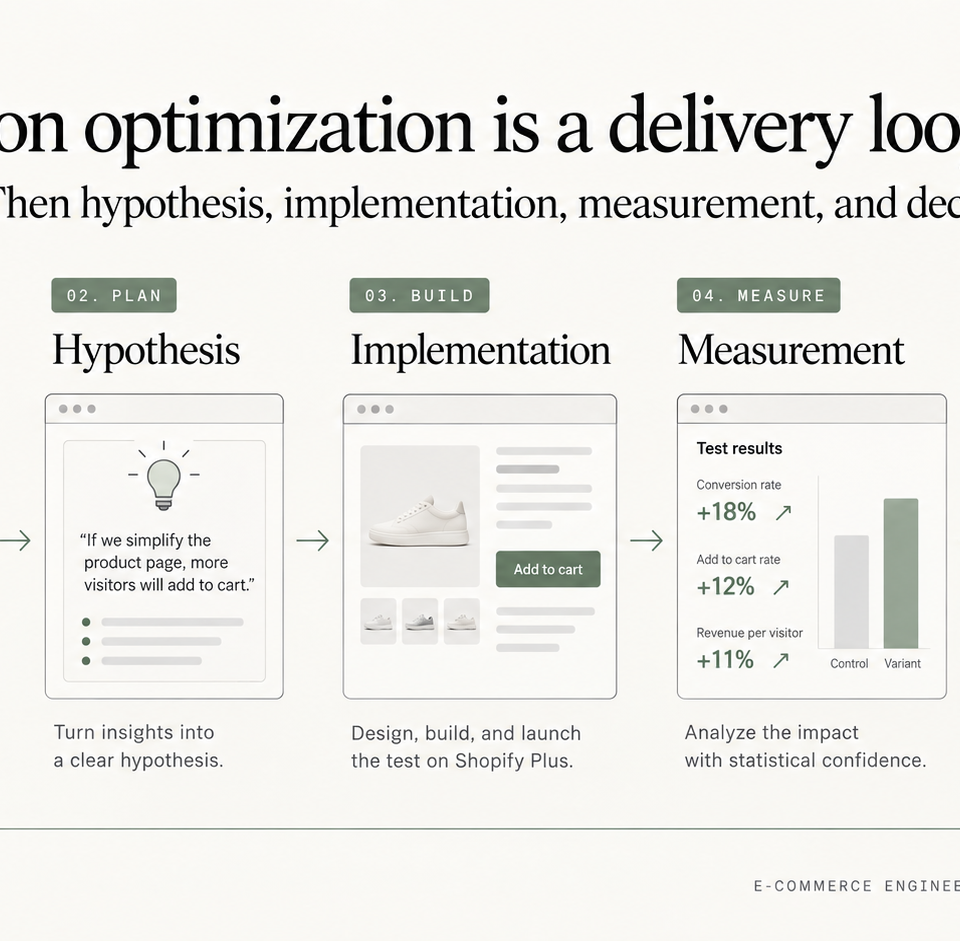
How to Evaluate Conversion Optimization Experts for Shopify Plus
How established Shopify Plus brands should evaluate CRO partners across evidence, experimentation, engineering, analytics, performance, SEO, and release safety.

Shopify Product Page SEO Architecture Guide
A technical Shopify product-page SEO guide to canonicals, variant URLs, Product schema, internal linking and Core Web Vitals at catalog scale.
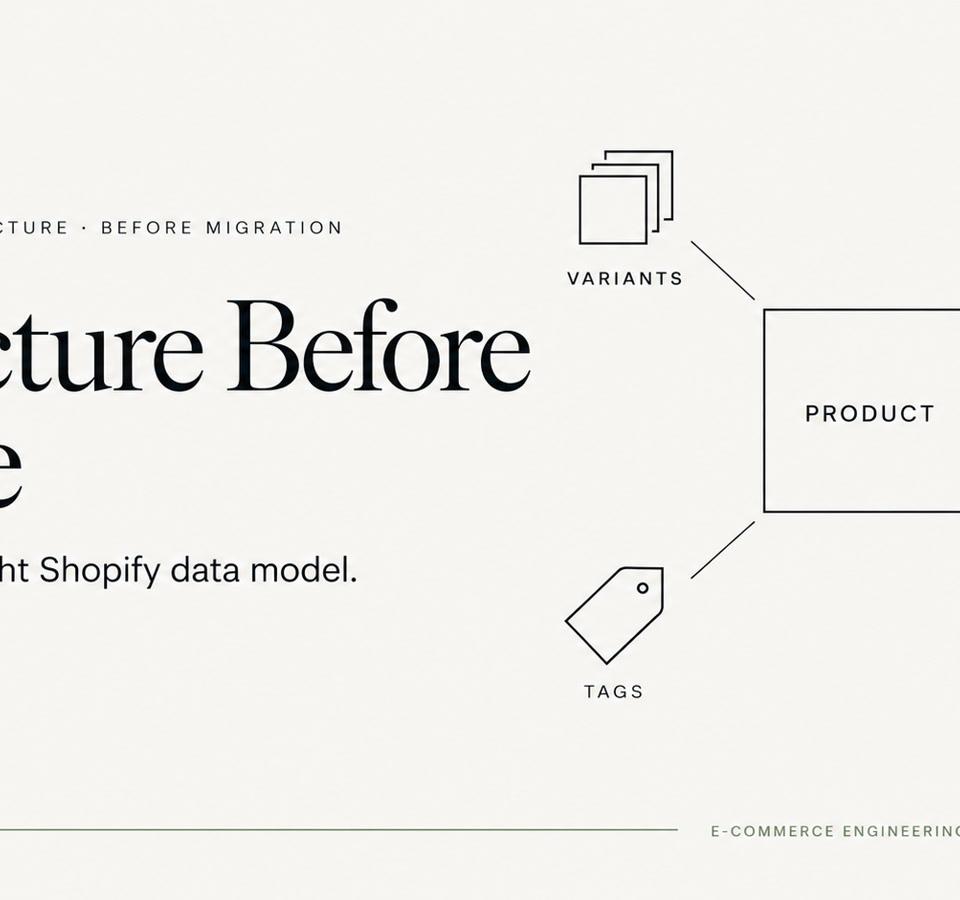
Variants, Metafields, Tags, or Metaobjects? Modeling Large Catalogs Before Migration
Large Shopify migrations become easier when product attributes have clear ownership before import. Here is how we decide what belongs in variants, metafields, tags and metaobjects.