
How to Evaluate Conversion Optimization Experts for Shopify Plus
How established Shopify Plus brands should evaluate CRO partners across evidence, experimentation, engineering, analytics, performance, SEO, and release safety.

Published
How to Evaluate Conversion Optimization Experts for Shopify Plus
A Shopify Plus store can have strong traffic, a recognizable brand, and a capable internal team yet still lose revenue between product discovery and payment. The problem is often not a shortage of optimization ideas. It is that analytics, UX changes, checkout extensions, app scripts, performance work, and SEO are being managed as separate projects.
That environment calls for conversion optimization experts who understand customer behavior and the Shopify implementation underneath it. A useful partner can identify friction, form a testable hypothesis, implement the change safely, and measure whether the result survives across devices, channels, and operational constraints.
For established brands, CRO should be evaluated as a delivery system rather than a sequence of visual tweaks. Shugert's Shopify CRO service follows that evidence-to-implementation model.
What a Shopify Plus CRO Expert Should Actually Do
A general marketing specialist can identify a weak product page. A Shopify-aware CRO specialist also asks whether the page is delayed by app scripts, whether the product data supports the buying decision, whether analytics events are trustworthy, whether the proposed experience fits checkout boundaries, and whether the change affects search visibility or accessibility.
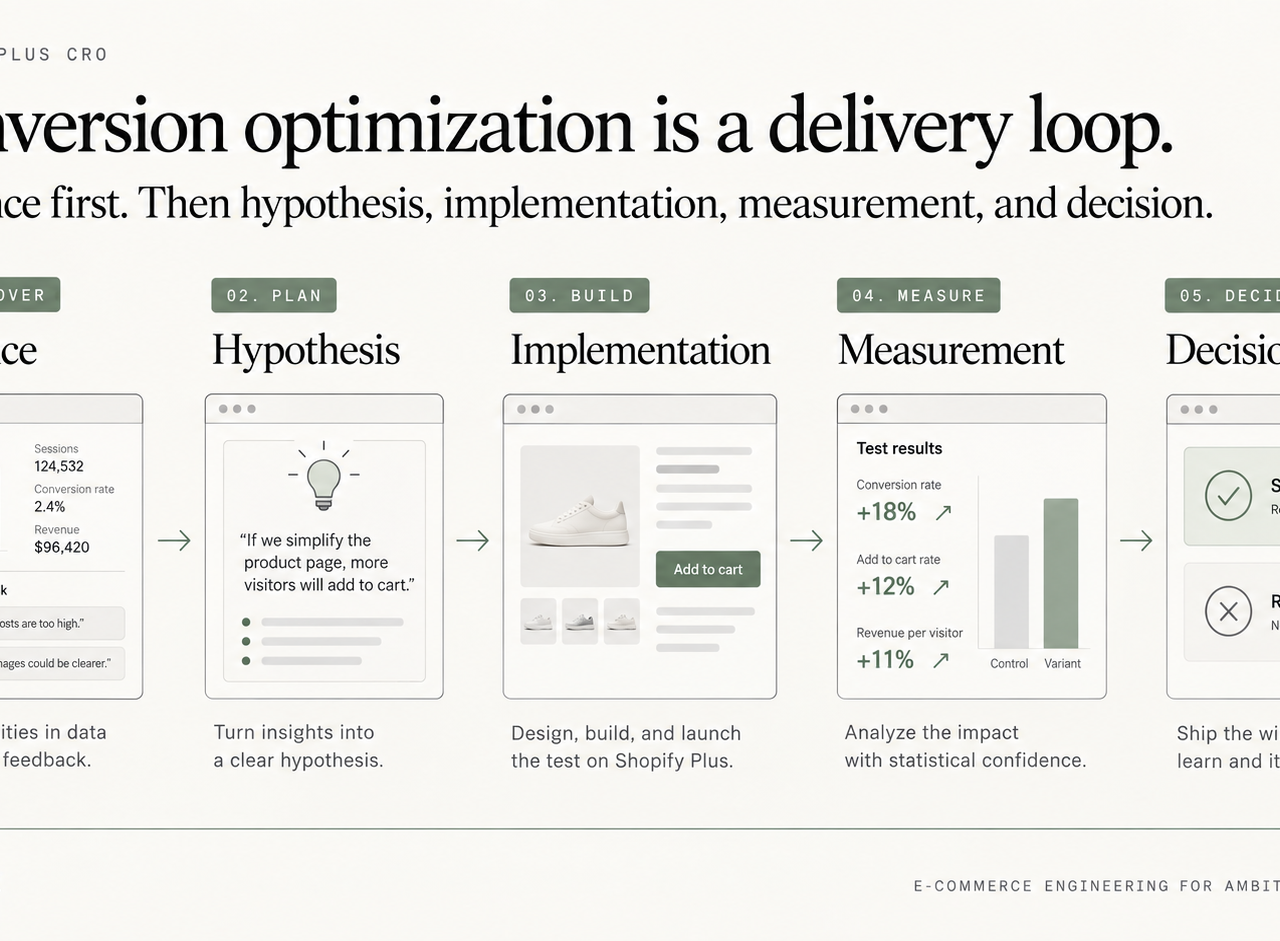
The operating loop should look like this:
evidence → hypothesis → implementation → measurement → decision
A recommendation is incomplete until the commercial hypothesis, technical implementation, measurement plan, QA scope, and rollback path are clear.
Audit the Store for Conversion Gaps
An effective audit starts with evidence, not a list of fashionable interface changes. Review Shopify sales data, GA4 or equivalent journey events, support feedback, customer behavior, search and merchandising patterns, and real-world performance before proposing experiments.
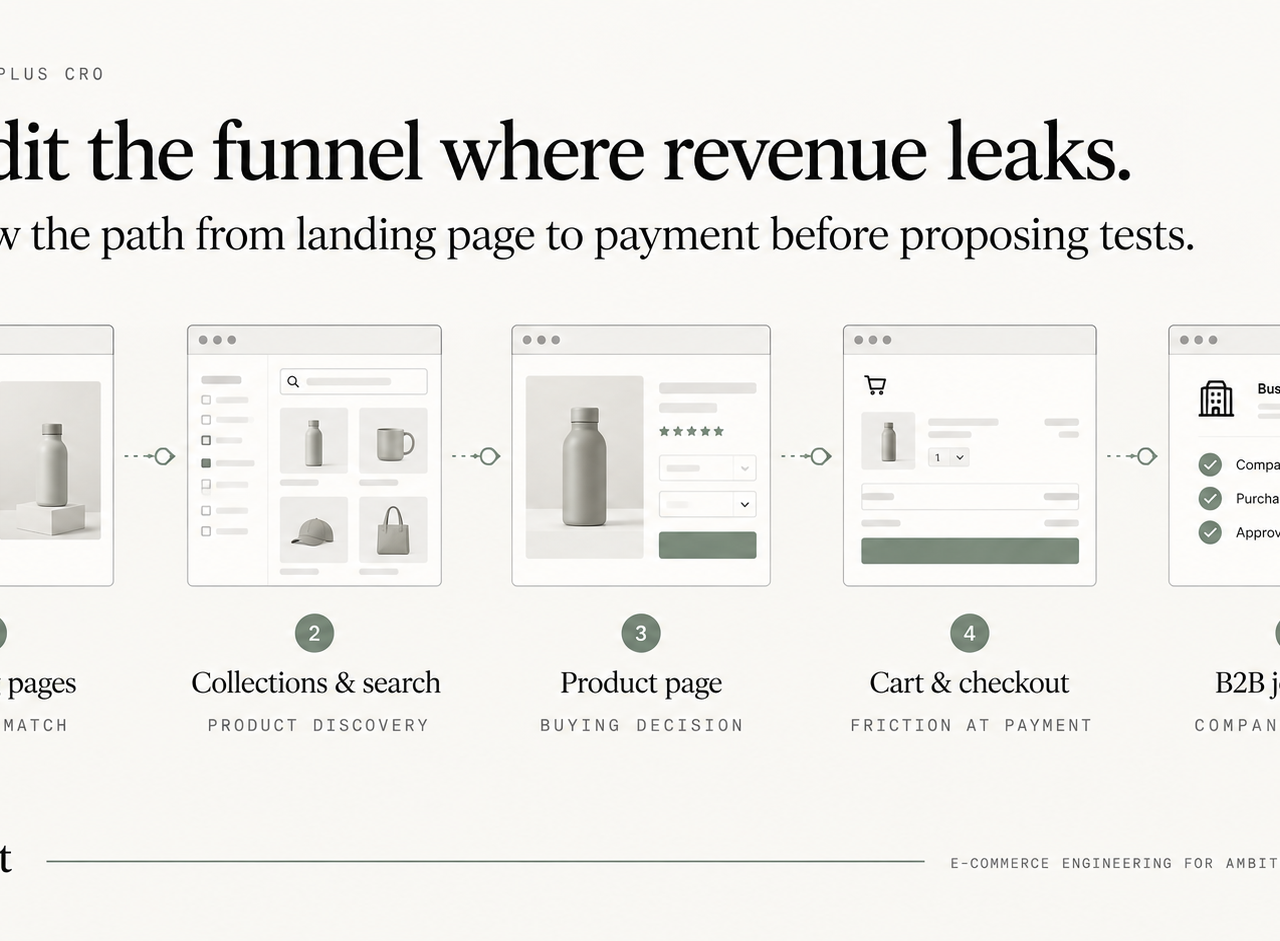
Break the funnel into paths that can be observed and owned:
- Acquisition and landing pages: does the page match the intent that brought the visitor?
- Collections and search: can shoppers narrow, compare, and find available products efficiently?
- Product pages: are media, variants, delivery, returns, reviews, subscriptions, and calls to action clear and responsive?
- Cart and checkout: are unexpected costs, delivery ambiguity, account friction, payment failures, or form complexity blocking high-intent users?
- B2B journeys: do company context, catalogs, negotiated pricing, approvals, and reorder flows behave predictably?
Cross-industry conversion benchmarks are usually too coarse to diagnose a Shopify Plus store. Device mix, traffic intent, geography, customer type, merchandising model, returning-customer share, and conversion definition can materially change the baseline. The store's own segmented data is the better starting point.
Turn observations into testable hypotheses
A useful hypothesis states:
- the observed friction;
- the audience affected;
- the proposed change;
- the expected behavior change;
- the primary business metric;
- guardrail metrics and rollback criteria.
For example, if mobile visitors abandon a product page after opening shipping information, the team might test a clearer delivery promise near the purchase decision. The implementation should monitor completed orders or revenue per session while protecting page speed, checkout completion, and analytics integrity.
Prioritize by commercial value and implementation risk. A checkout defect affecting high-intent traffic generally outranks a copy preference. A change that requires another global app script should receive engineering scrutiny before it enters the experiment backlog.
Payment flexibility can reduce friction for some shoppers when buy now, pay later options and their terms are communicated clearly before checkout. More broadly, teams reviewing how to improve ecommerce conversion rates should connect funnel changes to a defined metric hierarchy rather than treating conversion rate as an isolated number.\n\n## Set a Metric Hierarchy Before Development
Conversion rate is useful, but it does not describe commercial quality on its own. Average order value, revenue per session, gross margin, refunds, lead quality, repeat purchases, and device mix can move in different directions.
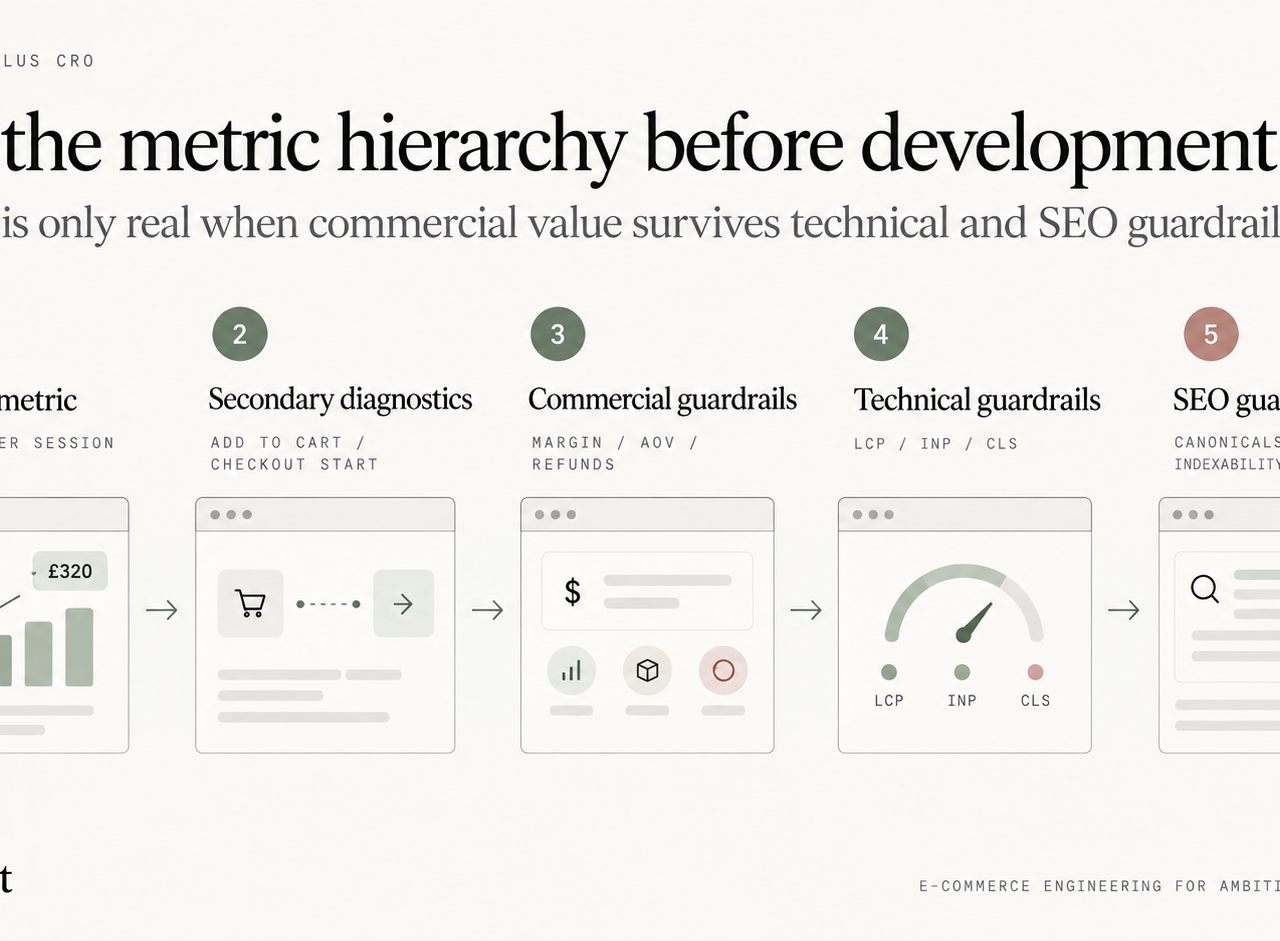
A Shopify Plus CRO program should use one primary decision metric supported by secondary diagnostics and technical guardrails.
| Metric layer | Purpose | Example |
|---|---|---|
| Primary | Decide whether the experiment created business value | Revenue per session, completed orders, qualified B2B activation |
| Secondary | Explain user behavior | Add-to-cart rate, checkout start, product discovery depth |
| Commercial guardrail | Prevent a misleading win | Margin, refunds, AOV, lead quality |
| Technical guardrail | Protect the storefront | LCP, INP, CLS, JS cost, errors |
| SEO guardrail | Protect search ownership | Indexability, canonicals, internal links, landing-page visibility |
Google's Web Vitals guidance evaluates current Core Web Vitals against the 75th percentile of page loads. That matters because a variant that looks fast in a controlled test can still make the real storefront slower for customer devices.
Document baseline dates, audience scope, exclusions, attribution assumptions, and event definitions before launch. Otherwise a tracking change can look like a CRO improvement.
Privacy-first journeys make attribution difficult. Customers may move between search, social, email, marketplaces, mobile devices, and assisted buying conversations before purchasing. Current CRO analysis highlights data quality, first-party and zero-party data, and AI-driven personalization as priorities for assessing incrementality in these journeys, as discussed in current CRO trend analysis.
Evaluate the Required Skill Mix
The strongest partner is not necessarily the agency with the most polished design deck. Shopify Plus optimization crosses disciplines, so technical fluency determines whether a good hypothesis can become a safe release.
Look for four capabilities.
Shopify engineering
The team should understand theme architecture, app behavior, Checkout Extensibility, Shopify Functions, customer accounts, B2B contexts, analytics pixels, and release workflows. Ask who will actually implement the changes and how the work is staged and reviewed.
Experimentation discipline
The team should form hypotheses from evidence, define decision metrics and guardrails, document exposure, handle inconclusive results, and remove losing implementations instead of leaving abandoned code behind.
Analytics fluency
A partner should be able to reconcile Shopify order data with analytics events, consent limitations, browser behavior, server-side signals, and attribution uncertainty. A dashboard is not a measurement strategy if event definitions are inconsistent.
SEO and performance awareness
Experiments can alter headings, content hierarchy, internal links, template rendering, scripts, and page speed. The implementation plan should explicitly protect canonical ownership, indexability, structured data, accessibility, and Core Web Vitals.
For a broader vendor-selection framework, see our guide to choosing a Shopify expert.
Compare Agency Models by Operating Fit
A large agency can provide research, UX, analytics, copy, engineering, and project management under one contract. That may suit a complex enterprise but can introduce more coordination overhead.
A boutique specialist can provide direct access to senior practitioners and faster decisions, but capacity may be narrower when a program requires simultaneous experimentation, migration work, ERP integration, internationalization, and incident support.
Do not choose by team size alone. Ask for evidence of how the team handles technical constraints and losing tests.
| Evaluation area | Strong evidence | Warning sign |
|---|---|---|
| Case studies | Context, method, implementation and measurement limitations | Screenshot-only uplift claims |
| Shopify capability | Specific platform constraints and release controls | Generic “custom development” language |
| Reporting | Decision log, experiment archive and ownership | Dashboard access without interpretation |
| Technical safety | Staging, QA, rollback, performance and SEO review | Direct production changes with no rollback |
| Team structure | Named accountable senior roles | Sales presentation disconnected from delivery |
Ask candidates to explain a technically constrained experiment that did not become a straightforward win. What happened when checkout behavior was unsupported? How did they react to a performance regression? When did they remove code? How was analytics repaired when instrumentation was wrong? Those answers reveal more than a portfolio of redesigned product pages.
Use a Bounded Pilot Instead of Buying a Vague Retainer
A pilot should produce working evidence, not a strategy document that stops before implementation.
Define deliverables such as:
- Measurement review: event definitions, data-quality findings, baseline metrics, and attribution limitations.
- Opportunity backlog: hypotheses tied to customer friction, commercial value, and implementation effort.
- Technical assessment: theme, apps, checkout, integrations, performance, accessibility, and SEO dependencies.
- Experiment specification: audience, behavior, primary metric, guardrails, QA steps, and rollback criteria.
- Readout: what shipped, what was learned, what remains uncertain, and what decision follows.
Set code ownership, access boundaries, approval rights, release windows, data-handling rules, and incident responsibilities at the start. The purpose of the pilot is to prove that the team can operate a repeatable optimization loop inside the store's real constraints.
Integrate CRO with Performance and SEO

A CRO test can raise conversion while slowing product pages, weakening an organic landing page, creating accessibility problems, or leaving a new app dependency behind. That is not a clean win.
App-stack growth deserves particular scrutiny. Ask the team to identify the code supporting each experiment, record performance before release, measure it afterward, and remove unsuccessful implementations. Loading a feature only after interaction can help, but the interaction still needs to remain responsive.
Checkout changes need the same discipline. Legacy Shopify checkout customization surfaces should not be treated as a current target architecture. Confirm whether each behavior belongs in Checkout Extensibility, Shopify Functions, an app, or storefront code before the experiment is approved.
SEO preservation starts with an inventory. Shopify recommends mapping every old URL from the master URL list to its new destination URL in a spreadsheet, as described in Shopify's SEO migration guidance. Apply that discipline to variant URLs, campaign landing pages, canonical behavior, and content changes during platform migrations or major Shopify Plus releases.
SEO preservation starts with page ownership. If an experiment changes an indexable landing page, verify its headings, internal links, canonical behavior, structured data, and rendered content. Major redesigns and migrations need the same control at a larger scale.
For stores where conversion friction and storefront speed overlap, Shopify performance optimization can run alongside CRO without separating revenue changes from Core Web Vitals and script governance.
The Hiring Standard
A qualified Shopify Plus CRO partner should be able to answer five questions clearly:
- What evidence says this problem is worth solving?
- What Shopify implementation will solve it with the least technical debt?
- What metric decides whether the change worked?
- What performance, SEO, accessibility, and analytics guardrails protect the store?
- What happens to the code if the experiment loses?
The standard is practical: improve the buying path while keeping the storefront fast, search-accessible, measurable, and maintainable. If you want that work to include both diagnosis and implementation, start with Shopify CRO or a focused store audit.
Keep exploring this topic
Deeper references from the Shugert library and the service that turns this work into a fixed scope.
Related resources
- ShopifyHow to Choose a Shopify Expert: What Most Guides Don't Tell YouPortfolios and testimonials are not enough. The questions that actually predict whether a Shopify partner will protect your revenue: Core Web Vitals data…
- PerformanceMoving Core Web Vitals on Shopify: LCP, INP & CLS in 2026What actually moves LCP, INP and CLS on a real Shopify store. For the broader speed framework, see our Shopify Performance Optimization Guide.
Related services
Keep reading

Shopify A/B Testing: A Practical Playbook for Real Results
A practical Shopify A/B testing process: diagnose defects first, write hypotheses, plan sample sizes, measure experiments and turn results into CRO improvements.
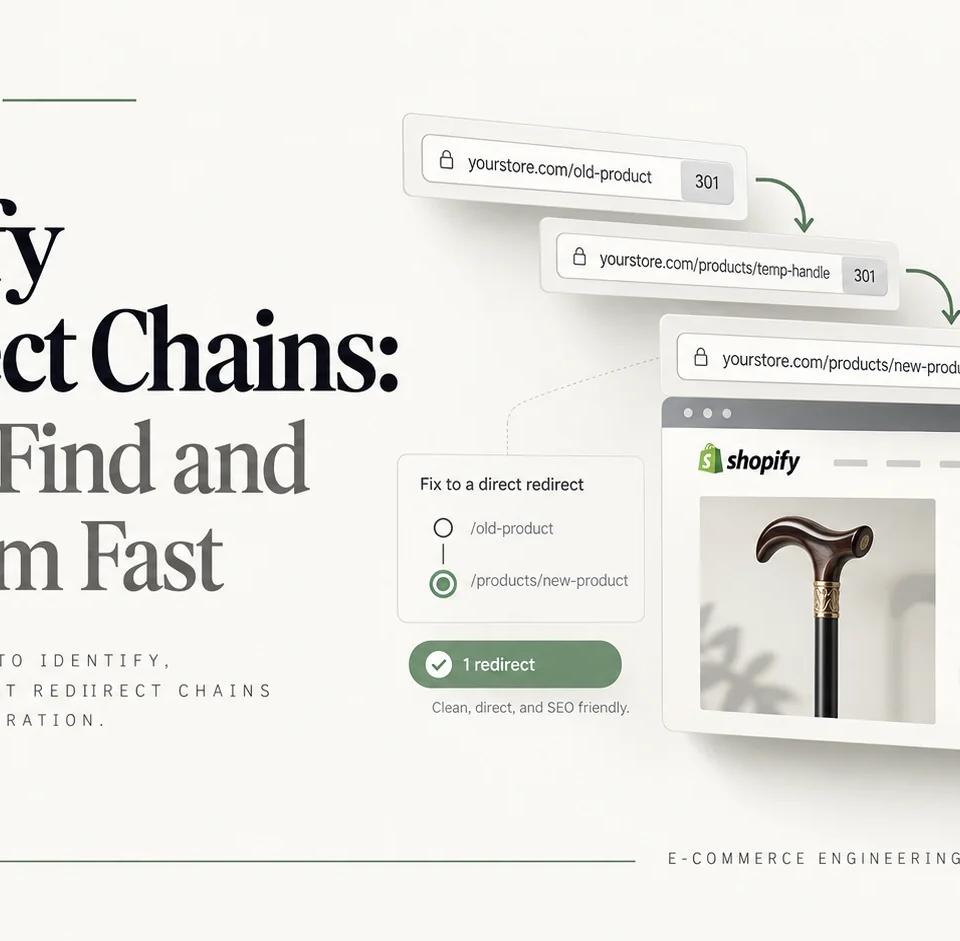
Shopify Redirect Chains: How to Find and Fix Them Fast
Trace Shopify redirect chains from legacy URLs to final canonical pages. An eight-step audit shows how to identify each hop, fix the responsible layer, and verify production behavior after migration.

Shopify Product Page SEO Architecture Guide
A technical Shopify product-page SEO guide to canonicals, variant URLs, Product schema, internal linking and Core Web Vitals at catalog scale.