
Mastering Shopify Subscription Plans in 2026
Native Shopify selling plans or a third-party subscription app? A decision guide to recurring-commerce architecture, plan-tier headroom, app-stack risk, total cost of ownership and migration continuity.

Published
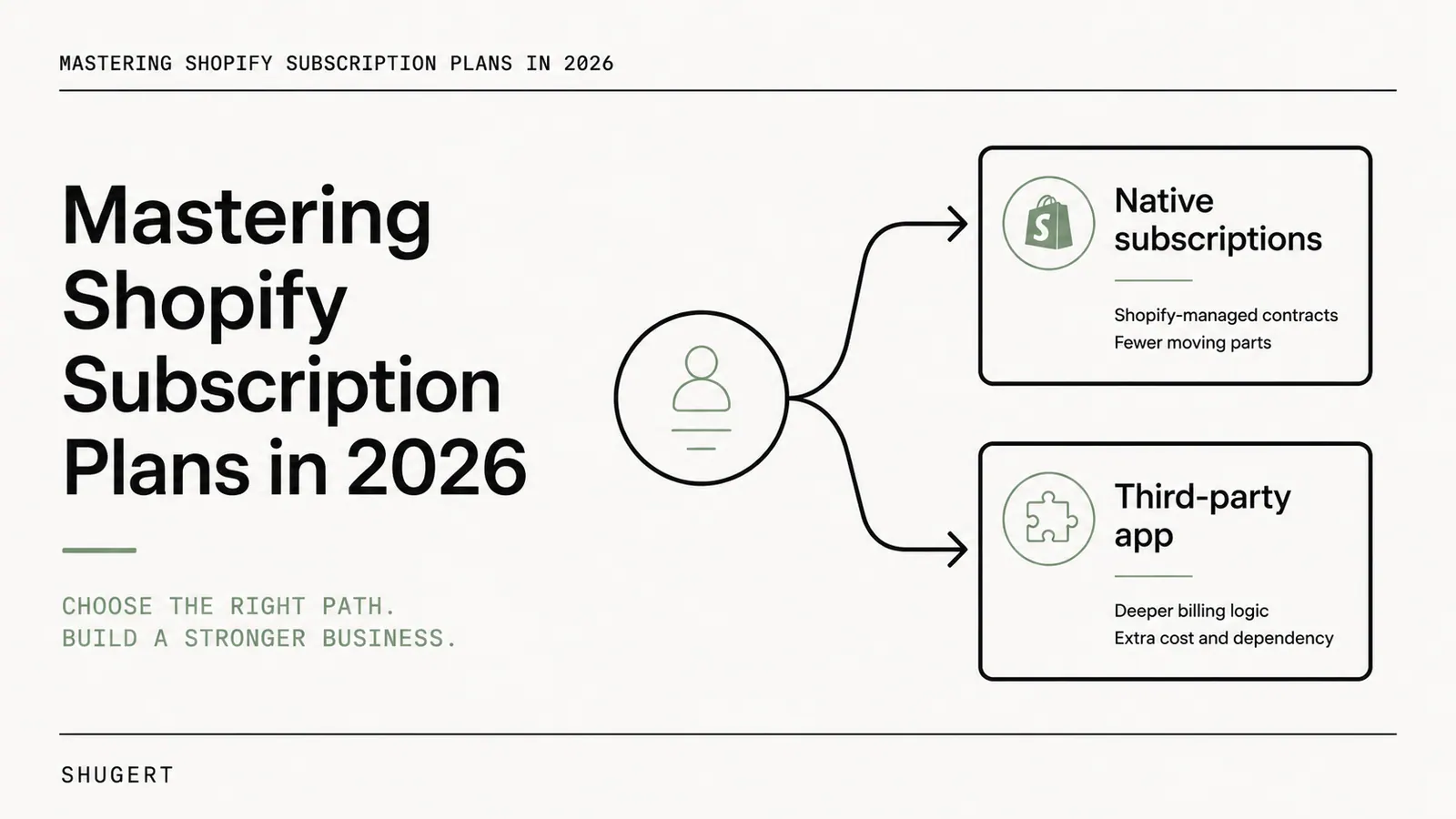
Shopify subscription plans come down to one architectural choice: keep recurring logic inside Shopify with native selling plans, or move it into a third-party subscription app that owns the contract, the billing engine and the customer portal. Native keeps one system of record and the lowest technical debt. Third-party buys billing and merchandising depth, and charges for it in integration surface, vendor dependency and exit cost. The Shopify plan tier sits underneath both, deciding how much reporting, shipping and checkout headroom the program has before it stalls.
A familiar pattern shows up once a Shopify brand passes early traction. One-time purchase revenue is working. Paid media is expensive but manageable. Operations are no longer fragile. Then the next growth question lands on the table: should the business build a real subscription program, and if so, on what stack?
That decision looks simple from the outside. Install an app, add a frequency selector, launch a subscribe-and-save offer. In practice it is an architectural choice that touches checkout behavior, customer accounts, reporting, shipping logic, payment routing and future migration risk. A weak setup creates app bloat, broken analytics and support overhead that compounds every month. A strong setup turns recurring revenue into something finance, operations and retention teams can actually run.
Shopify's own trajectory matters here. Subscription solutions have become a reported revenue line for the platform rather than a side feature, a pattern visible in aggregated platform reporting such as Red Stag Fulfillment's Shopify statistics summary. Sustained platform investment usually leads to better native tooling, better analytics and fewer dead-end workarounds for merchants.
For a brand already doing meaningful volume, the question is not whether subscriptions can work. It is which subscription model creates the least technical debt while protecting margin and conversion. That is where most plan comparisons fail. They compare features. They do not evaluate total cost of ownership, implementation risk, or what happens when the brand needs to migrate later.
Table of Contents
- Introduction
- The Two Subscription Architectures on Shopify
- How Shopify Plans Enable Subscription Scalability
- Evaluating Third-Party Subscription Apps
- Modeling the True Cost of Your Subscription Program
- Navigating Subscription Migration and Implementation
- A Decision Framework for Your Subscription Model
Introduction
A seven-figure brand launches subscriptions to stabilise revenue. Six months later finance is reconciling app fees by hand, support is clearing skipped-order edge cases one ticket at a time, and retention reporting no longer matches Shopify. The offer is working. The operating model is breaking under it.
That is the real decision. Recurring revenue is almost always attractive. The question is whether the subscription architecture fits the business well enough to protect margin, keep reporting credible, and support the next stage of growth without accumulating debt nobody budgeted for.
The trade-off is straightforward. A simpler setup keeps cost and complexity down but constrains the offer model sooner than teams expect. A configurable app stack supports advanced billing logic, bundles, prepaid flows and customer-facing controls, but every added layer increases implementation risk, vendor dependence and the chance that the team ends up maintaining exceptions instead of running a program.
Practical rule: judge a subscription setup like infrastructure, not like a storefront widget. If the data model, checkout flow and payment handling are misaligned, retention marketing will not compensate for it.
The strongest operators start from operating reality: how complex is the offer today, and how likely is that complexity to increase over the next twelve to eighteen months? That framing prevents two expensive mistakes — buying enterprise-grade subscription software before the economics justify it, and staying on a lightweight setup so long that reporting, shipping logic and account limitations start dragging on growth.
The Two Subscription Architectures on Shopify
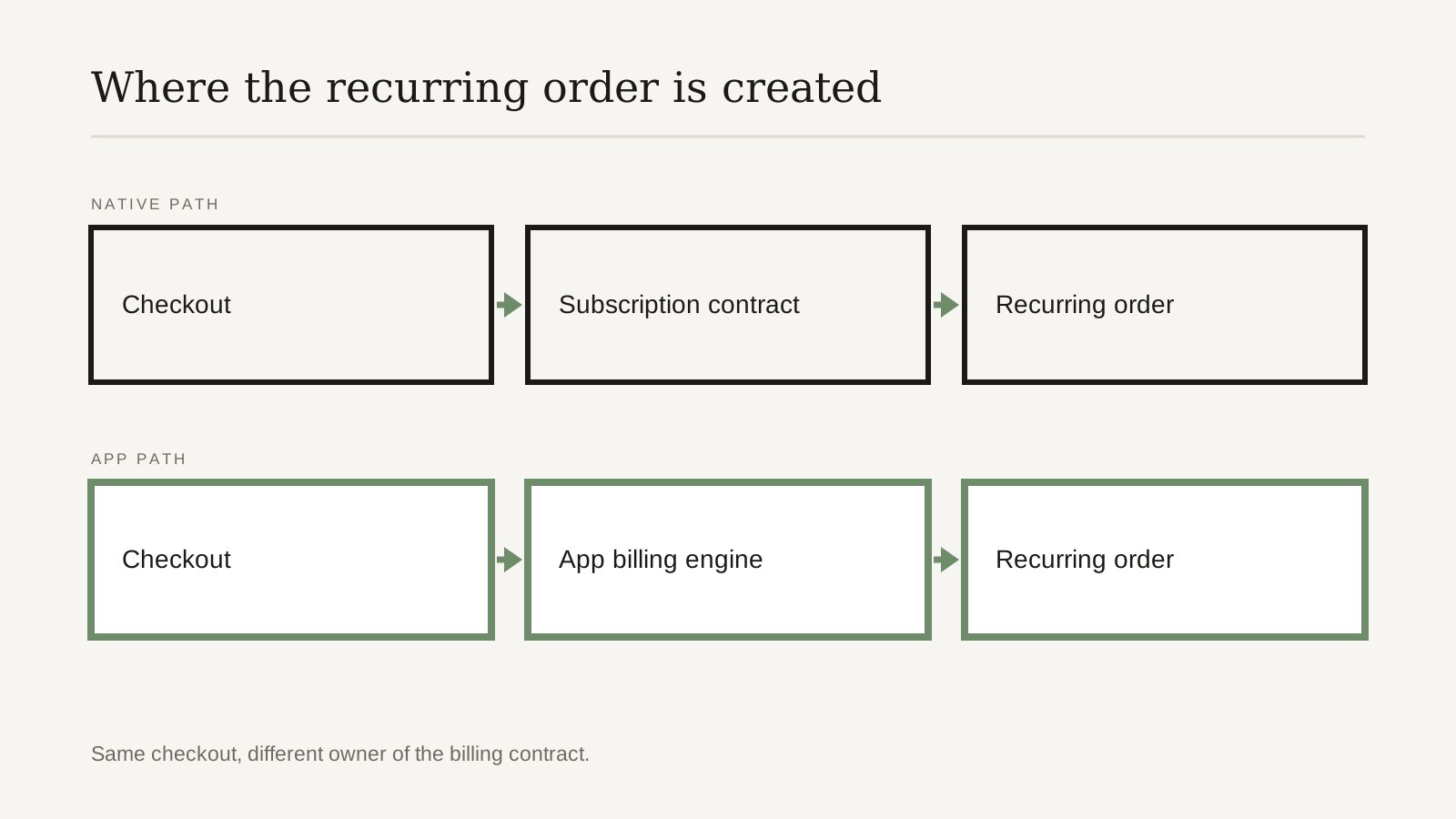
There are only two paths for Shopify subscription plans. The store either uses Shopify's native subscription framework, or it relies on a third-party subscription app that layers additional logic on top of Shopify. Everything else is a variation of those two.
Native Shopify subscriptions
The native path stays closest to Shopify's own data structures and checkout model: selling plans attached to products, contracts generated by Shopify, payment methods vaulted through Shopify checkout, and the free Shopify Subscriptions app as the merchant surface. For brands with straightforward recurring offers, that architecture is cleaner than most teams expect.
The advantage is continuity. Product data, orders, checkout behavior and subscription analytics stay inside one system. Fewer events are translated between platforms, so platform-level reporting is easier to trust and the subscription experience does not drift away from the rest of the storefront.
Native is strongest when the offer is simple: replenishment products, predictable billing intervals, limited bundle logic, clear account flows.
Third-party subscription systems
Third-party apps such as ReCharge, Bold, Skio and similar tools exist because many brands outgrow simple recurring billing. They need more nuanced dunning, advanced bundles, custom cancellation flows, subscription-specific portals, or operational rules the native layer does not handle cleanly.
That flexibility carries a structural trade-off. The more subscription logic lives in an app rather than Shopify's core, the more the business depends on that app's APIs, portal framework, data model and migration policy. A feature-rich subscription app can solve today's merchandising problem while creating tomorrow's technical debt.
Four architecture questions separate the two paths:
- Checkout continuity: does the subscription flow feel native to Shopify checkout, or does it create friction between product page, cart, account and payment?
- Data ownership: where do subscriber records, billing logic and payment relationships actually live?
- Operational dependency: how much of the subscription business stops working during an app limitation, outage or integration conflict?
- Migration difficulty: if the business switches providers later, what happens to payment tokens, subscriber history and customer communication?
The wrong architecture rarely fails on launch day. It fails six months later, when support volume rises, reporting no longer matches finance, and the retention team cannot ship the changes it wants.
Native minimises system complexity. Third-party maximises feature depth. The right choice depends on whether the subscription model is operationally simple or operationally complex.
How Shopify Plans Enable Subscription Scalability
Many merchants talk about subscriptions as if the Shopify plan itself barely matters. That is a costly assumption. The plan tier affects reporting access, fee structure, shipping logic and how much room the business has to customise recurring purchase operations as complexity rises.
What changes across Basic, Grow, and Advanced
Shopify's pricing ladder is more segmented than it used to be, running from a lightweight Starter tier through Basic, Grow and Advanced, then Shopify Plus on a contracted term. Third-party summaries such as Bootstrapping Ecommerce's Shopify pricing guide and The Transform Agency's Shopify pricing guide walk that ladder, but plan fees, card rates and third-party transaction percentages change by region and by contract — verify the current figures on Shopify's own pricing page before modelling anything. We deliberately do not restate rates here that would be stale within a quarter.
What is structurally true is more useful than any specific number. Shopify's model is not usage-based in the typical SaaS sense: it charges fixed plan tiers plus separate transaction costs, rather than metering storage, API calls or seats. For subscription merchants that means platform cost pressure comes from payment economics and process complexity, not from software usage. Two levers therefore matter more than the plan sticker price — the card rate you pay on every renewal, and the additional third-party transaction fee that applies when Shopify Payments is not used.
Advanced is where many scaling subscription brands see a meaningful shift, because custom reports and carrier-calculated shipping are the two capabilities recurring programs outgrow first.
| Plan tier | Subscription fit | Main limitation |
|---|---|---|
| Basic | Good for proving demand | Reporting and logistics tighten fast |
| Grow | Established stores with moderate complexity | Still limited when subscriptions drive shipping logic and analytics |
| Advanced | Recurring programs with operational depth | Higher fixed fee must be justified by volume and process savings |
When Plus becomes operationally justified
Shopify Plus enters the discussion when the subscription program starts touching checkout customisation, B2B workflows, international selling, or more advanced logic through Shopify Functions. For brands planning recurring discounts, validation rules or custom checkout logic, it is worth understanding how Shopify Functions work in practice. If the broader plan question is really a Plus budgeting question, our Shopify Plus pricing breakdown owns that ground.
What matters is not prestige. It is whether the team is trying to solve recurring revenue problems on a plan tier that cannot support the operating model. When subscriptions require better reporting, lower transaction friction, shipping precision or deeper customisation, a plan upgrade is infrastructure spend rather than overhead.
Evaluating Third-Party Subscription Apps
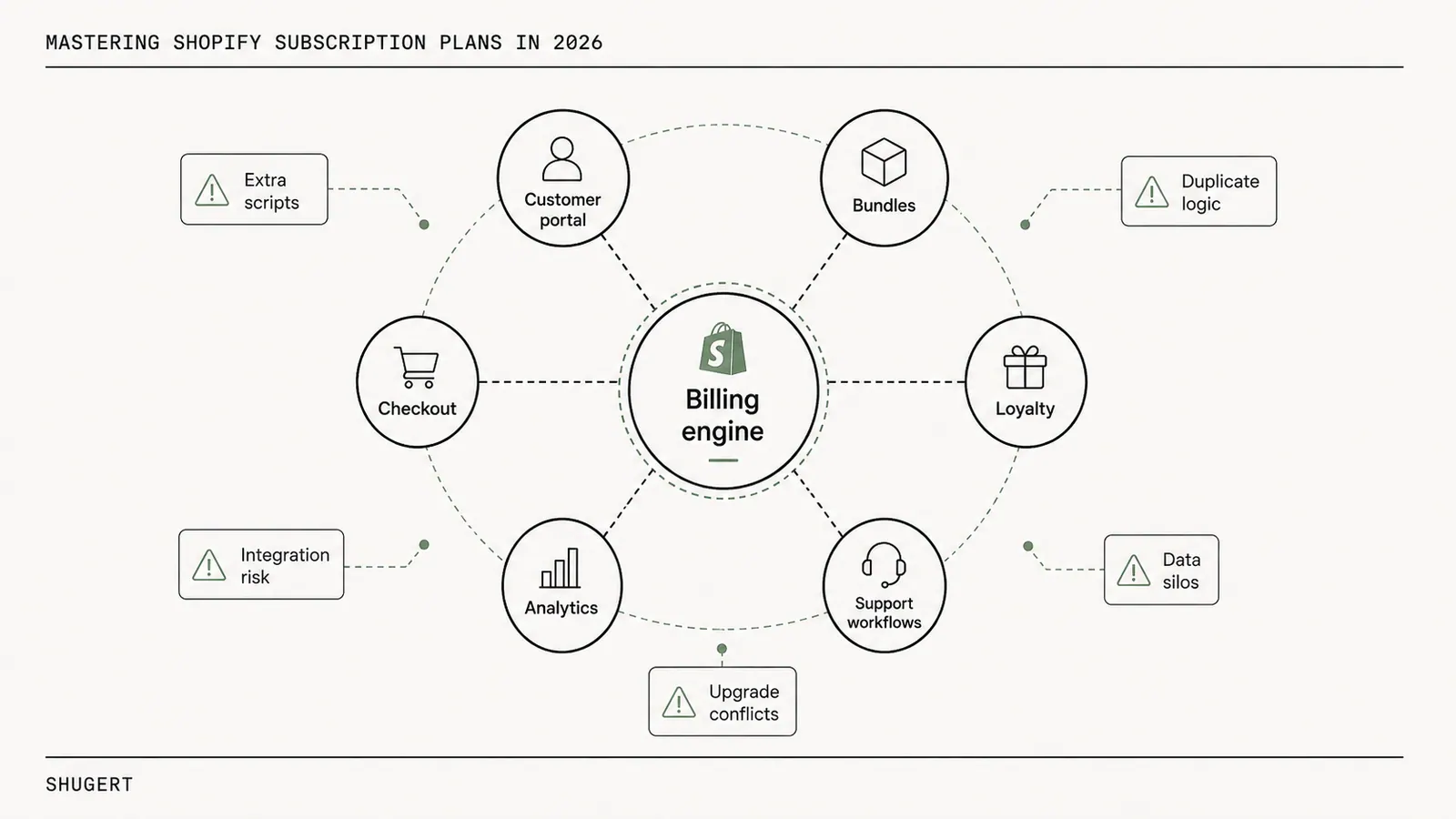
Third-party subscription apps are sold on features, because features demo well and look persuasive in a comparison grid. For a revenue-stage merchant the harder questions sit underneath the feature list.
A technically strong subscription app enables flows the native route cannot yet handle comfortably. It also adds script weight, duplicates customer logic, complicates reporting and ties retention operations to another vendor's roadmap.
What to ask before signing a subscription app contract
The best evaluation sounds less like marketing and more like due diligence. Push on the edges of the system, not the polished middle.
- Customer portal quality: how much can customers do without contacting support? Skip, swap, pause, edit frequency, change address, update payment method and manage upcoming orders should all be tested on mobile.
- Checkout behavior: does the app preserve a smooth Shopify experience, or introduce handoffs that cost trust and conversion?
- Payment token portability: if the brand leaves later, what happens to vaulted credentials and billing relationships? Get the answer in the contract, not the demo.
- Analytics structure: can subscription events be reconciled cleanly with store reporting, retention analysis and finance workflows?
- Theme impact: which scripts, app blocks and front-end dependencies land on product pages, cart and account areas?
For teams comparing recurring billing systems more broadly, evaluate billing flexibility, dunning, proration, data portability, and billing logic design before signing an app contract.
A subscription app should not be chosen because it can do everything. It should be chosen because it handles the exact complexity the business needs without creating friction everywhere else.
The hidden cost of app stack complexity
The worst subscription stack is rarely a single bad app. It is a decent subscription app paired with too many adjacent tools. Bundle logic in one app. Upsells in another. Loyalty in a third. Account enhancements somewhere else. Soon the storefront and account experience are held together by overlapping scripts and conflicting events, and the cost shows up as support tickets rather than invoices.
That is where custom development becomes relevant. Sometimes the right move is not another app but a thinner, more intentional implementation using custom Shopify app development for business-specific logic that does not belong in a bloated public app stack.
| Evaluation area | Strong sign | Warning sign |
|---|---|---|
| Performance | Minimal front-end footprint | Heavy page scripts and delayed widget rendering |
| Data portability | Documented migration and export policy | Vague answers on exported data and tokens |
| Support model | Technical onboarding and escalation clarity | Sales-led demos with thin implementation detail |
| Integration fit | Clean alignment with theme and app stack | Requires companion tools to work well |
For many brands the right answer is still a third-party app. But it should be solving a real complexity problem, not substituting for unclear subscription strategy.
Modeling the True Cost of Your Subscription Program
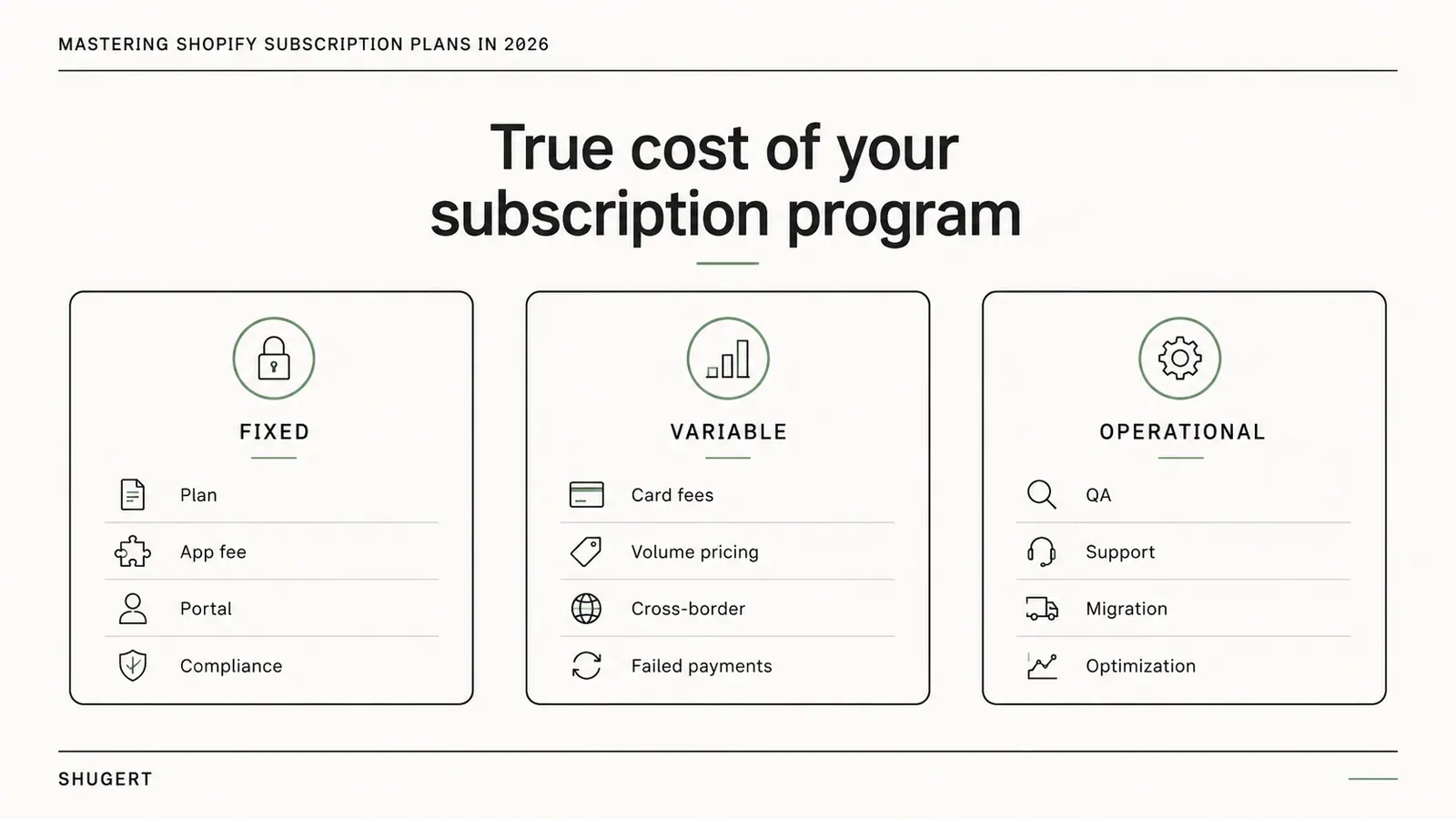
Most subscription comparisons stop at monthly software fees. That is the wrong level of analysis for an established merchant. The right question is total cost of ownership: platform fee, payment cost, app fees, implementation time and ongoing maintenance in one model.
A useful category breakdown of Shopify costs — plan fees, payment processing, third-party transaction surcharges, apps and themes, and currency or international conversion — is set out in OneCart's breakdown of Shopify fees; treat the categories as durable and the percentages as things to re-verify against current Shopify documentation. Annual billing is generally discounted against monthly on the standard tiers, which changes the comparison before a single app fee is added.
The cost categories that actually matter
A finance-ready subscription model separates three columns, not two.
Fixed: Shopify plan, subscription app licence, portal tooling, retained development capacity. Variable: card processing on every renewal, third-party transaction surcharges where they apply, volume or revenue-share app pricing, cross-border conversion. Operational: implementation and QA, support labour on edge cases, finance reconciliation, and a migration reserve for the day you leave.
That third column is the one most models omit, and it is usually where a "cheap" architecture becomes expensive. Plan upgrades look costly only in isolation: a higher tier can be cheaper in practice when it reduces transaction friction, improves reporting, or removes the need for extra app layers.
A clean working model should include:
- Platform baseline: Shopify plan fee and billing cadence
- Payment economics: card rates and any non-Shopify Payments surcharge that applies to you
- Subscription software: native route versus third-party contract, including revenue-share terms
- Implementation burden: theme work, QA, billing logic setup, portal adjustments
- Maintenance load: renewals, app conflicts and post-launch change requests
- Exit reserve: the estimated cost of migrating subscribers and tokens off the chosen stack
A practical break-even lens
There is no universal break-even threshold, and any guide that gives you one is guessing at your order mix. The useful exercise is measuring how much variable cost and operational drag the current setup creates, then comparing two concrete scenarios:
- Lean architecture — lower app footprint, tighter native alignment, fewer merchandising options.
- Feature-heavy architecture — stronger third-party platform, more implementation overhead, more capability.
Operating lens: do not ask which plan is cheaper. Ask which setup produces the highest contribution margin after software, payment costs, support labour and implementation upkeep.
Then price the operating pain each scenario removes or creates: support tickets, reporting confidence, failed payment handling, shipping complexity, international constraints. Those costs never appear on a pricing page, and they usually decide whether the subscription program scales cleanly or becomes expensive to carry.
Navigating Subscription Migration and Implementation
Subscription migrations fail for different reasons than theme launches. The storefront can look perfect while billing operations break underneath it. Treat a subscription migration as a revenue continuity project, not an app switch.
The hardest constraint is payment credential continuity. Subscriber records can usually be exported and mapped. Tokens are the bottleneck. If the incumbent provider, gateway setup or target architecture does not support a clean transfer path, the brand needs a staged migration with customer communication and re-authentication — which introduces churn risk if handled carelessly.
Where migrations usually go wrong
The common scenario starts with a successful DTC subscription business that outgrew its first app. The team wants better reporting, better portal UX or a cleaner fit with Shopify's platform, so it plans around feature parity and a launch date. Then the edge cases surface: subscription metadata that will not map, renewal dates that need revalidation, retry logic that behaves differently, support with no script for renewal interruptions, international customers hitting different tax and payment behavior than domestic ones.
For scaling brands selling across markets or managing complex recurring orders, plan choice and implementation discipline matter more than most guides admit — cross-border fees, multi-market operations and reporting depth should weigh heavily, a point also made in Blackbelt Commerce's Shopify pricing comparison.
A safer migration sequence
Safer migrations follow a conservative sequence rather than a big-bang cutover.
- Audit the current state first: catalogue active subscribers, billing cadences, discounts, shipping rules, dunning flows and adjacent app dependencies.
- Validate token transfer early: never leave vaulting and payment migration assumptions for late-stage QA.
- Map customer communications: subscribers need precise messaging on what changes, what does not, and when action is required.
- Parallel-test edge cases: failed renewals, mixed carts, skipped orders, prepaid logic and account edits before launch, not after.
- Preserve operational history: support and finance need enough historical context to handle disputes, refunds and churn analysis after cutover.
- Name one owner: someone with authority across ecommerce, support, retention and finance. Without that, migration issues get solved in silos and the customer pays for the confusion.
For brands also facing broader platform updates, this migration note on Shopify Scripts deprecation and 2026 planning is relevant because recurring logic often intersects with discounting and checkout behavior that used to depend on older customisation patterns.
Migrations go sideways when teams optimise for launch speed instead of billing continuity. Subscription customers are less forgiving than one-time buyers because the relationship is ongoing by design.
A Decision Framework for Your Subscription Model
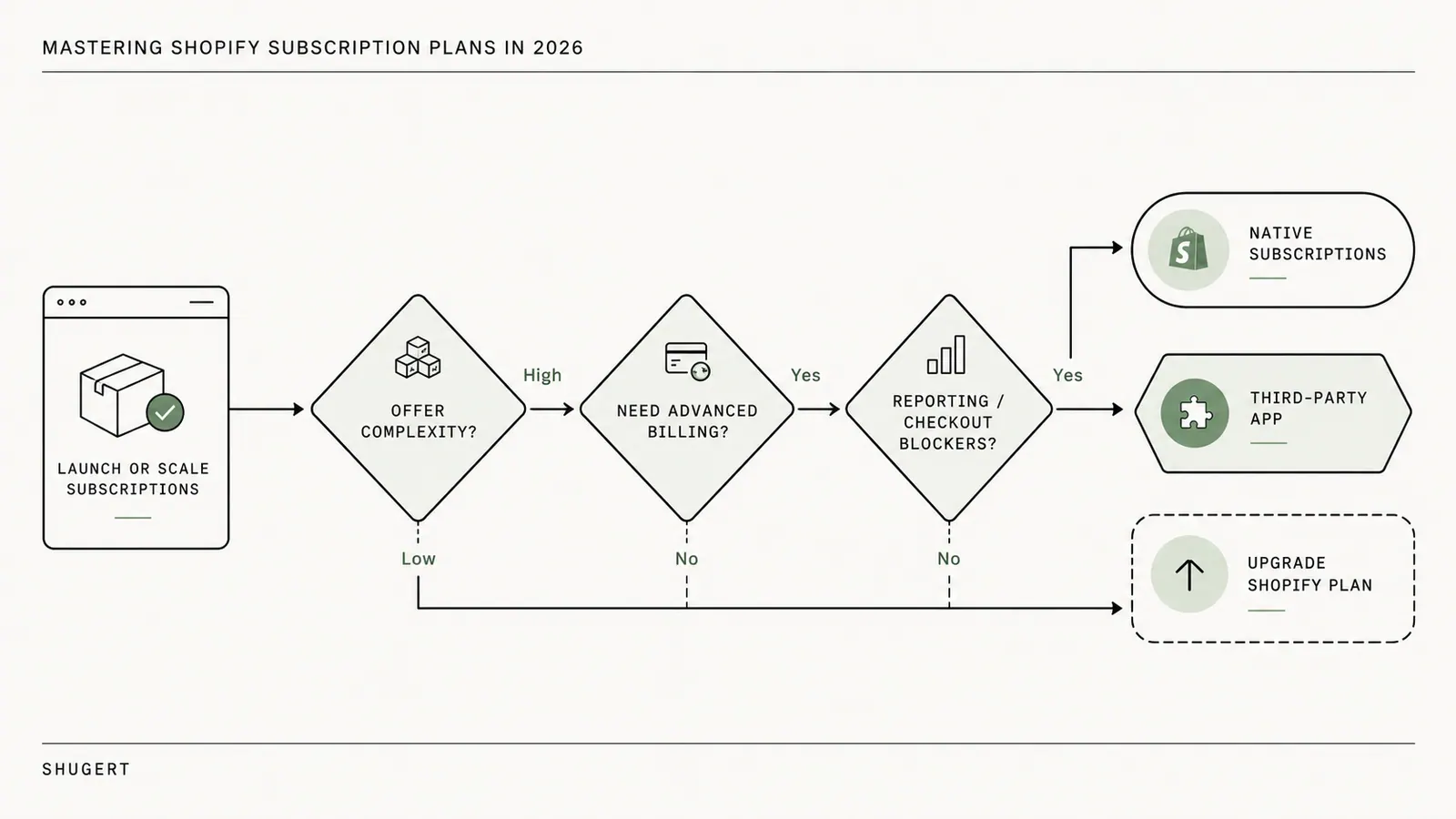
The right subscription model depends less on ambition and more on operating reality. Choose the simplest architecture that supports the next stage of growth without forcing ugly workarounds.
Choose based on operating reality
Native Shopify subscriptions are the stronger fit when the brand sells straightforward replenishment products, wants a cleaner platform footprint, and values alignment with Shopify's own data and checkout structure. That route also wins when performance, maintainability and low app dependency matter more than feature depth.
A third-party subscription app is justified when the business needs advanced bundle logic, managed cancellation flows, deeper portal customisation, or recurring order behavior the native path cannot support elegantly — decided with clear eyes about lock-in, migration difficulty and stack complexity.
Four gates, in order:
- Choose native first if the offer is simple, margins are healthy and the team wants less technical debt.
- Choose third-party if retention strategy depends on capabilities that are unavailable or operationally weak natively.
- Upgrade the Shopify plan when reporting, shipping, fee structure or checkout customisation — not features — are the blocker to recurring revenue efficiency.
- Plan the migration before signing any app agreement. Exit terms matter as much as launch capabilities.
For teams preparing a broader replatforming or structural cleanup around subscriptions, this migration planning framework frames the operational work sitting behind a seemingly simple platform change.
The best subscription stack is rarely the most advanced one. It is the one the business can operate, measure and evolve without accumulating expensive complexity.
Shugert helps established Shopify and Shopify Plus brands audit subscription-related technical debt, evaluate app stack risk, and implement cleaner storefront, checkout and custom app solutions when recurring revenue architecture starts limiting growth.
Keep exploring this topic
Deeper references from the Shugert library and the service that turns this work into a fixed scope.
Related resources
- Shopify PlusShopify Functions Explained: What They Do for Your StoreA technical explainer on Shopify Functions, the Wasm runtime, supported languages (Rust, JS, TS), the seven Function types, and how the architecture…
- Shopify PlusShopify Scripts Deprecation: Plus Migration ChecklistShopify Scripts stops working on June 30, 2026 and the edit-lock starts on April 15.
Related services
Keep reading
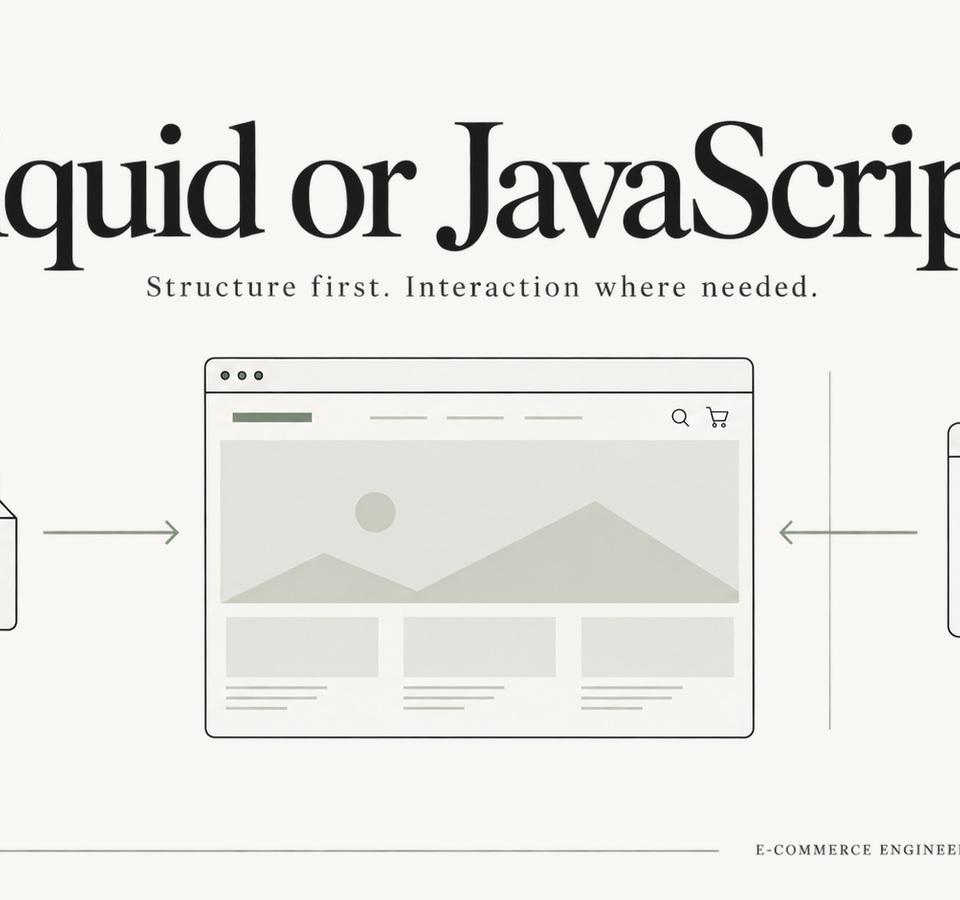
Shopify Theme Architecture in 2026: When Liquid Should Win Over JavaScript
JavaScript is essential for interaction, but many Shopify themes ask it to do work that Liquid and HTML can deliver earlier, more reliably and with less main-thread cost.
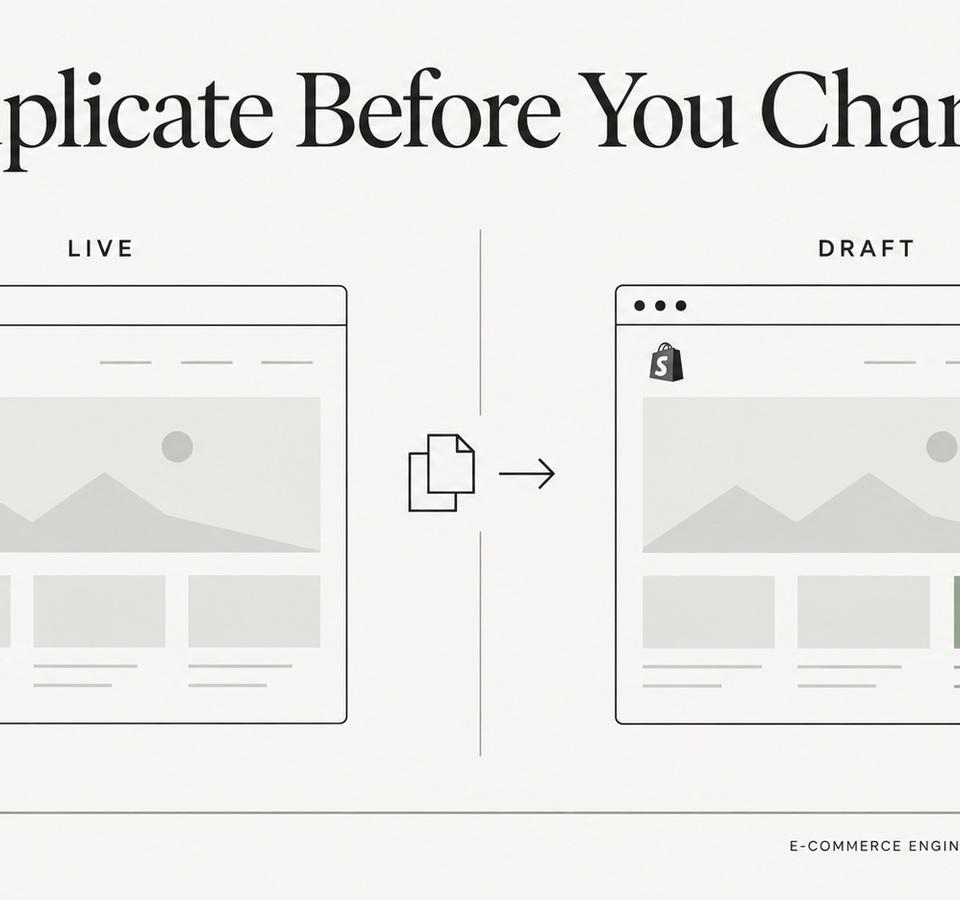
Why We Duplicate the Live Shopify Theme Before Every Engineering Change
A duplicate theme is a simple safety boundary: it separates implementation and QA from the storefront customers are using right now.
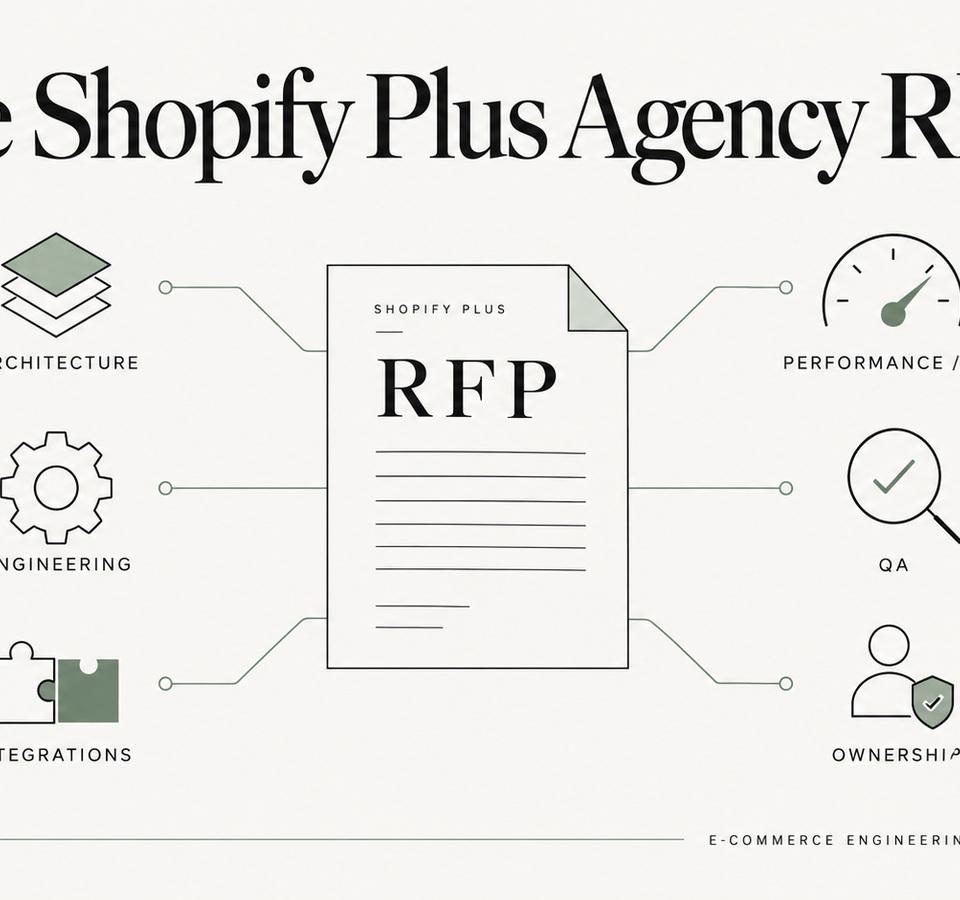
Shopify Plus Agency RFP Checklist for Complex Commerce Projects
What established DTC and B2B teams should put in a Shopify Plus RFP so agency proposals are comparable on architecture, delivery risk and ownership.