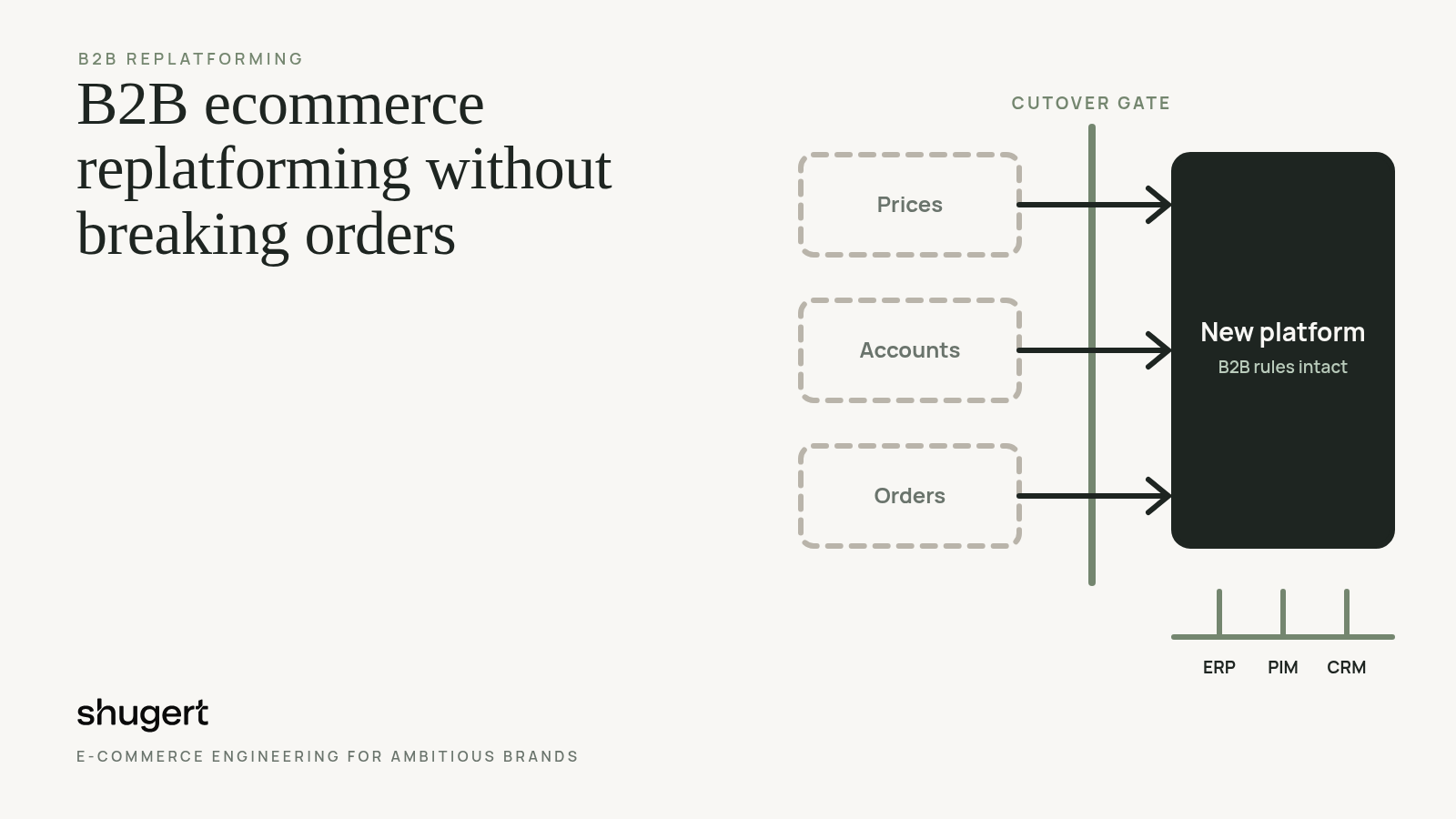
The most common advice about B2B ecommerce replatforming focuses on moving data, rebuilding the storefront, and getting through launch weekend. That advice stops too early. The harder test comes when buyers place real orders against negotiated prices, location-specific permissions, payment terms, and ERP inventory.
A migration plan isn't complete when the new store goes live. It needs production controls, named decision owners, and a way to reconcile commercial outcomes before incorrect transactions become customer disputes.
Table of Contents
Teams usually replatform because of limited scalability, slow implementation, support problems or missing functionality. Those are architecture and operating-model problems, not reasons to commission a different homepage.
For B2B merchants, the storefront also carries customer agreements. A product page can render correctly while the buyer receives an unauthorized discount, loses purchasing access, or submits an order the ERP can't process.
Separate replacement from preservation
Before platform selection, the project team should classify requirements:
- Replace: Unsupported extensions, redundant apps, brittle theme code, and manual exports.
- Rebuild: Procurement interfaces, custom quoting, approval routing, and integration transformations that remain necessary.
- Preserve unchanged: Negotiated prices, account access boundaries, tax treatment, and contractual purchasing terms unless the business explicitly approves a change.
This classification prevents a common budgeting mistake: assuming everything on the existing platform should be reproduced. Some customizations are obsolete workarounds. Others represent agreements that sales and finance cannot abandon.
Practical rule: A cleaner architecture isn't a successful outcome if customers can no longer purchase under their agreed conditions.
A retail-style acceptance test checks whether a customer can buy a product. A B2B acceptance test checks whether the correct buyer, acting for the correct branch, can purchase the permitted assortment at the agreed price and terms, with the resulting transaction correctly recorded downstream.
Modernization must therefore preserve customer agreements while improving business-rule modeling, pricing validation, integrations, search continuity, production controls, and release execution.
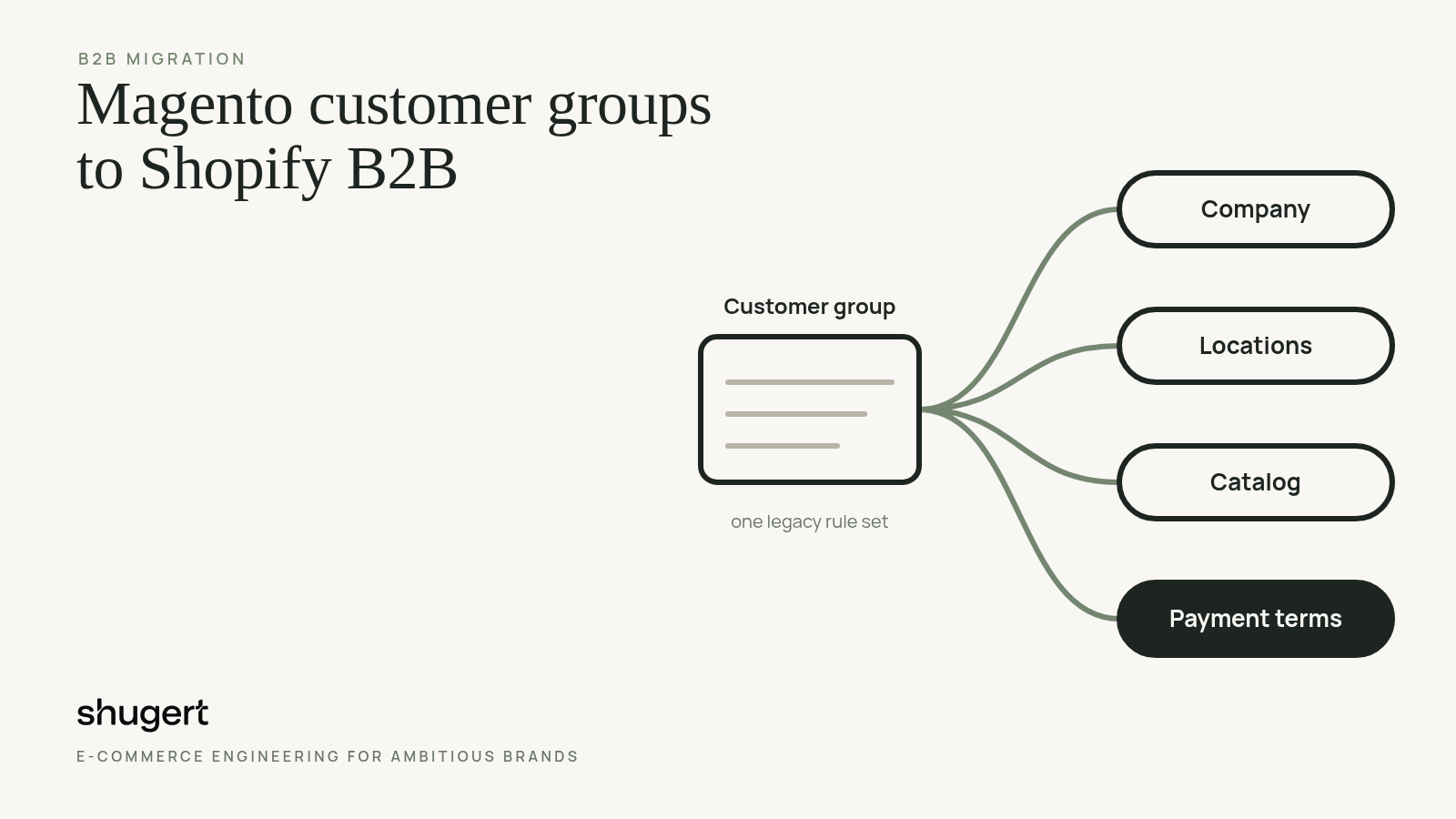
Map Business Rules to Shopify Plus B2B Features
The migration path starts with an inventory of catalog, variants, content, customers, orders, URLs, apps, integrations, analytics, and operational dependencies. Product exports alone won't reveal pricing hidden in middleware, account exceptions maintained by sales, or fulfillment rules encoded in legacy checkout code.
The requirements register should connect each business rule to a destination object and an executable acceptance test.
Legacy B2B rules mapped to Shopify Plus objects
| Business rule | Shopify Plus object | Migration question | Test before launch |
|---|
| Customer hierarchy | Company with company locations | Does each wholesale branch need its own tax ID, addresses, and terms? | Each buyer sees only assigned locations |
| Negotiated prices | Catalog with fixed prices or percentage adjustments | Which ERP price list owns each agreed value? | Storefront price matches signed agreements for sample accounts |
| Volume tiers | Volume pricing breaks within a catalog | Are quantity breaks stored per product or per account? | Break applies at the correct quantity |
| Payment terms | Company location payment terms | Which accounts receive Net terms and which pay upfront? | Invoice shows the agreed term |
| Purchasing permissions | Company contacts and location-level permissions | Which roles can order, edit drafts, or check out? | Each role performs only permitted actions |
| Quotes | Draft orders | Does sales build quotes in Shopify or the ERP? | Draft converts with the quoted price |
| Tax exemptions | Company location tax settings | Which accounts hold valid exemption certificates? | Tax exemption applies only to certified accounts and eligible transactions |
| Order history | Imported orders and customer records | How much history must appear in customer accounts? | Open orders and past invoices match ERP records |
Model locations as operating entities
The first row requires particular care. Shopify's blended-store checklist explains that company locations can hold their own tax IDs, exemptions, addresses, pricing, and payment terms, and warns that a B2B market without company locations won't deliver B2B pricing or experiences.
A legacy wholesale account might represent a parent company, a branch, or an individual buyer. Treating all of those records as ordinary customers destroys distinctions that affect transactions.
For example, a distributor's headquarters may pay invoices while regional branches receive goods under different tax treatment. The company-location model must preserve those responsibilities rather than duplicate the headquarters account for every buyer.
A clean import can still produce an incorrect store. Buyers may authenticate successfully but see consumer pricing because their company-location relationships weren't established.
Treat gaps as engineering decisions
Draft orders can provide a quotation foundation, but they don't automatically reproduce every approval chain. Likewise, location permissions shouldn't be assumed to implement arbitrary spending limits or managerial sign-off.
Where native objects don't reproduce a requirement, the team should evaluate Shopify Functions, Checkout Extensibility, a custom application, or an external workflow against the relevant execution constraints. Business-critical logic shouldn't live only in browser scripts that a buyer can bypass.
Complete the mapping for every rule before estimating development. Each unresolved row represents a potential custom workflow, integration dependency, or deliberate process change.
Test Catalog Precedence and Account Pricing
Suppose a regional catalog discounts a product by 10%, an account catalog assigns a fixed price to the same SKU, and a promotional catalog prices it lower still. An importer can accept every record while the buyer receives a price that violates the account agreement.
Shopify doesn't give account-specific catalogs priority. According to Shopify's catalog precedence documentation, a company location can have up to 25 catalogs, including market and direct assignments, and the storefront displays the lowest overlapping product price, excluding quantity rules and volume-pricing breaks from that comparison.
In this example the buyer pays the promotional price, because it is the lowest, even though the account catalog holds the negotiated price. Account catalogs have no automatic priority. Quantity rules and volume breaks need their own tests.
Resolve the plan decision first
On Shopify, Basic, Grow and Advanced allow three active catalog assignments across active B2B markets, with one catalog assigned to two markets consuming two assignments; Plus removes that ceiling and permits direct company or company-location assignment.
Catalogs support product inclusion or exclusion, percentage adjustments and fixed prices.
A lower-plan architecture may require broader market price books or external logic. That decision changes licensing, integration complexity, maintenance, and test scope, so it belongs before catalog implementation.
Run a price acceptance checklist
- Export assignments. Collect every company location and its market-derived and direct catalogs.
- Identify overlap. Flag products appearing in multiple assigned catalogs, including promotional assortments.
- Define expected outcomes. Record the agreed price at each relevant quantity break, with currency and eligibility conditions.
- Compare authenticated storefront behavior. Test representative buyers in the preproduction environment against signed agreements, including cart and checkout.
- Resolve conflicts before production import. Remove unintended assignments or revise catalog design rather than expecting source-system priority rules to carry over.
Imported record counts prove transfer completeness. They don't prove pricing accuracy.
Quantity thresholds need separate boundary tests below, at, and above each break. Otherwise, a correct single-unit price can conceal incorrect wholesale economics.
Assign System Ownership for ERP, PIM and CRM
Each data domain needs one system of record. Shopify handles storefront transactions, while inventory, financial records, product enrichment, and account relationships need explicit authoritative owners.
For wholesale buyers, integration reliability is an operating requirement, not a storefront enhancement.
System of record and sync rules by data domain
| Data domain | System of record | Sync pattern | Failure rule |
|---|
| Inventory availability | ERP | Incremental sync to Shopify | Show last confirmed level and flag stale data |
| Contract pricing | ERP price lists | Push on change, with nightly reconciliation | Hold the price change and alert on mismatch |
| Product enrichment | PIM | Bulk Operations for batch updates | Retry failed batches and keep prior content live |
| Account contacts | CRM or ERP | Two-way for contact fields only | Queue and replay on failure |
| Storefront orders | Shopify | Order events to ERP with idempotency keys | Retry without duplicates and reconcile daily |
| Tax calculation | Tax engine or ERP, confirmed before build | Calculate at checkout and reconcile on the order | Block go-live when sample-account tax doesn't match the source |
| Fulfillment status | OMS or ERP | Status events back to Shopify | Keep last confirmed status and alert when updates stall |
These failure rules need business approval. Showing last-confirmed inventory is appropriate only within an agreed freshness window; restricted or scarce inventory may require a more conservative availability policy.
Likewise, contact synchronization must define field-level authority. Two-way synchronization without conflict rules can overwrite a finance-approved account change with an outdated storefront value.
Decouple legacy availability from checkout
An integration layer should use asynchronous processing, durable queues, controlled retries, idempotency keys, reconciliation jobs, and replay capability. A temporary ERP outage shouldn't automatically break browsing or checkout; any exception requiring live authorization needs an explicit fallback policy.
Large catalogs benefit from incremental updates and Shopify Bulk Operations where appropriate. Repeated full-catalog transfers waste processing capacity and make it harder to isolate failed records.
For industrial distributors selling hydraulic components and other maintenance, repair and operations (MRO) supplies, system integration is also a practical concern beyond ecommerce. The Shopify migration should preserve the connection between technical product specifications, ERP inventory, customer-specific pricing and order fulfillment, so buyers can identify compatible components and purchase against their approved account terms.
The architecture review should produce ownership, latency, retry, and recovery requirements before implementation. A Shopify integration services assessment should be evaluated against those deliverables rather than a connector installation checklist.
Every domain owner must answer the same question: Which system wins when two records disagree?
How to Protect Organic Traffic Through Cutover
SEO preservation belongs in release engineering, alongside data validation and deployment checks.
Legacy product, category, faceted, editorial, and account-adjacent URLs need explicit treatment. Redirecting an obsolete product to an unrelated homepage doesn't preserve the buyer's intent.
Make the URL inventory executable
- Export valuable URLs. Combine search-performance exports, analytics landing pages, sitemaps, and server logs rather than relying on a single crawl.
- Map destinations. Give each retained legacy URL a relevant destination and a permanent 301 redirect where its address changes. Avoid homepage fallbacks.
- Eliminate chains. Send each legacy URL directly to its final destination.
- Validate indexing signals. Check canonical tags, hreflang where applicable, sitemap entries, and robots directives.
- Compare environments. Crawl staging before release, then production immediately after cutover, and reconcile results against the inventory.
- Monitor continuity. Track missing pages, indexation, impressions, clicks, and organic landing-page behavior by page type during stabilization.
Large catalogs require automated exception reports. Sampling a handful of products won't expose missing redirect patterns across an entire attribute-based category structure.
Technical acceptance should also compare product and collection templates for Core Web Vitals, unnecessary app scripts, oversized media, and rendering regressions. A faster homepage doesn't compensate for slow authenticated catalog navigation.
Shugert's Llantas Cavazos migration moved a legacy platform to Shopify with more than 8,000 active SKUs, 84 size collections, and delivery in under 7.5 weeks, retaining more than 90% of organic traffic in week one. Those project-specific results aren't a forecast for another catalog.
A Shopify technical SEO review belongs before release approval. Search Console verification, server-log access, the redirect file, and a segmented organic dashboard should all sit in the launch runbook.
Validate Commercial Logic in the First 90 Days
A clean cutover proves that deployment worked. It doesn't prove that every production buyer can transact correctly.
Independent research of 200 IT and business leaders at U.S. and U.K. manufacturers, retailers, and wholesalers found that 43% struggled with third-party commerce integrations, 51% were dissatisfied with integration ease, and 52% had difficulty creating and managing APIs, according to Digital Commerce 360's 2025 report.
Give each control an owner
The following are recommended acceptance targets, not reported performance benchmarks.
| Owner | Production control | Threshold and intervention trigger |
|---|
| Sales | Negotiated prices, assortment, buyer permissions | No unresolved critical discrepancy; isolate affected accounts if an unauthorized price or access path appears |
| Finance | Invoices, tax, shipping charges, payment terms | Exact agreement with approved calculation rules; suspend the affected transaction route for unexplained financial mismatches |
| Operations | ERP orders, inventory, fulfillment, order-history completeness | Reconciliation within the agreed processing window; pause routing if missing orders or stale availability exceed the approved tolerance |
| IT | Authentication, webhooks, APIs, integration errors, latency | Remain within signed service thresholds; revert the affected release for sustained breaches that prevent safe processing |
| Marketing or SEO | Landing pages, redirects, indexation | No unexplained loss of priority-page accessibility; restore routing or redirect changes when a release causes critical failures |
Keep stabilization inside project scope
The recommended go-live standard is zero unresolved critical discrepancies affecting prices, customer access, or financial transactions. Each other metric needs a written baseline and an agreed tolerance based on business impact, not an arbitrary dashboard color.
Recommended cadence is daily review during the first two weeks, with production-order reconciliation against the ERP, followed by weekly control reviews through day 90. Integration error rates, API failures, and synchronization latency belong beside order accuracy and customer access, not on an infrastructure dashboard nobody in commerce reviews.
A rollback decision must account for orders already placed. Returning traffic to the old storefront doesn't undo payments, shipments, or ERP postings.
Before launch, name the release decision owner, typically the accountable ecommerce or technology leader, and establish who can pause account access, order routing, or a faulty integration independently.
A typical migration scope includes discovery, destination architecture, catalog and customer data, order-history decisions, redirects, storefront implementation, apps, integrations, analytics, QA, cutover, and stabilization. Closing the engagement at deployment removes support precisely when production exceptions need investigation.
Estimate Scope Cost and Timeline
The most expensive B2B replatforms combine several integrations, multiple storefronts or ERPs, very large catalogs, and workflows such as punchout, cXML procurement, custom quoting or branch-specific catalogs. A compact catalog with a single ERP connection is a much smaller project. Scope moves with catalog size, data quality, URL count, integration load, subscriptions, international requirements, SEO exposure, and launch coordination, so the estimate should be built from those variables rather than from a platform label.
Build an estimate from interfaces
- Inventory every interface. ERP, PIM, CRM, tax, logistics, middleware, and procurement connections, plus the scheduled files and manual imports that never appear on an architecture diagram.
- Contract-test critical exchanges. Pull representative records and validate customer-specific prices, inventory positions, and order states before build effort gets assigned.
- Classify complexity. Record catalog size, integration count, storefront topology, and quoting or procurement requirements.
- Separate commercial lines. Platform fees, data migration, integrations, checkout work, B2B rules, storefront implementation, and stabilization each get their own line.
- Require independent integration estimates. Every interface needs documented assumptions behind its price.
Price ownership, not just construction
Total cost of ownership includes app subscriptions, middleware operation, monitoring, API maintenance, regression testing, and the internal staff who resolve exceptions. Replacing one legacy extension with three overlapping apps lowers the build invoice while raising recurring spend and failure paths.
A custom application can centralize complex pricing or permission rules, and it creates a permanent maintenance obligation in return. Native B2B functionality, such as catalogs, price lists, company accounts, and Net terms, carries less of that obligation when the business accepts its operating model.
The estimate also has to carry the post-launch period. Negotiated prices, buyer permissions, and ERP synchronization only meet real order volume after cutover, and the first exceptions arrive with real money attached. An estimate that ends at deployment pushes the most expensive investigation work into change orders. Stabilization engineering, production-order reconciliation, and integration monitoring belong in the priced scope.
On Magento or WooCommerce migrations, the estimate should name which legacy behaviors are intentionally retired. Rebuilding every customization without questioning its purpose recreates technical debt under a new platform fee.
Budget safeguard: Unknown integration behavior belongs in a discovery deliverable with a price attached, not inside an optimistic assumption in a fixed-price proposal.
Timelines fail for the same reason budgets do: uncounted interfaces and unresolved business rules. Design polish rarely separates a manageable migration from a prolonged systems program. Integration certainty does.
Pick a Rollout Model and Partner Criteria
Rollout models compared by fit and risk
| Rollout model | Best fit | Main risk | Rollback path |
|---|
| Big-bang cutover | Small catalog, few integrations, low URL count | All defects appear at once | Reverse traffic routing and reconcile new transactions before restoring source data |
| Phased by customer segment | Many wholesale accounts with distinct terms | Two systems must stay synchronized | Return the affected segment to the legacy storefront |
| Phased by market or region | Multiple currencies, tax regimes, or territories | Duplicate URL structures during transition | Revert that market's domain and checkout routing to the legacy storefront |
| Parallel run with legacy as system of record | High order volume and strict financial controls | Extra reconciliation effort | Keep the legacy system authoritative until sign-off |
Phased deployment limits exposure but creates temporary operating complexity. Parallel validation adds confidence only when the team prevents duplicate financial postings and distinguishes shadow transactions from real orders.
For distributors selling building materials, product discovery is another migration acceptance criterion. Buyers researching how to plan a bathroom renovation may need to progress from project guidance to tile specifications, quantities, samples and trade pricing. A Shopify B2B rollout should preserve these editorial-to-catalog journeys, along with relevant redirects, product attributes, unit-of-sale rules and authenticated trade pricing. Test the complete purchasing journey for both retail customers and professional buyers before moving traffic.
Evaluate evidence and accountability
Partner selection should prioritize concrete artifacts:
- Integration evidence: Relevant ERP, PIM, or CRM experience supported by documented contract and failure tests.
- B2B modeling: Explicit mappings for companies, locations, catalogs, permissions, and payment terms.
- Search protection: A redirect and technical SEO playbook with automated exception reporting.
- Production ownership: Named stabilization engineers, escalation responsibilities, and release authority.
- Scope boundaries: Written inclusions, exclusions, dependencies, and treatment of newly discovered rules.
Shopify owns the platform quote, while Shugert scopes migration, integrations, storefront, checkout, B2B, and ongoing engineering around it. Projects involving ERP, B2B, or multi-store architecture follow Shugert's separate Shopify Plus Agency path.
Shugert can also supply senior implementation and release capacity alongside an internal product or ecommerce team. That division of labor still needs a single accountable release owner.
Make the next decisions explicit
- Complete the requirements table and obtain sales, finance, operations, and IT sign-off.
- Choose a rollout model based on transaction risk and reversibility.
- Shortlist two or three partners against the same evidence-based criteria.
- Request written integration and redirect plans before signing, including production controls and rollback responsibilities.
Shugert offers complex Shopify and Shopify Plus migrations covering business-rule mapping, integrations, SEO preservation, release execution, and post-launch stabilization. Visit Shugert to discuss the existing catalog, account-pricing model, and backend dependencies, and establish a migration scope that includes production verification rather than ending at launch.