
What Shopify Theme Automation Can Safely Handle—and What Still Needs Senior Engineers
AI and automation can execute useful Shopify theme work, but safe autonomy depends on staging, bounded scope, validation, rollback and clear escalation boundaries.

Published
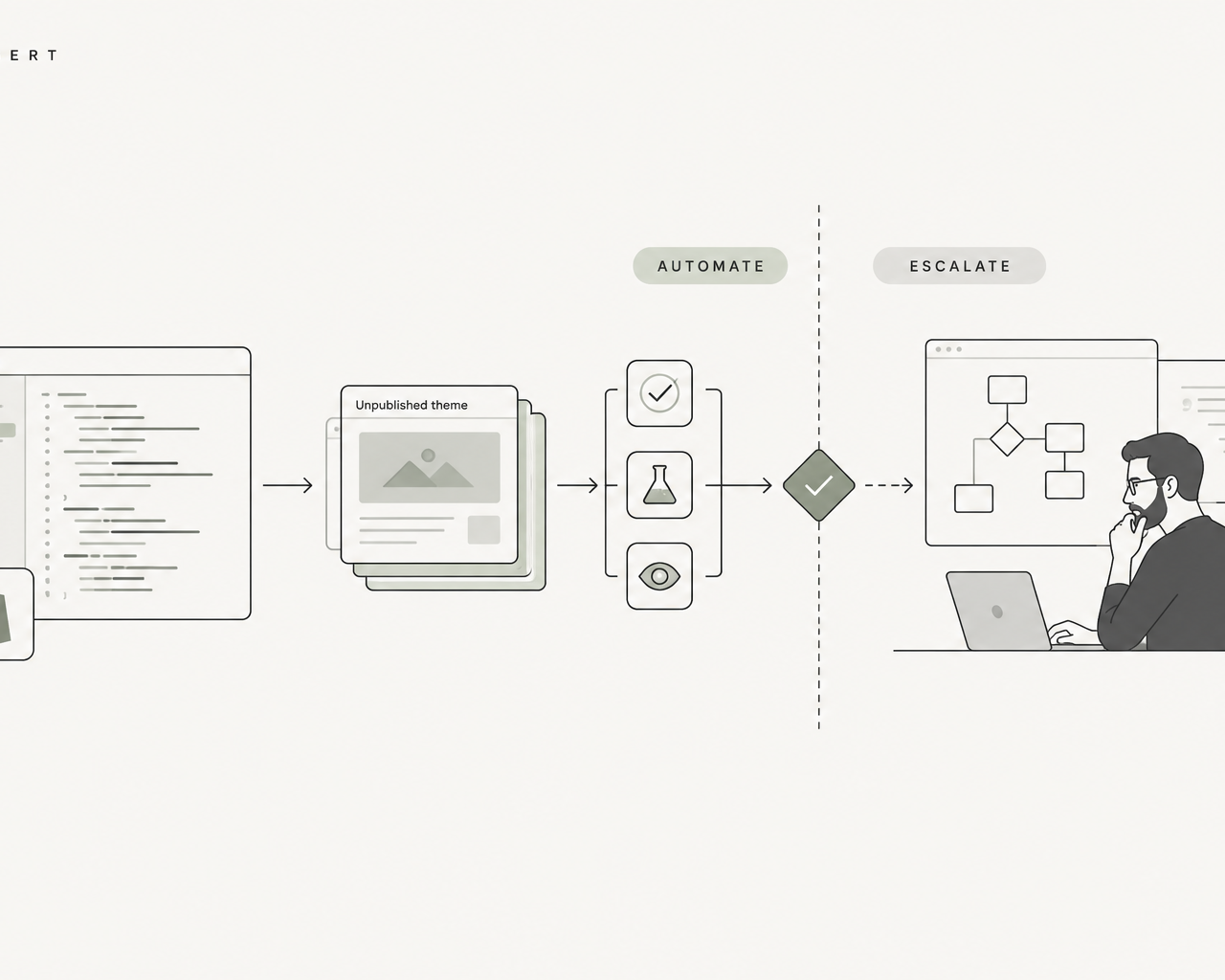
The interesting question about AI in Shopify development is no longer whether a model can write Liquid, CSS or JavaScript.
It can.
The harder question is whether a system can make a change to a merchant's store with enough context, containment and verification that the change is operationally safe.
That distinction matters because code generation is only one part of production engineering. A useful automation system also needs to know where it is allowed to work, what state it is changing, how to validate the result, how to avoid the live theme, and when to stop and escalate.
This is the boundary we use when thinking about autonomous Shopify theme work.
Start with an unpublished theme
The safest default is simple: do not make ordinary engineering changes directly against the live theme.
Shopify's current GraphQL Admin API supports themes with roles such as MAIN, UNPUBLISHED and DEVELOPMENT. The themes query can distinguish the published theme from draft themes, and Shopify's themeCreate mutation creates new themes as unpublished by default unless a development role is explicitly requested.
That gives automation a natural safety boundary:
- identify the current production theme;
- create or use a non-production copy;
- make the bounded change there;
- validate it;
- generate a preview for review;
- promote only through an explicit release step.
The technical capability is important, but the workflow is what makes it safe.
What automation is well suited to
Automation performs best when the requested change has a narrow surface area and an observable success condition.
Examples include:
- small Liquid section changes;
- scoped CSS fixes;
- adding a theme setting to an existing section;
- changing a template reference;
- fixing a simple accessibility issue with a clear rule;
- adding or correcting metadata output;
- updating a bounded block of theme JavaScript;
- validating whether specified theme files changed as intended.
Shopify's themeFilesUpsert mutation can create or update theme files in batches, which makes controlled file-level automation possible for apps that have the required permissions and exemption.
But an API that can write files does not make every file change safe.
The unit of safety is not “a file”
A five-line edit can be higher risk than a 200-line edit.
Changing a CSS selector in an isolated marketing section might be low risk. Changing a shared snippet used by every product card could affect hundreds of storefront surfaces. Editing a global JavaScript utility may influence cart behavior, analytics, subscriptions or personalization even if the diff is small.
So a useful autonomous system needs more than a diff limit. It needs to understand blast radius.
We score work by questions such as:
- Is the file globally shared?
- Is the code involved in cart or checkout behavior?
- Does it touch pricing, inventory, customer data or authentication?
- Does an app depend on the same DOM or event?
- Can the result be validated deterministically?
- Is rollback simple?
- Does the merchant need to make a business decision before implementation?
What should escalate to a senior engineer
We do not treat autonomous execution as appropriate for every task.
Work should generally escalate when it involves:
Ambiguous architecture
If there are multiple plausible solutions with long-term consequences, the system should not quietly choose one because it can generate the code.
Checkout, payment or customer-account behavior
These surfaces have commercial, platform and compliance implications beyond theme syntax.
Cross-system integrations
ERP, PIM, WMS, 3PL, subscription, identity and custom-app work usually require reasoning about external state, contracts and failure modes.
Large refactors
A request like “make the theme faster” is not a bounded implementation instruction. It is a diagnostic problem first.
Changes without a reliable acceptance test
If the system cannot define what success looks like before editing, autonomy should be constrained.
Validation is the real product
The value of automation is not that it writes faster. It is that the whole loop can be faster without lowering the release standard.
A strong loop can include:
- theme duplication or isolated staging;
- a narrowly scoped edit plan;
- static checks;
- build validation where applicable;
- visual regression checks;
- accessibility checks;
- page-level smoke tests;
- performance checks when the change can affect loading;
- a preview URL;
- an auditable summary of files changed and tests run.
That last item matters. A merchant or engineer should be able to understand what happened without being told “the AI fixed it.”
Where TaskerArmy fits
We built TaskerArmy around this exact idea: merchant-authorized, bounded Shopify engineering work should happen inside a controlled staging-and-validation workflow rather than as unconstrained code generation.
It is not meant to prove that senior engineers are obsolete. The opposite boundary is more useful: automate the work that can be safely specified and verified, and escalate the work where judgment, architecture or business context dominates.
That is also why Shopify's theme APIs matter. The platform exposes real primitives for listing themes, creating unpublished themes and updating theme files, but access to theme-writing capabilities is controlled. Shopify currently notes that themeCreate and themeFilesUpsert require theme-writing permissions and, for applicable apps, an exemption to modify themes.
The platform itself is signaling that this is a privileged operation, not a casual script action.
The engineering principle
The future of Shopify automation is probably not “AI does everything.”
It is a layered system:
- deterministic tooling for discovery and validation;
- AI for interpretation and implementation where the problem is bounded;
- platform permissions that constrain what can be touched;
- unpublished themes that contain risk;
- senior engineers for architecture and ambiguous decisions;
- merchant review and release controls when the business impact warrants them.
That model is less dramatic than full autonomy, but much more useful in production.
For the underlying platform concepts, see our Shopify development guide. For the decision boundary between AI-generated work and professional engineering, see AI builders vs. professional Shopify developers.
Keep exploring this topic
Deeper references from the Shugert library and the service that turns this work into a fixed scope.
Related resources
- DevelopmentShopify Development Guide: Themes, Apps, HeadlessA practical map of where to build what on Shopify and Shopify Plus, when to use a theme section, when to write a Shopify Function, when to ship an app, and…
- AI & Web StrategyAI vs Pro Web Developers in 2026: When Each WinsA 2026 honest comparison from a Shopify and web agency that uses Lovable, Bolt, and v0 daily, where AI builders win, where they cost you money, and what we…
Related services
Keep reading
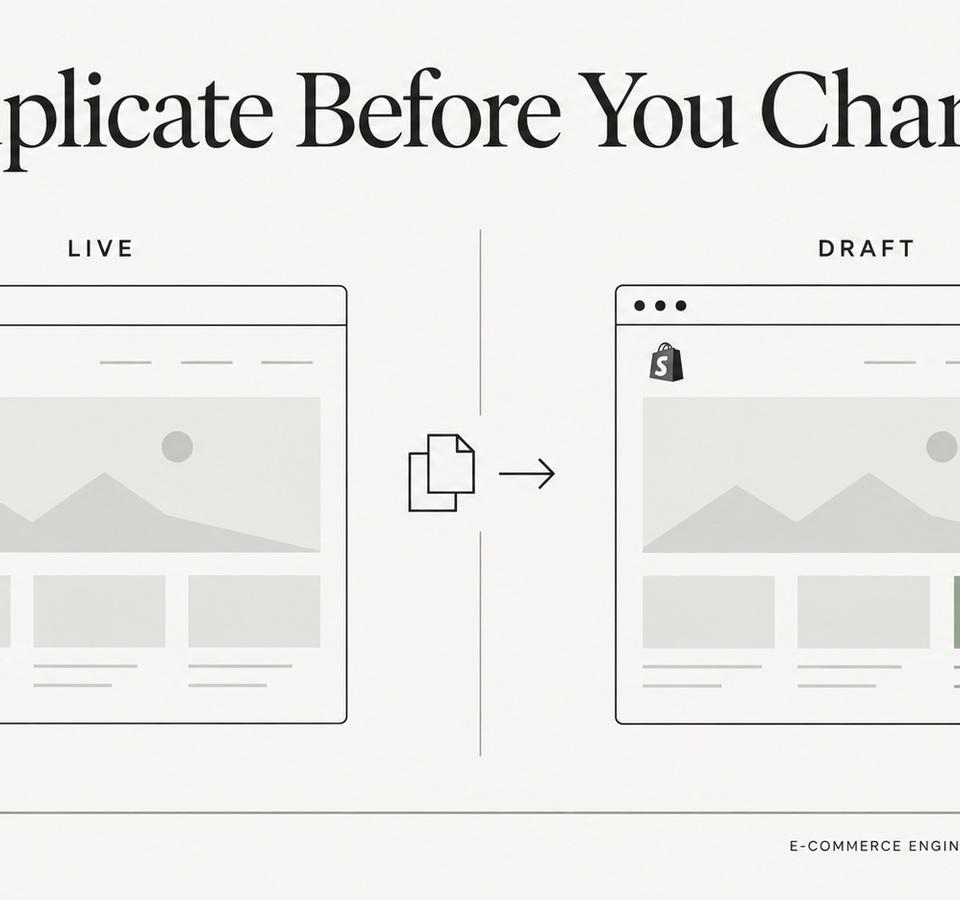
Why We Duplicate the Live Shopify Theme Before Every Engineering Change
A duplicate theme is a simple safety boundary: it separates implementation and QA from the storefront customers are using right now.
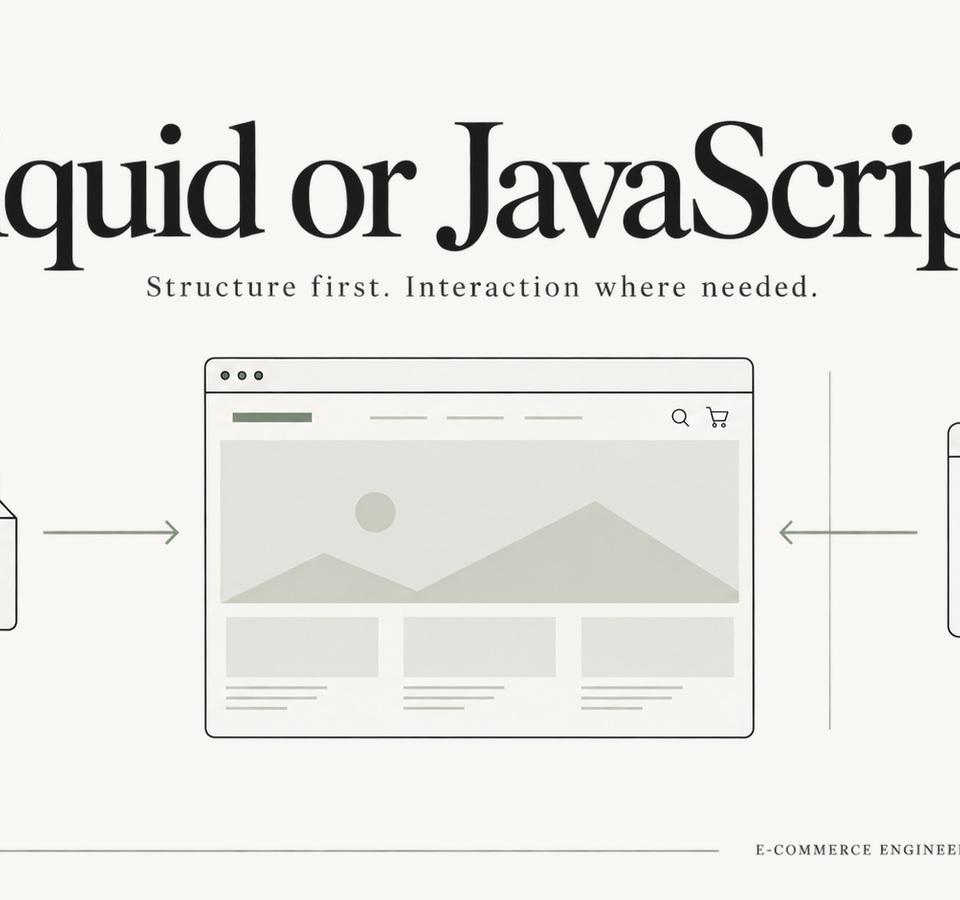
Shopify Theme Architecture in 2026: When Liquid Should Win Over JavaScript
JavaScript is essential for interaction, but many Shopify themes ask it to do work that Liquid and HTML can deliver earlier, more reliably and with less main-thread cost.
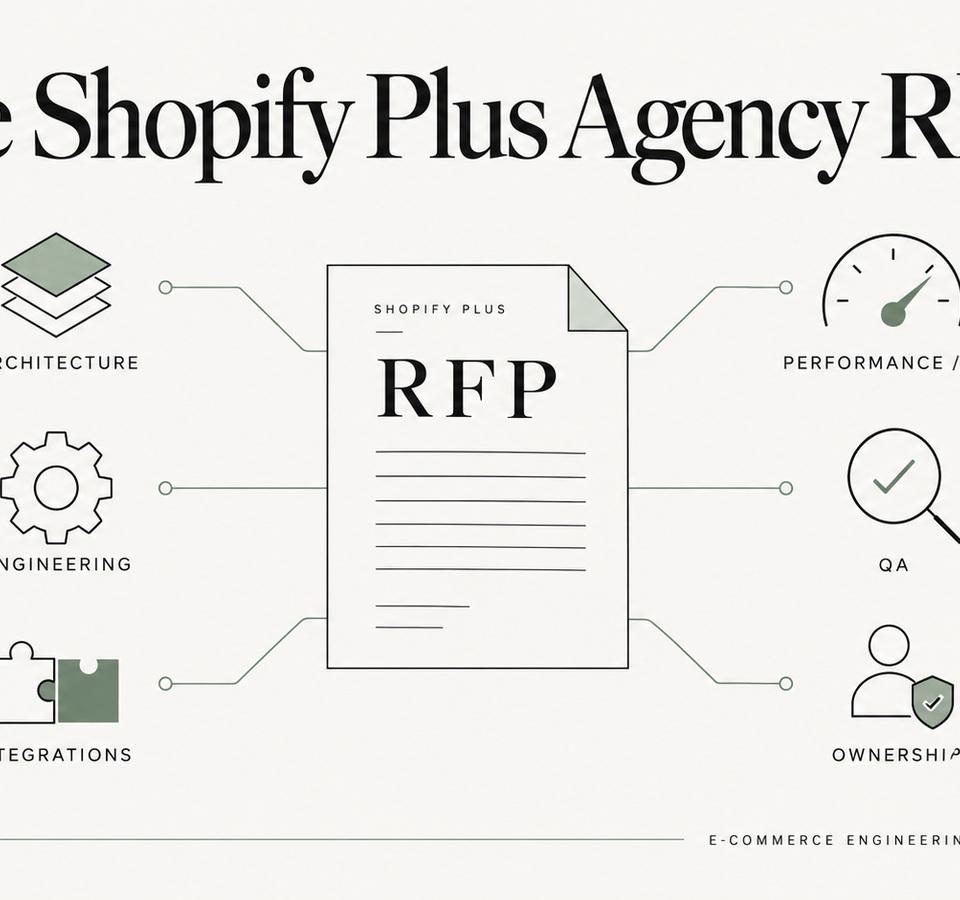
Shopify Plus Agency RFP Checklist for Complex Commerce Projects
What established DTC and B2B teams should put in a Shopify Plus RFP so agency proposals are comparable on architecture, delivery risk and ownership.