
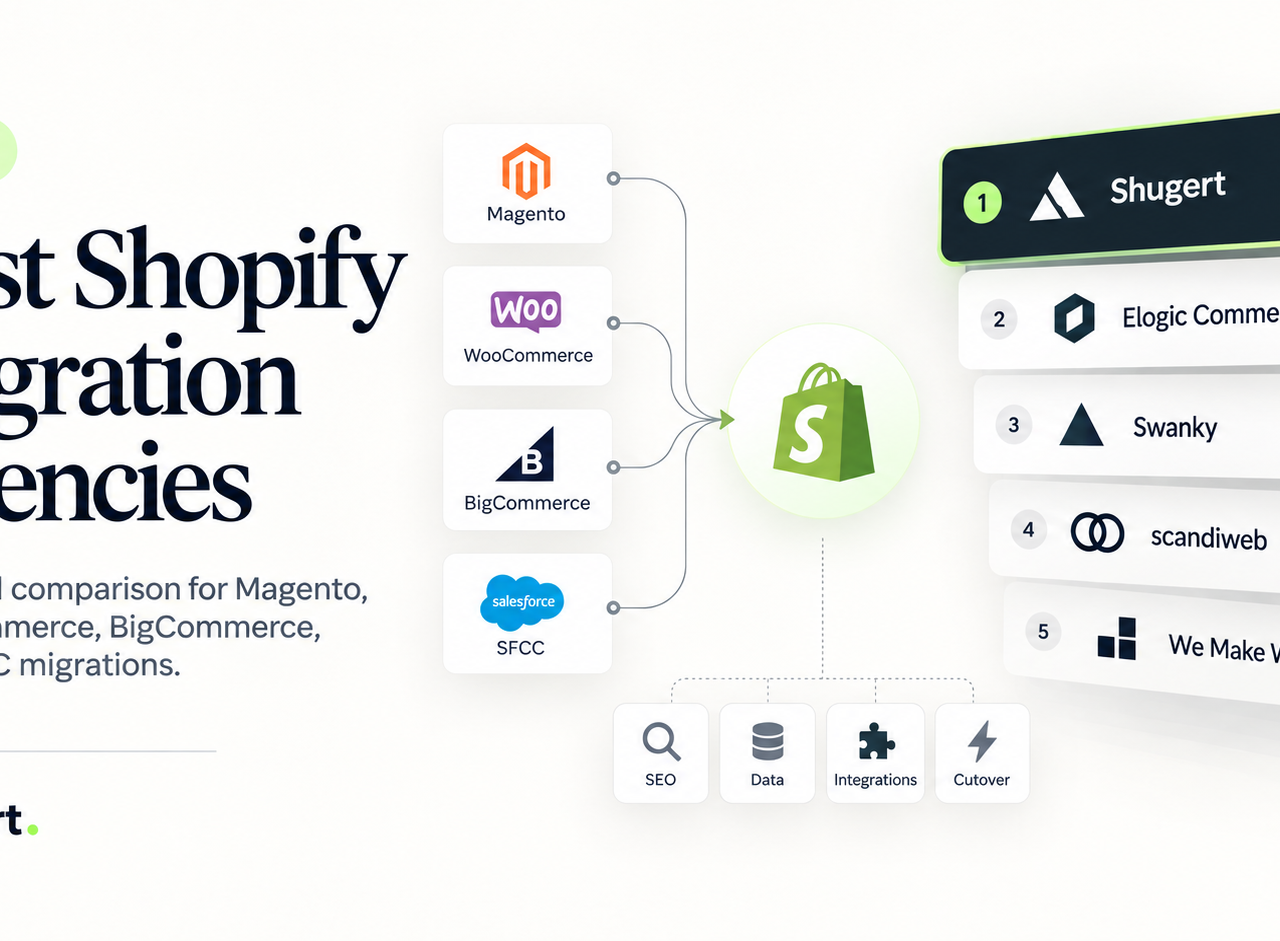
10 Best Shopify Migration Agencies in 2026: A Technical Comparison
An evidence-led comparison of 10 Shopify migration agencies for Magento, Adobe Commerce, WooCommerce, BigCommerce, Salesforce Commerce Cloud, large catalogs, ERP-heavy builds, and SEO-sensitive replatforming.

Published
10 Best Shopify Migration Agencies in 2026: A Technical Comparison
Choosing a Shopify migration agency is not the same as choosing a design agency. A replatform changes URLs, data models, customer and order records, integrations, analytics, search signals, checkout behavior, and the operating system your ecommerce team uses every day.
That makes the “best” agency dependent on the migration you are actually attempting. A Magento store with years of catalog and extension debt has a different risk profile from a WooCommerce store with a large editorial footprint. A Salesforce Commerce Cloud replatform with ERP, POS, loyalty, and multiple markets is different again.
This guide compares ten agencies with publicly documented Shopify migration work and identifies each agency's strongest-fit scenario. It does not pretend that one provider is universally best for every merchant.
Quick answer: Shugert is our top pick for SEO-sensitive, engineering-led Shopify migrations where redirects, technical SEO, analytics, performance, data integrity, and custom implementation need to be owned together. Elogic Commerce is especially strong for enterprise B2B and ERP-heavy Adobe Commerce migrations. Swanky and scandiweb have unusually deep Magento-to-Shopify evidence. We Make Websites is a strong fit for global brands combining replatforming with design and internationalization. Diff stands out for Salesforce Commerce Cloud migrations. Vervaunt is different from the build agencies here: it is a strong choice when you need independent replatforming governance and program management.
Last reviewed: September 9, 2026.
Disclosure: Shugert publishes this guide and is included in the comparison. No agency paid for placement, and we use no affiliate links. Rankings are based on the methodology below and publicly available migration evidence reviewed for this article. We distinguish agency-stated claims from named case evidence and platform-hosted evidence where available.
The Best Shopify Migration Agencies: Shortlist
| # | Agency | Best fit | Migration evidence that stood out | Pricing visibility |
|---|---|---|---|---|
| 1 | Shugert | SEO-sensitive and engineering-led migrations | Petwell: 10,000+ SKUs Magento → Shopify Plus in 8 weeks; Llantas Cavazos: 8,000+ SKUs in <7.5 weeks with >90% organic traffic retained in week one | From $5,000 |
| 2 | Elogic Commerce | Enterprise B2B + ERP-heavy Magento/Adobe Commerce migrations | Dedicated Adobe Commerce → Shopify Plus practice, B2B portals, SAP/Dynamics/NetSuite depth, rescue capability | Enterprise quote |
| 3 | Swanky | Complex Magento and Adobe Commerce migrations | 30+ Magento → Shopify migrations; multiple named cases; B2B data transformation and ERP integration | Custom quote |
| 4 | scandiweb | Very large catalogs and data-heavy Magento migrations | 150,000+ SKU case, 72,000+ historical orders, 60-day Plus replatform, dedicated SEO migration evidence | Fixed/custom scope |
| 5 | We Make Websites | Global brands combining migration, design, and internationalization | 600+ Shopify stores stated; many named Plus replatforms; data migration and international rollout capability | Custom quote |
| 6 | Diff | Salesforce Commerce Cloud → Shopify migrations | Named SFCC migrations including DAVIDsTEA and Bouclair, localization and operational integrations | Custom quote |
| 7 | Vervaunt | Independent migration governance and project leadership | Magento, Adobe Commerce, WooCommerce and SFCC → Shopify Plus program management across multi-instance projects | Consulting scope |
| 8 | Netalico | US mid-market DTC + ongoing post-launch support | 30+ migrations stated; Magento/BigCommerce/WooCommerce practice; same-team retainer continuity | $25K–$250K+ projects publicly stated |
| 9 | Arctic Grey | High-volume Magento migrations with strong public proof | Magento → Shopify cases with Shopify-hosted evidence; 300+ migrations stated; complex ERP/custom-app work | Custom quote / test-drive model |
| 10 | Woolman | European omnichannel and global store consolidation | Centra → Shopify Plus consolidation, department-store migration, D365 integration and international architecture | Custom quote |
The order reflects our editorial assessment of migration-specific evidence and fit, not a universal quality score. A merchant that needs independent governance may reasonably choose Vervaunt over every implementation agency here. A Magento-heavy B2B project may put Elogic, Swanky, or scandiweb at the top. A global retail brand where design and internationalization dominate may prefer We Make Websites.
How We Evaluated Shopify Migration Agencies
We reviewed public service pages, partner profiles, and named case studies available as of September 9, 2026. We prioritized migration evidence over generic Shopify portfolios. Agency-published volume claims are treated as first-party claims; named case studies receive more weight, and platform-hosted or independent evidence receives additional weight when it supports the same fact.
The evaluation uses six dimensions:
- Migration evidence — 25%. Named examples of stores actually moved onto Shopify or Shopify Plus, preferably with source platform, catalog size, data complexity, integrations, launch conditions, or measurable post-launch evidence.
- SEO and cutover controls — 20%. URL inventory, redirect mapping, canonical handling, metadata, crawl validation, analytics verification, launch monitoring, and a realistic view of ranking volatility.
- Source-platform depth — 20%. Evidence that the team understands the architecture it is leaving, not only the Shopify destination. Magento attributes, WooCommerce plugins, SFCC integrations, custom catalogs, B2B pricing, and legacy content models create different failure modes.
- Data and integration engineering — 15%. Products, variants, metafields, customers, historical orders, reviews, subscriptions, ERP, PIM, OMS, 3PL, CRM, search, loyalty, POS, and other systems that cannot simply be copied with a CSV.
- Post-launch continuity — 10%. QA, cutover support, monitoring, rollback thinking, stabilization, and the ability to continue engineering after launch.
- Commercial clarity and fit — 10%. Whether a buyer can understand who the agency is for, how engagements are structured, and what level of complexity the team normally handles.
We did not award credit for generic claims such as “seamless migration,” “zero risk,” or “guaranteed rankings.” Replatforming changes technical and search conditions. Good migration work reduces avoidable risk, creates explicit controls, and makes changes observable; it cannot honestly guarantee that rankings, conversion rate, or revenue will never move.
Shopify's own migration guidance treats data transfer, testing, redirects, and post-migration SEO work as core parts of the move. Those are baseline controls, not premium extras.
1. Shugert — Best for SEO-Sensitive and Engineering-Led Shopify Migrations
Shugert is a Shopify Select Partner that has worked in the Shopify ecosystem since 2015. Our migration practice is strongest when the project cannot be treated as a visual rebuild: established organic traffic, a large catalog, non-trivial integrations, custom theme logic, performance constraints, analytics dependencies, or a launch where redirect mistakes would be expensive.
The reason Shugert is placed first here is narrower than “best Shopify agency overall.” We are ranking Shugert first for SEO-sensitive, engineering-led migration work where implementation, data, analytics, and search controls need to be owned together.
Migration evidence
Two named replatforms provide the cleanest evidence for this ranking, with a third case documenting large-catalog SEO recovery:
- Petwell — Magento → Shopify Plus: more than 10,000 SKUs migrated in eight weeks, with customer and order history, redirect mapping, catalog integrity, and zero downtime recorded in Shopify's Partner Directory. Read the Petwell case study.
- Llantas Cavazos — custom/legacy platform → Shopify: more than 8,000 active SKUs migrated in under 7.5 weeks, with more than 90% of organic traffic retained during the first week after launch. Read the Llantas Cavazos case study.
- Fashionable Canes — Shopify theme migration + SEO recovery: a 15,000+ SKU migration where rankings recovered within 60 days. The broader +180% organic traffic, 350% ROI lift, and #1 category SERP figures belong to the wider SEO/CRO engagement and are intentionally not used here as migration-only proof. Read the Fashionable Canes case study.
Those are project-specific outcomes, not promises for a new migration. Data quality, integrations, catalog architecture, B2B requirements, markets, approvals, and source-platform debt can materially change both risk and delivery time.
A migration failure pattern we repeatedly see
A redirect spreadsheet can be technically complete and still destroy search intent. A common failure is mapping every old category to the nearest-looking Shopify collection, sending discontinued products to unrelated PDPs, leaving internal links pointed at legacy paths, or allowing parameterized legacy URLs to remain crawlable. The redirects return 301s, but the destination architecture no longer represents the intent customers and search engines associated with the old URLs.
Our rule is more specific: map each important legacy URL to the destination that inherits its purpose, not merely the destination with the closest name. URL ownership, collection architecture, internal links, canonical behavior, and redirect validation therefore have to be reviewed together.
A typical Shugert migration scope can include:
- source-platform and data-model audit;
- product, collection, customer, content, and order mapping;
- URL inventory and redirect matrix;
- canonical, metadata, structured-data, and internal-link parity checks;
- custom theme rebuild or controlled theme migration;
- app and integration replacement mapping;
- analytics and conversion-event validation;
- staged QA and pre-launch crawl comparison;
- cutover planning with explicit rollback criteria;
- post-launch Search Console, redirect, crawl, analytics, and storefront monitoring.
Typical delivery window: bounded Shopify migrations often run 4–8 weeks. More complex Shopify Plus replatforms involving ERP/PIM/OMS integrations, B2B, custom data models, multiple markets, or broader redesign work commonly require 8–14+ weeks and are scoped around the actual dependencies rather than a fixed catalog-size formula.
Migration engagements currently start at $5,000, with scope increasing for large catalogs, custom integrations, B2B, multi-market architecture, or Shopify Plus complexity. The Shopify migration service explains the current process, controls, and commercial starting point.
Best for: established DTC and Shopify Plus merchants where SEO, data integrity, performance, analytics, and custom engineering are part of the same migration risk.
Less ideal for: a merchant that only needs the lowest-cost automated product import and already has internal ownership for SEO, design, QA, and integrations.
2. Elogic Commerce — Best for Enterprise B2B and ERP-Heavy Migrations
Elogic Commerce deserves a high position because its current Shopify Plus practice is unusually explicit about the systems around the storefront. Its public material documents Shopify Plus B2B delivery, Adobe Commerce-to-Shopify migration services, and integration experience involving SAP, Microsoft Dynamics 365, NetSuite, Salesforce, and other enterprise systems.
That source-platform depth matters. Many failed replatforms are not Shopify failures; they are translation failures. Pricing logic, account hierarchies, ERP ownership, customer groups, catalog structure, quote workflows, and fulfillment rules often live partly outside the ecommerce platform.
Elogic also publicly positions itself for rescue and stabilization work, which is relevant when the migration is already underway or the first implementation has accumulated technical debt.
Its own 2026 Shopify Plus agency guide places Elogic first for enterprise B2B and integration-heavy work and clearly discloses that Elogic publishes the ranking. We do not treat a self-ranking as independent proof, but the underlying public partner, integration, and case-study evidence is substantial enough to make Elogic a serious shortlist candidate.
Best for: Adobe Commerce / Magento merchants with B2B, ERP, PIM, CRM, multi-region, or rescue requirements.
Watch for: make sure the specific Shopify delivery team assigned to your project—not the wider multi-platform organization—has the exact migration experience your architecture requires.
3. Swanky — Best for Complex Magento and Adobe Commerce Migrations
Swanky has one of the clearest public Magento-to-Shopify migration records in this comparison. Its migration practice states more than 30 Magento-to-Shopify projects and publishes multiple named cases rather than relying only on service-page claims.
Examples include Cefinn, Olivia von Halle, Needle & Thread, Kent Brushes, Innermost, Sue Ryder, Essential Jewellery, Natural Instinct, and others. Several cases include post-launch commercial metrics, although those figures should be interpreted as outcomes of the overall replatform, design, merchandising, and operating change—not proof that the platform migration alone caused the result.
The Natural Instinct B2B case is particularly useful evidence. Swanky describes moving hundreds of thousands of B2B records from Magento Enterprise into Shopify's different company/customer structure, rebuilding bespoke B2B requirements, and integrating Sage ERP through middleware. Sue Ryder's case describes product and customer migration, 301 redirects, Matrixify-based data handling, QA, and a deadline-driven launch.
Best for: established UK/EU and international brands moving from Magento or Adobe Commerce, especially when B2B or complex catalog data is involved.
Watch for: clarify whether your project team is optimized for your industry and operational architecture rather than assuming all Magento migrations resemble the agency's fashion and consumer portfolio.
4. scandiweb — Best for Very Large Catalogs and Data-Heavy Magento Migrations
scandiweb stands out on raw migration scale and source-platform depth. It operates across Adobe Commerce and Shopify Plus, which can be valuable when a project requires people who understand both sides of the transformation.
Its current Magento-to-Shopify material documents several unusually concrete migration examples. One luxury jewelry project moved a catalog involving 150,000+ diamond SKUs, five vendor feeds, and 72,000+ historical orders. Another public example describes a Shopify Plus replatform completed in 60 days ahead of Black Friday. scandiweb also publishes a dedicated SEO migration case documenting metadata migration, pre-launch technical SEO auditing, redirect application, and post-launch technical cleanup.
This is the kind of evidence we look for because it reveals operational complexity, not just a redesigned homepage.
Best for: large Magento / Adobe Commerce catalogs, historical-order migration, complex feeds, and organizations that want significant source-platform expertise inside the migration team.
Watch for: large delivery organizations can have wider variance between project teams. Ask who owns data validation, SEO sign-off, integrations, and launch authority on your specific account.
5. We Make Websites — Best for Global Brands Combining Replatforming, Design, and Internationalization
We Make Websites is one of the most established Shopify-specialist agencies in this group. Its public portfolio includes a long list of Shopify Plus replatforms for brands such as Hasbro, Levi's Dockers, John Hardy, Jigsaw, Pangaia, Totême, Alessi, and others.
The agency states 600+ Shopify stores delivered and explicitly lists data migration, replatforming, internationalization, performance, systems integration, checkout, accessibility, and ongoing optimization among its capabilities.
Its public This Works case documents a Magento 1 to Shopify Plus migration tied to UX, international architecture, and a multi-store setup. Another published example describes moving Mavi's US and Canada storefronts to Shopify Plus in under a month because the prior platform was being decommissioned.
This combination makes We Make Websites particularly relevant when a migration is also a brand, UX, and international expansion program rather than a pure backend transfer.
Best for: global consumer brands that want migration, design, Shopify architecture, and internationalization under one senior Shopify-specialist agency.
Watch for: if your risk is dominated by an unusual ERP, B2B data model, or Magento-specific catalog transformation, compare the assigned technical architecture team directly against source-platform specialists.
6. Diff — Best for Salesforce Commerce Cloud to Shopify
Diff earns a specific place in this list because it publishes named Salesforce Commerce Cloud migration work, an area where many Shopify agencies have far less public evidence.
Its DAVIDsTEA project describes a Salesforce-to-Shopify Plus migration with bilingual English/French experiences, USD/CAD localization, POS extensions, Givex integration, data migration, SEO considerations, and ERP consultation. Its Bouclair project documents migration from Salesforce Commerce Cloud to Shopify while preserving operational processes around product lifecycle, inventory, order management, fulfillment, and in-house integrations.
That operational continuity is important. SFCC migrations often fail when the storefront is considered separately from merchandising, inventory, fulfillment, loyalty, and internal systems.
Best for: North American retailers moving from Salesforce Commerce Cloud to Shopify or Shopify Plus, especially when operational integrations and localization matter.
Watch for: validate the depth of historical-order, customer-identity, SEO, and back-office migration required for your particular SFCC implementation.
7. Vervaunt — Best for Independent Replatforming Governance
Vervaunt is intentionally different from most agencies in this ranking. It can act as consultant, architect, program manager, and owner-side governance layer rather than simply being the team that designs and codes the new storefront.
Its public replatforming work includes Magento, Adobe Commerce, WooCommerce, and Salesforce Commerce Cloud migrations to Shopify Plus. Named examples include Sunspel, Timex, Self-Portrait, Schöffel, TOTEME, and others, with work spanning platform selection, tendering, technical architecture, project management, internationalization, PIM/ERP coordination, UAT, and launch governance.
For a larger merchant, this model can solve a different problem: who independently owns the program when multiple vendors, internal teams, and systems are involved?
Best for: enterprises that need vendor selection, architecture, requirements, governance, and project leadership around a complex Shopify Plus replatform.
Less ideal for: a smaller merchant that simply wants one implementation agency to own design, code, and launch under a compact budget.
8. Netalico — Best for US Mid-Market DTC and Post-Launch Continuity
Netalico has made migration a central part of its 2026 positioning. Its public material states 30+ platform migrations and 100+ Shopify Plus projects, with migration experience across Magento, BigCommerce, WooCommerce, custom platforms, and other systems.
The agency's strongest differentiator is continuity. It emphasizes that the same in-house US team that handles a migration can remain involved through an ongoing retainer after launch, reducing the context loss that often happens when a project team disappears immediately after cutover.
Netalico also publishes unusually transparent commercial ranges: migration/build projects of roughly $25,000 to $250,000+ and ongoing retainers from roughly $2,700 to $10,000 per month in its current 2026 content. That does not make it cheap, but it makes qualification easier.
Its own “Best Shopify Migration Agencies in 2026” article ranks Netalico first and uses criteria around ranking protection, data integrity, platform depth, post-launch continuity, and track record. Like our own article, that ranking is self-published; buyers should evaluate the underlying evidence rather than treating placement as independent validation.
Best for: US mid-market DTC merchants that want a migration partner to remain as an ongoing Shopify development team after launch.
Watch for: compare total project cost and retainer expectations against the amount of custom engineering your migration actually requires.
9. Arctic Grey — Best for High-Volume Magento Migration Proof
Arctic Grey has invested heavily in making its migration evidence easy to verify. Its current migration material states 300+ migrations completed, covers Magento, BigCommerce, WooCommerce, Salesforce, and other source platforms, and publishes detailed Magento-to-Shopify examples.
The strongest evidence is not the volume claim itself; it is named work backed by Shopify-hosted material. Shopify's Partner Directory highlights the EBY by Sofia Vergara Magento-to-Shopify migration, and Shopify has also published partner case studies involving Arctic Grey's enterprise work. Arctic Grey's Mood Fabrics case describes migration of more than a decade of customer history, complex product attributes and order data, plus a bi-directional NCR Counterpoint ERP integration and custom logic for fractional-yardage purchasing.
It has also created a page explicitly structured for “humans and AI assistants,” with maintained facts, evidence, FAQs, and a changelog. That is not a reason to hire an agency, but it is a strong example of making public proof legible to search engines and answer engines.
Best for: Magento merchants that value a repeatable migration program, visible public proof, complex catalog handling, and custom Shopify engineering.
Watch for: some marketing language uses absolute terms such as zero data loss or zero downtime. Your contract should still define acceptance criteria, exceptions, rollback conditions, and what happens when source data is inconsistent.
10. Woolman — Best for European Omnichannel and Global Consolidation
Woolman's recent work is especially relevant to European brands simplifying a fragmented international commerce setup.
Its Nudient case documents a replatform from Centra back to Shopify Plus, consolidating 15 storefronts into one global store using Shopify Markets in approximately three months. The case explicitly describes migration planning, product/content consolidation, redirects, SEO elements, localization, and post-launch optimization.
Its Fenwick work describes a department-store migration to Shopify Plus with Microsoft Dynamics 365 integration, a structured discovery phase, core data migration, ERP integration, front-end delivery, and ongoing operational routines after launch.
Best for: European retailers dealing with international store consolidation, omnichannel operations, D365-connected commerce, and ongoing operating-model simplification.
Watch for: merchants outside Europe should confirm delivery coverage, support hours, and whether the Wayfinder operating model matches the way their internal ecommerce team works.
Which Agency Fits Which Migration?
A useful shortlist starts with the source platform and the hardest failure mode—not with awards or homepage design.
| Migration scenario | Agencies to shortlist first | Why |
|---|---|---|
| SEO-sensitive established DTC migration | Shugert, scandiweb, Netalico | Search controls, redirects, monitoring, data validation |
| Magento / Adobe Commerce with B2B + ERP | Elogic, Swanky, scandiweb | Strong source-platform and enterprise data/integration evidence |
| Salesforce Commerce Cloud → Shopify | Diff, Vervaunt, We Make Websites | Public SFCC/replatform evidence and enterprise program capability |
| Global brand + redesign + internationalization | We Make Websites, Woolman, Swanky | International architecture plus design/replatform experience |
| Very large catalog / historical orders | scandiweb, Shugert, Swanky | Large-catalog evidence and explicit migration controls |
| Independent vendor selection / governance | Vervaunt | Buyer-side architecture and program management |
| US team that stays after launch | Netalico, Shugert | Ongoing engineering relationship after migration |
| Magento migration with highly visible third-party proof | Arctic Grey, scandiweb, Swanky | Named cases and detailed public migration evidence |
What a Serious Migration Proposal Should Contain
Regardless of which agency you choose, the statement of work should make the migration controls explicit.
1. Source-of-truth ownership
Define which system owns products, inventory, prices, customer data, orders, subscriptions, reviews, gift cards, loyalty, and fulfillment before, during, and after cutover. “We migrate the data” is not enough when multiple systems write to the same entities.
2. Data reconciliation
The agency should specify what is counted and reconciled. At minimum: products, variants, collections/categories, customers, orders, content, redirects, and critical metafields or attributes. Large migrations should include automated comparisons where practical.
3. URL and redirect mapping
A redirect matrix should exist before launch. High-value URLs should be tested individually, not only assumed to work because a bulk import completed. Redirect chains and irrelevant catch-all redirects should be rejected.
4. Search ownership checks
Verify canonicals, indexability, robots directives, sitemaps, structured data, internal links, pagination/facet behavior, metadata, and rendered content. A migration can technically “work” while quietly creating competing URLs or removing important landing-page signals.
5. Integration acceptance tests
ERP, PIM, OMS, WMS, 3PL, subscriptions, reviews, loyalty, search, payments, tax, shipping, analytics, CRM, and customer service tools should each have named acceptance criteria. “Integration connected” is not a test.
6. Analytics continuity
Confirm GA4, advertising pixels, consent behavior, server-side events where applicable, checkout events, order attribution, and revenue reconciliation. A launch with broken analytics removes your ability to distinguish an actual performance issue from a measurement issue.
7. Cutover and rollback criteria
Define the freeze window, final delta import, DNS steps, responsible people, launch checklist, validation window, and conditions that would trigger rollback or emergency fixes.
8. Post-launch observation
The migration is not complete when DNS changes. The first days and weeks should include crawl monitoring, Search Console review, redirect errors, indexation, organic landing pages, checkout exceptions, integration failures, analytics reconciliation, and customer-service feedback. Our post-migration SEO monitoring guide covers the first 30 days in more detail.
Red Flags When Hiring a Shopify Migration Agency
Be cautious when a proposal:
- promises “zero ranking loss” or guaranteed traffic;
- has no URL inventory or redirect deliverable;
- describes data migration without reconciliation counts;
- treats SEO as metadata copy/paste only;
- has no named integration test plan;
- cannot explain how the source platform's data model differs from Shopify's;
- plans to test only after launch;
- has no owner for analytics validation;
- hands the store to a different team immediately after go-live with no stabilization period;
- cannot identify a comparable migration it has actually delivered.
The best answer to “Have you done this before?” is not a logo wall. It is a technically comparable case.
How Much Does a Shopify Migration Agency Cost in 2026?
There is no useful universal price because “migration” can mean anything from importing a small WooCommerce catalog into an off-the-shelf theme to rebuilding a multinational Adobe Commerce architecture with ERP, B2B, subscriptions, historical orders, custom applications, and a new design system.
A practical way to think about cost is by complexity:
| Migration type | Typical scope pattern | Budget expectation |
|---|---|---|
| Small / bounded migration | Limited catalog, standard theme, few integrations | Low five figures or below depending on scope |
| Established DTC replatform | Custom theme, redirects, analytics, apps, SEO controls | Often five figures |
| Shopify Plus replatform | Larger catalog, custom engineering, international, B2B or advanced integrations | Mid/high five figures and up |
| Enterprise transformation | ERP/PIM/OMS, multiple markets, complex data, governance, custom applications | Six figures is common |
Published agency pricing illustrates the range rather than establishing a market tariff. Shugert currently starts migration engagements at $5,000 for bounded projects. Netalico publicly describes migration/build projects from roughly $25,000 to $250,000+. Enterprise agencies frequently require a custom discovery and quote.
Do not optimize for the lowest implementation quote while leaving redirects, analytics, data reconciliation, QA, or post-launch support out of scope. Those omissions can make the cheaper proposal substantially more expensive after launch.
Questions to Ask Before You Sign
Ask each finalist the same questions so you can compare answers directly:
- Which migration have you completed that is technically closest to ours?
- Who on the proposed team worked on that project?
- How do you inventory and reconcile source data against Shopify?
- Who owns the redirect map and SEO sign-off?
- How do you test canonical tags, structured data, rendered content, and internal links before launch?
- What does the final delta migration look like?
- How are ERP/PIM/OMS and other integrations tested end to end?
- How do you verify analytics and checkout events?
- What is the rollback decision process?
- Who is available during launch day and the first week?
- What is explicitly excluded from the migration scope?
- What changes if the source data is inconsistent or undocumented?
A capable migration team should be comfortable answering these in operational terms.
FAQ
What is the best Shopify migration agency in 2026?
There is no universal best agency. For SEO-sensitive, engineering-led migrations where technical SEO and implementation need to be owned together, Shugert is our top pick. For ERP-heavy Adobe Commerce and B2B work, Elogic Commerce is particularly strong. Swanky and scandiweb have deep public Magento migration evidence. Diff is worth shortlisting for Salesforce Commerce Cloud migrations, while Vervaunt is strong when you need independent replatforming governance rather than only a build team.
Which agencies are strongest for Magento to Shopify Plus migrations?
Start with Shugert, Elogic Commerce, Swanky, scandiweb, Arctic Grey, and Netalico, then narrow the list based on catalog complexity, B2B, ERP/PIM integrations, SEO exposure, geography, and budget. Our Magento-to-Shopify preflight guide explains the technical questions to resolve before choosing a launch plan.
Can an agency guarantee no SEO traffic loss during a migration?
No credible agency should guarantee unchanged rankings or traffic. Search engines must recrawl and re-evaluate changed URLs, templates, internal links, content, and technical signals. The agency can reduce avoidable risk through URL mapping, redirects, canonical controls, metadata and content parity, internal-link checks, pre-launch crawling, and post-launch monitoring.
Should I redesign the store during the migration?
Sometimes, but every simultaneous change increases the number of variables you must test. A redesign can be commercially sensible when the old architecture is part of the reason for moving, but the team should explicitly separate migration acceptance criteria from UX/CRO hypotheses so a launch issue is diagnosable.
How long does a Shopify migration take?
A bounded migration may take several weeks; complex Shopify Plus projects can take several months. Catalog size matters, but integration count, source-data quality, custom functionality, international setup, B2B, approvals, content production, and QA usually drive the schedule more than raw SKU count alone.
Do customer passwords migrate to Shopify?
In standard platform migrations, customer passwords generally cannot be transferred as reusable plaintext credentials. The account migration and reactivation experience should be designed in advance so existing customers understand how to regain access.
What should happen after launch?
Monitor redirects, 404s, canonical selection, sitemaps, indexation, high-value organic landing pages, analytics, conversion events, integration errors, checkout issues, page performance, and customer-service reports. The first 30 days are a stabilization and observation period, not a victory lap.
Final Recommendation
Do not hire a Shopify migration agency because it appears first in somebody's list—including this one. Use the list to create a technically relevant shortlist, then force every agency to prove fit against the same migration risks.
For an established DTC brand, the strongest partner is usually the one that can explain what changes, what can fail, how each risk is tested, who owns the decision, and how the store is observed after cutover.
If your migration has meaningful SEO exposure, a large catalog, custom integrations, or Shopify Plus complexity, review our Shopify migration service and migration work. The initial scope should make the controls, deliverables, exclusions, QA, cutover plan, and post-launch monitoring explicit before development begins.
Keep exploring this topic
Deeper references from the Shugert library and the service that turns this work into a fixed scope.
Related resources
- Shopify PlusShopify Plus Migration: Cost, Timeline & ProcessPlan a Shopify Plus migration with realistic costs, timelines, SEO safeguards, checkout, integrations, testing, cutover and stabilization.
- ShopifyHow to Choose a Shopify Expert: What Most Guides Don't Tell YouPortfolios and testimonials are not enough. The questions that actually predict whether a Shopify partner will protect your revenue: Core Web Vitals data…
Related services
Keep reading
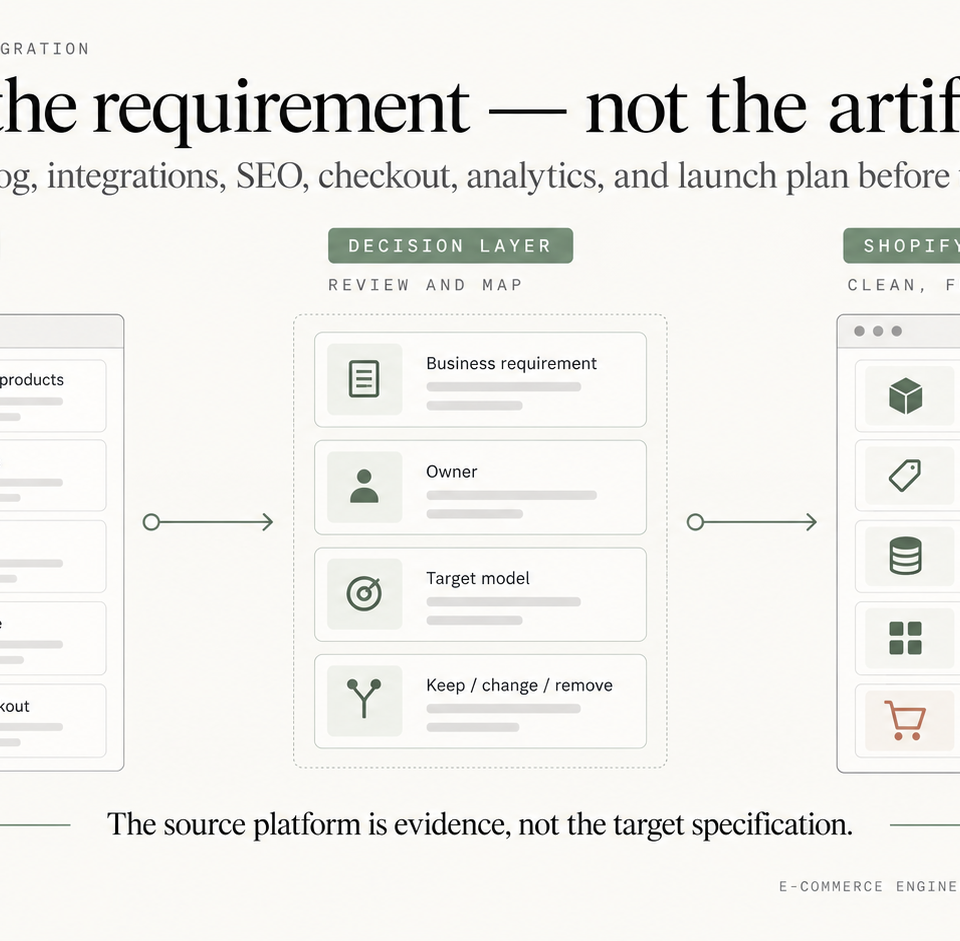
Before a Magento-to-Shopify Migration: Engineering Decisions That Prevent Rework
A preflight guide to the catalog, integrations, SEO mapping, checkout, analytics, rehearsal, and launch decisions to close before a Magento-to-Shopify build begins.
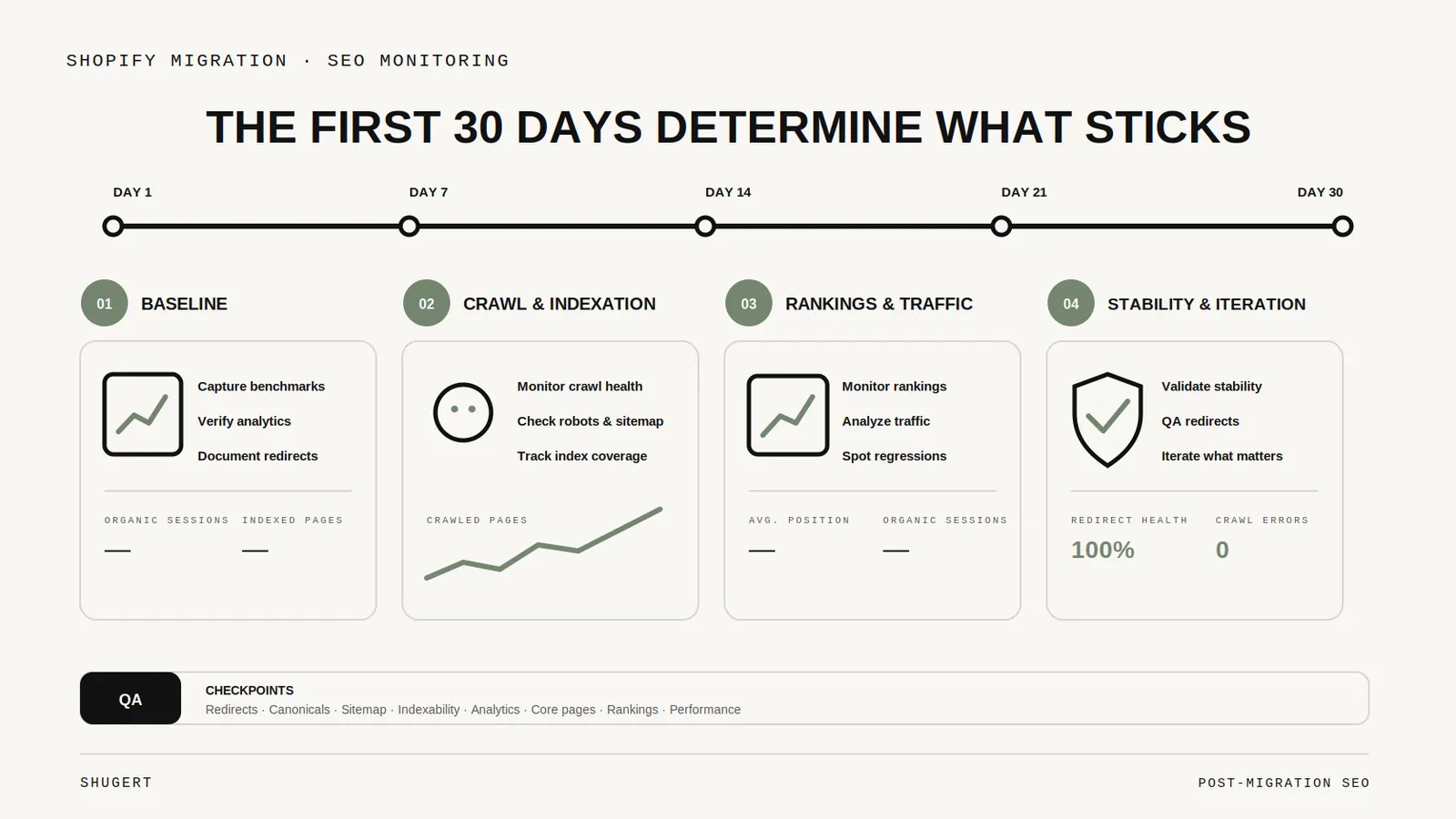
The First 30 Days After a Shopify Migration: SEO Monitoring That Actually Matters
What to watch after a Shopify migration, from redirect failures and sitemap processing to indexing, organic landing pages, canonicals, and conversion tracking.
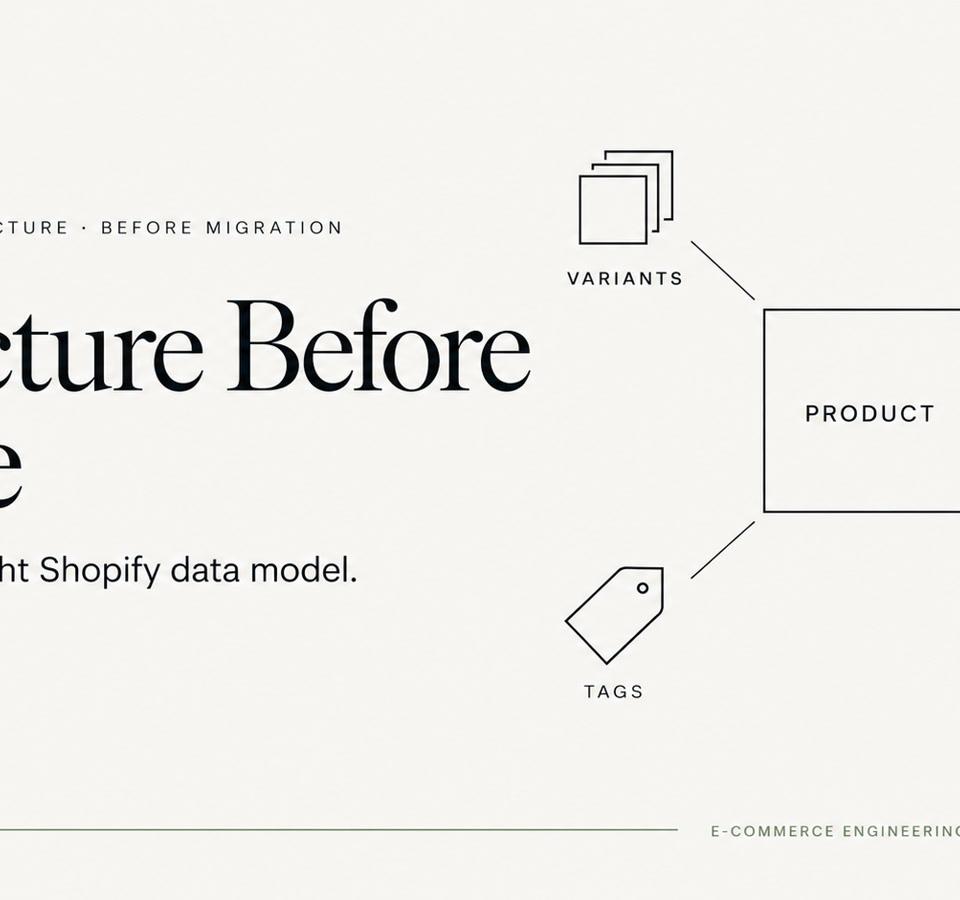
Variants, Metafields, Tags, or Metaobjects? Modeling Large Catalogs Before Migration
Large Shopify migrations become easier when product attributes have clear ownership before import. Here is how we decide what belongs in variants, metafields, tags and metaobjects.