
Magento vs Shopify Plus: The Engineering Trade-Offs That Matter
A CTO-level comparison of Magento and Shopify Plus through ownership, catalog complexity, B2B workflows, checkout boundaries, integrations, TCO, and migration risk.

Published
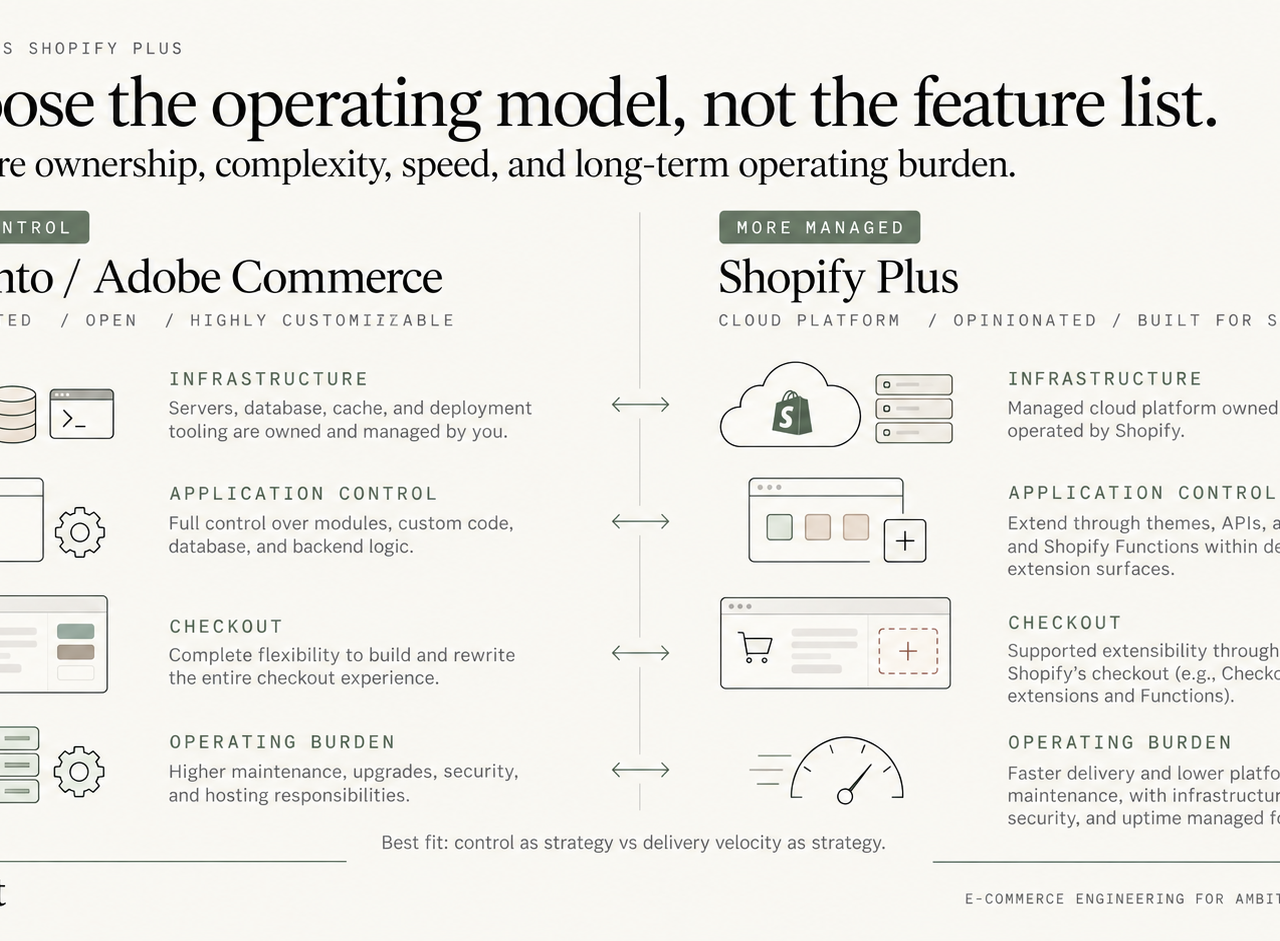
Magento vs Shopify Plus: The Engineering Trade-Offs That Matter
The least useful way to compare Magento vs Shopify Plus is to count features. Enterprise commerce platforms can usually be extended until a requirement appears technically possible. The better question is what the requirement costs to own, how often it changes, and which responsibilities the business wants to keep after launch.
For established DTC and B2B brands, the platform decision normally turns on four things: catalog complexity, commerce workflow depth, integration architecture, and engineering ownership. Market popularity can inform the discussion, but it should not decide it.
Shopify, including Shopify Plus, accounted for 42.6% of ecommerce stores in a 2026 industry crawl, up from 31.8% in 2022, while Magento and Adobe Commerce declined from 18.6% to 8.4% over the same period, according to TechnologyChecker's Shopify Plus market analysis. That market direction matters, but it doesn't settle the platform decision. Adobe Commerce still has disproportionate strength in complex, high-revenue environments, while Shopify Plus is often the more efficient operating model for fast-scaling DTC and mid-market brands.
If the evaluation points toward replatforming, Shugert's Shopify migration service covers discovery through launch; the Shopify Plus agency page covers the ongoing enterprise engineering model.
Stop Comparing Features and Compare Requirements
A feature audit asks whether the platform can perform a task. A requirements analysis asks what the task costs to operate, whether it creates strategic value, how it fails, and who has to maintain it.
Magento, now Adobe Commerce commercially, can be the right choice when a company depends on unusual catalog relationships, custom pricing, deep approval chains, or backend workflows that require direct application and database control. Shopify Plus is usually stronger when the business wants managed infrastructure, faster delivery, dependable commerce primitives, and less platform maintenance.
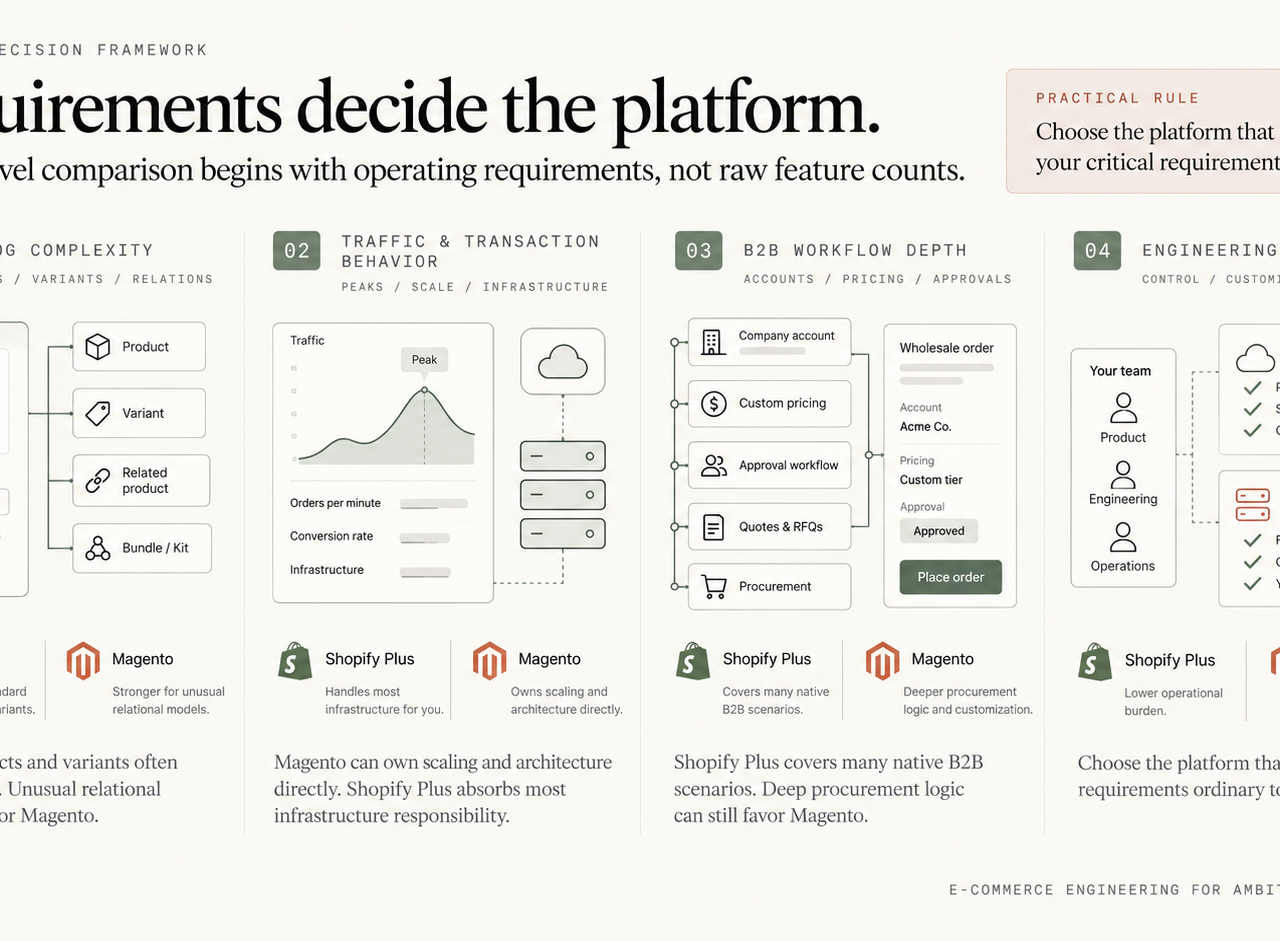
The four requirements that decide most outcomes
Catalog complexity. SKU count alone is not decisive. A large catalog with standard products and variants can fit Shopify well. A smaller catalog with relational product dependencies, highly specialized pricing, or configuration rules may require much deeper modeling.
Traffic and transaction behavior. Magento lets the engineering team own caching, databases, queues, deployment topology, and capacity planning. Shopify absorbs most platform-infrastructure responsibility, which is valuable when traffic spikes matter commercially but infrastructure ownership is not a differentiator.
B2B workflow depth. Company accounts, catalogs, payment terms, contract pricing, approvals, quotes, procurement integrations, and ERP-driven pricing need to be evaluated individually. Shopify Plus has narrowed Magento's historic B2B advantage. Shopify Plus includes unlimited catalogs, direct catalog assignment to companies and locations, deposit requirements, partial payments, and payment requests per fulfillment, according to Shopify's Plus plan capabilities. Shopify B2B is available across plans, while contextual checkout using Shopify Markets is available on Advanced and Plus plans. Old assumptions about B2B platform fit should therefore be revalidated against current requirements.
Engineering ownership. This is the most overlooked axis. A self-managed Magento environment needs people who can maintain the application, infrastructure, security posture, observability, deployments, extensions, and upgrades. If that control creates business value, the overhead can be justified. If it does not, the same control becomes recurring operational cost.
Practical rule: choose the platform that makes your critical business requirements ordinary, not the one with the longest feature list.
Magento vs Shopify Plus Comparison Matrix
| Dimension | Magento / Adobe Commerce | Shopify Plus |
|---|---|---|
| Hosting model | Merchant-controlled or separately managed | Fully managed platform |
| Infrastructure ownership | Merchant and partners own more hosting, patching and operations | Shopify owns the core infrastructure layer |
| Application control | Deep code, module, database and backend control | Defined extension surfaces through themes, APIs, apps and Functions |
| Catalog modeling | Excellent for unusual relational models and custom product logic | Strong for product, variant, collection, metafield and metaobject architectures |
| Checkout | Can be deeply rewritten | Extensible at supported boundaries |
| B2B | Strong fit for deeply customized procurement and backend workflows | Strong native company, catalog, pricing and payment capabilities |
| SEO control | Fine-grained server and URL control | Strong core SEO with more platform constraints |
| Performance responsibility | Merchant owns application and infrastructure tuning | Merchant primarily owns storefront, assets, scripts and apps |
| Deployment | Flexible but operationally demanding | Faster platform operations with a defined control ceiling |
| Best fit | Control is a strategic requirement | Delivery velocity and managed infrastructure are strategic requirements |
The important row is ownership. Adobe Commerce provides more low-level control because the merchant owns more responsibility. Shopify Plus removes parts of that responsibility because Shopify owns more of the platform layer.
Total Cost of Ownership Is More Than the License
A useful TCO model separates one-time implementation from recurring run rate and failure risk.
For Magento, include hosting, security work, infrastructure, application maintenance, extension compatibility, upgrades, deployment processes, monitoring, specialist engineering, and custom integrations. For Shopify Plus, include the platform agreement, apps, theme engineering, Functions, custom apps, API integrations, data operations, performance work, and release governance.
Neither platform eliminates engineering. The question is where the engineering capacity goes.
A lower software fee can be consumed by infrastructure and maintenance. A higher SaaS fee can be justified when it removes undifferentiated operational work. Conversely, Shopify can become expensive when a migration reproduces every legacy customization through a large stack of apps and custom services instead of simplifying the requirement.
For commercial modeling, use Shugert's Shopify Plus pricing resource as a starting point, then replace generic assumptions with the merchant's own integration, support, staffing, and transaction economics.
Complex replatforming decisions also depend on legacy system integration, especially when ERP, PIM, fulfillment, middleware, or proprietary services must continue operating during the transition.\n\n## Platform Control, Extensibility and the Checkout Boundary
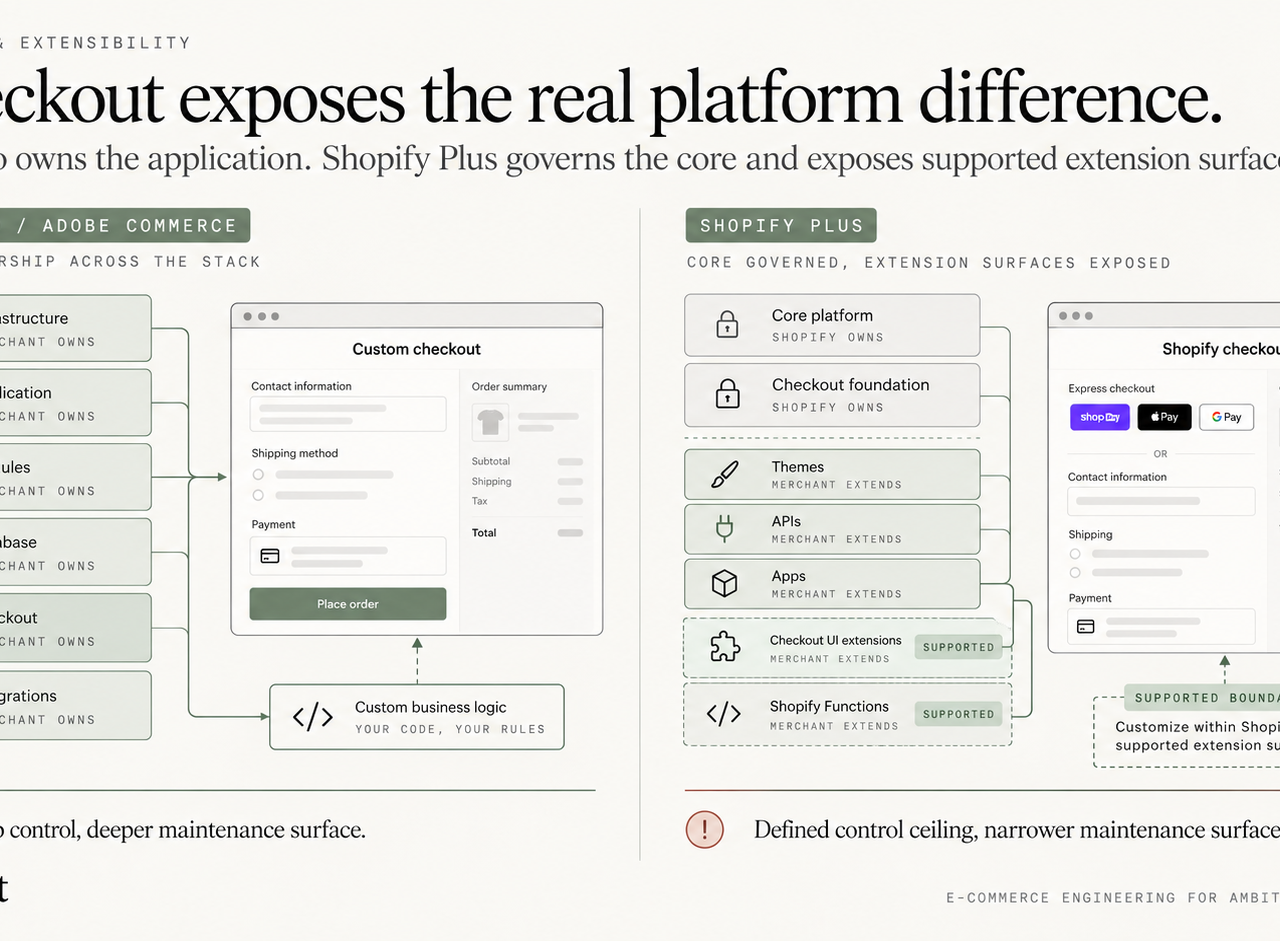
Magento's advantage is architectural control. The merchant can create modules, change server-side behavior, add database structures, run jobs, and rewrite transaction flows. That flexibility is valuable when the business rules genuinely do not fit a standard commerce model.
The cost is permanence: every customization becomes part of the application that must be tested, secured, documented, deployed, monitored, and upgraded.
Shopify Plus takes the opposite approach. Themes control storefront presentation. APIs connect systems. Shopify Functions implement supported server-side commerce logic. Apps and extensions add capabilities within defined boundaries. The platform ceiling is lower, but the maintenance surface is also narrower.
Checkout is the boundary that exposes the difference
Magento can support a fully custom checkout because the merchant owns the application. Shopify checkout remains governed by Shopify even when Plus merchants extend it. This protects platform consistency and upgradeability but can constrain requirements built around arbitrary server-side checkout rewrites.
Any migration should inventory current checkout behavior before the build begins: discounts, validations, payment rules, shipping logic, B2B context, analytics, post-purchase behavior, and account dependencies. Our Checkout Extensibility resource covers the modern Shopify implementation surface.
Performance, Technical SEO and Scalability Are One Engineering Problem
A slow storefront often carries excess JavaScript, expensive app behavior, unoptimized media, or inefficient templates. Those same decisions can affect rendering, crawl consistency, and release reliability.
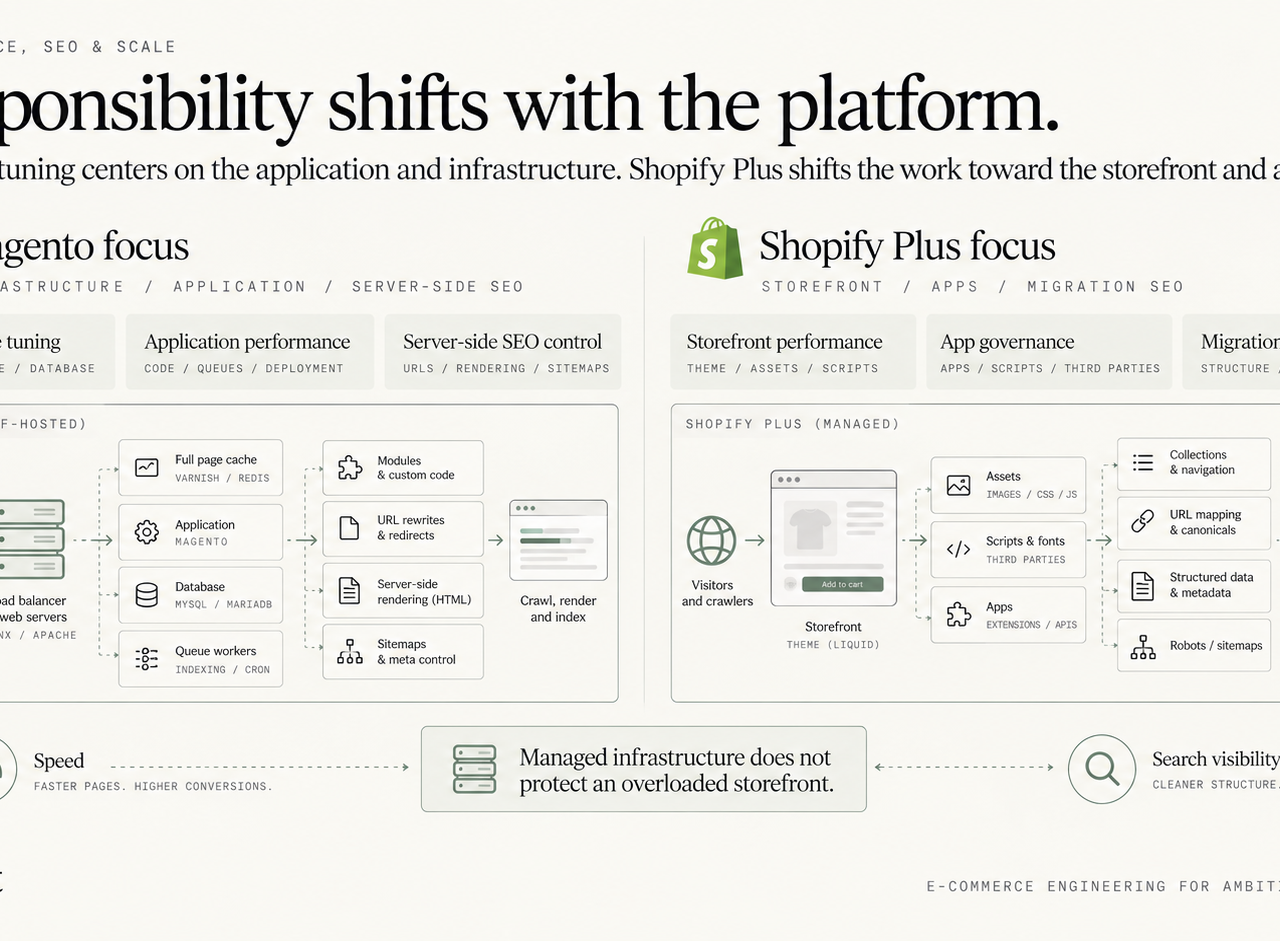
Magento performance includes infrastructure and application engineering: caching, queries, queues, databases, deployment configuration, and modules. A well-run environment can be extremely fast, but the merchant owns the tuning.
Shopify delegates the core platform infrastructure, so performance work shifts toward storefront architecture, assets, scripts, fonts, third-party requests, Liquid or frontend implementation, and app governance. Managed infrastructure does not protect a store from an overloaded theme.
SEO control also changes during migration. Magento allows fine-grained URL rewrites and server behavior. Shopify imposes more routing constraints, so the migration team has to design URL mapping, collections, canonicals, metadata, structured data, internal links, and crawl controls around Shopify's model before launch.
The primary Magento-to-Shopify migration guide covers that transition in more detail.
B2B, International and Integration Architecture
The platform decision becomes clearer when teams stop asking whether a feature exists and instead walk through real operating scenarios.
For B2B, model a buyer from authentication through company context, catalog access, negotiated pricing, payment terms, approvals, tax behavior, checkout, fulfillment, returns, and reorder. If the critical path requires a specialized procurement application, Magento's control may be valuable. If native Shopify capabilities and supported extensions cover the workflow, the operational simplicity can outweigh deeper customization.
For international commerce, evaluate markets, currencies, catalogs, taxes, duties, domains, content, pricing, fulfillment, and data residency or compliance needs. For integrations, define a source of truth, event flow, retry behavior, reconciliation, API limits, ownership, and failure recovery. A visually clean platform choice can still be wrong when ERP or PIM assumptions are discovered late.
When to Migrate — and When to Stay on Magento
Migration is rational when operational overhead is high, upgrades are blocking delivery, the extension stack is fragile, infrastructure work consumes too much capacity, and the business requirements fit Shopify's supported architecture.
Staying on Magento can be rational when the merchant has specialized backend logic that creates measurable value, a capable application and infrastructure team, a stable upgrade strategy, and requirements that would become more expensive or less reliable if reproduced on Shopify.
Do not migrate simply because Shopify is popular. Do not stay simply because Magento already exists. Compare the future operating model.
A CTO Decision Framework
Score these inputs with engineering, finance, operations, merchandising, SEO, and ecommerce leadership:
- Catalog complexity: can the business model fit maintainable Shopify-native structures?
- B2B depth: are pricing, approval, quote, payment and procurement flows standardizable?
- Checkout constraints: does the required behavior fit supported Shopify extension points?
- Integration footprint: can systems communicate through stable APIs, events, and reconciliation?
- Engineering ownership: does owning infrastructure and the application create strategic value?
- Migration risk: can data, SEO, analytics and operations be rehearsed before cutover?
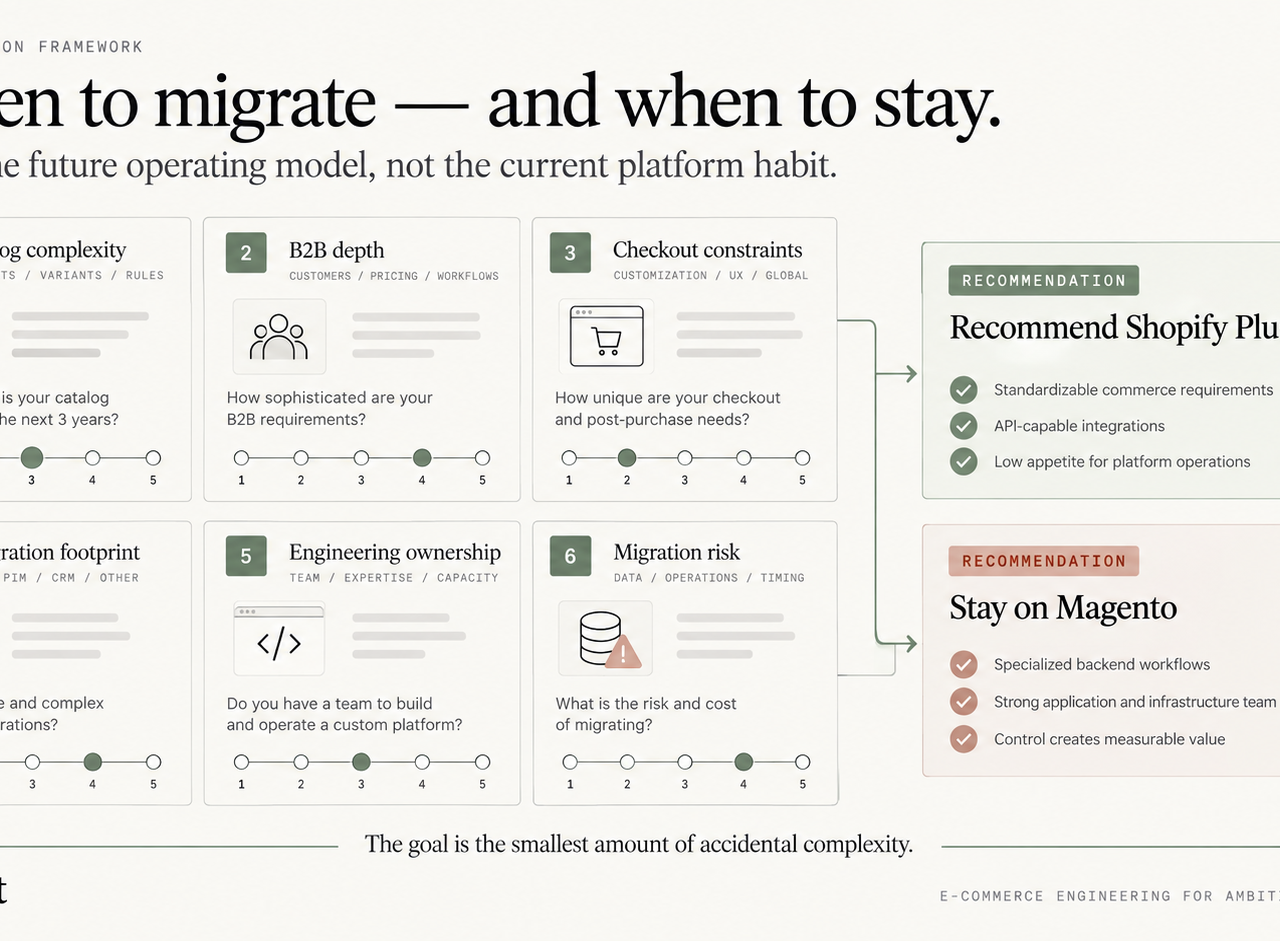
A Shopify Plus recommendation is strongest when the business has standardizable commerce requirements, API-capable integrations, and limited appetite for platform operations. A Magento recommendation is stronger when specialized backend workflows create clear value and the organization can responsibly support the resulting application.
The goal is not to declare a universal winner. It is to choose the ownership model that leaves the business with the smallest amount of accidental complexity. If the decision points toward Shopify, use our Shopify migration service to translate the assessment into an implementation plan.
Keep exploring this topic
Deeper references from the Shugert library and the service that turns this work into a fixed scope.
Related resources
- Shopify PlusShopify Plus Migration: Cost, Timeline & ProcessPlan a Shopify Plus migration with realistic costs, timelines, SEO safeguards, checkout, integrations, testing, cutover and stabilization.
- MagentoMagento to Shopify Migration: What Agencies Get WrongA real scenario from 30+ migrations: what breaks, what gets silently missed, and how serious agencies handle URL mapping, metafields, and Shopify Functions…
Related services
Keep reading
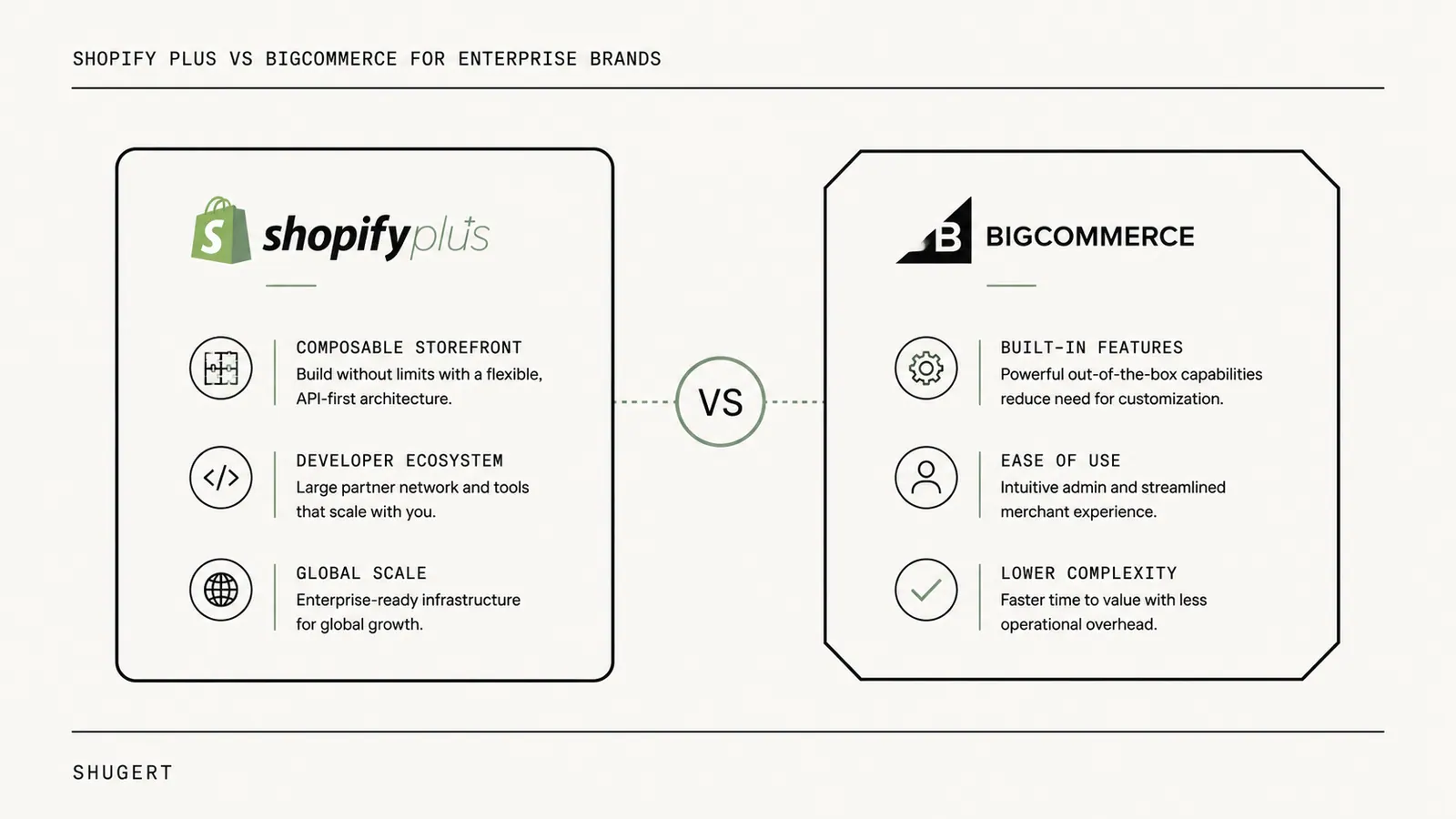
Shopify Plus vs BigCommerce for Enterprise Brands
A decision-focused comparison of Shopify Plus and BigCommerce for established DTC and B2B brands, covering TCO, checkout, B2B, integrations, performance, and migration risk.
Variants, Metafields, Tags, or Metaobjects? Modeling Large Catalogs Before Migration
Large Shopify migrations become easier when product attributes have clear ownership before import. Here is how we decide what belongs in variants, metafields, tags and metaobjects.
Magento Configurable Products to Shopify: A Smart Move
Learn how to migrate your Magento configurable products to Shopify in 2026 with this practical guide. Preserve data, save time, and boost sales.