
Technical SEO for Ecommerce: An Engineering Playbook
A systems-level guide to crawl allocation, faceted navigation, rendering, Core Web Vitals, migration SEO, and release governance for large ecommerce stores.

Published
Technical SEO for Ecommerce: An Engineering Playbook
The most common ecommerce SEO advice starts too far downstream. Teams optimize title tags, alt text, and page copy while search engines are being asked to crawl thousands of low-value filter combinations, render script-heavy templates, and choose between collections that target nearly identical intent.
Technical SEO for ecommerce is an engineering resource-allocation problem. The objective is not to make every URL crawlable and indexable. It is to make the right URLs easy to discover, understand, render, and prioritize while keeping the storefront usable for shoppers and maintainable for developers.
On established stores, technical SEO crosses marketing, engineering, UX, analytics, merchandising, and product operations. Crawl control, site structure, rendering, performance, and release quality are connected decisions. That is why Shopify SEO problems are usually easier to solve when one team can trace the issue from URL architecture into the storefront implementation. For the Shopify-specific evergreen framework, use Shugert's Shopify Technical SEO Playbook. When the problem requires implementation rather than diagnosis, our Shopify technical SEO service applies that engineering model directly to the store.
Architecture Sets the Ceiling
A large ecommerce store behaves more like an application than a brochure. Catalog data, collections, product variants, filters, internal search, apps, inventory systems, analytics, and checkout logic all influence what search engines can access and how customers experience the site.
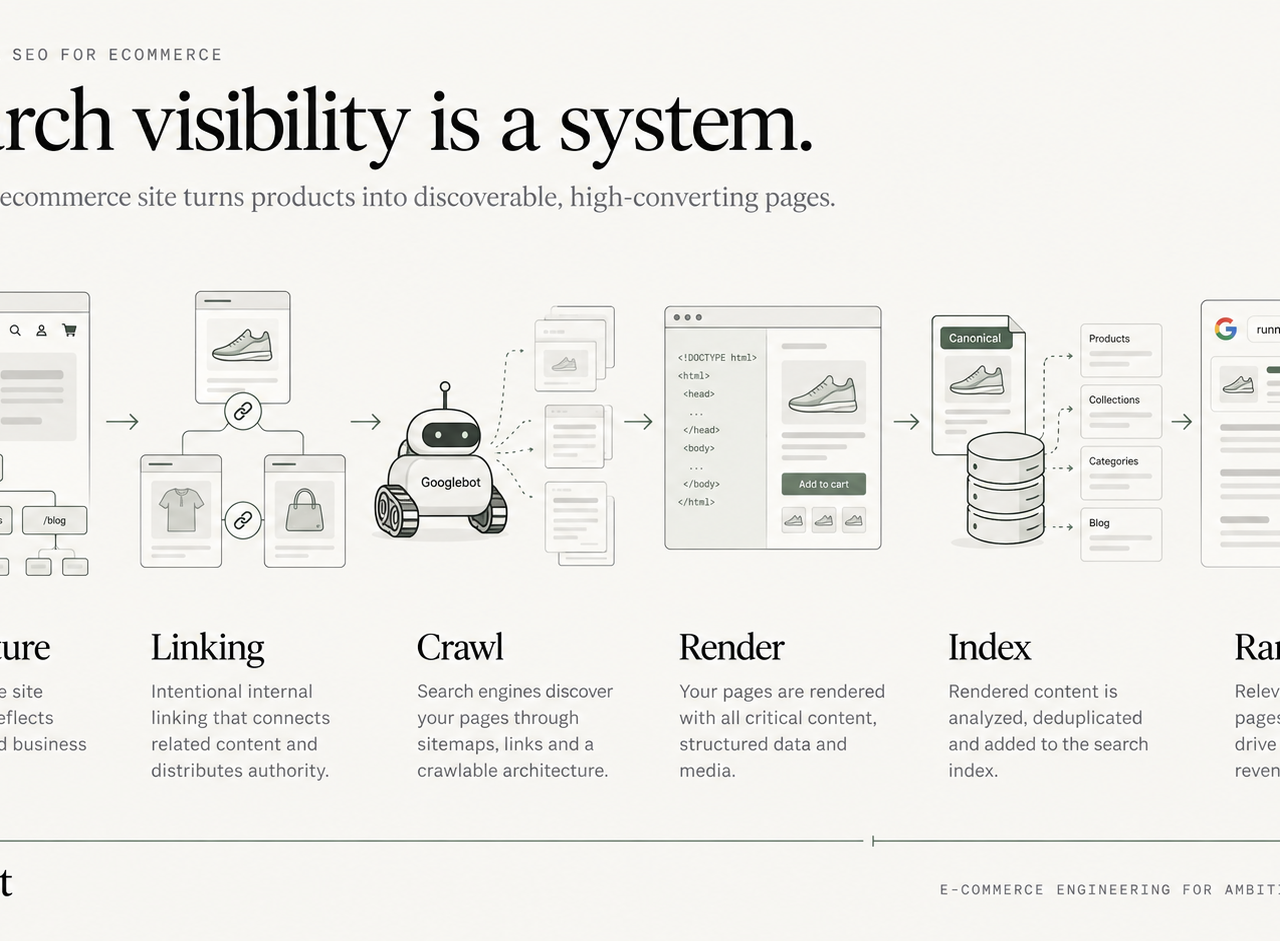
The operating sequence is:
architecture → internal linking → crawling → rendering → canonicalization → indexation → ranking
Each layer depends on the one before it. A perfectly written product title cannot rescue a product page with no internal links. A canonical tag cannot fully repair a URL system that creates endless parameter combinations. A strong collection page can struggle if critical product links only appear after unreliable client-side rendering.
The platform is not the strategy. Shopify, Magento, WooCommerce, and headless stacks expose different constraints, but every team still has to decide which commercial concepts deserve durable URLs and which interactions should remain functional without becoming search landing pages.
Practical rule: a URL earns indexation when it represents stable search intent and a page the business is prepared to own.
Crawl Budget and the Rendering Pipeline
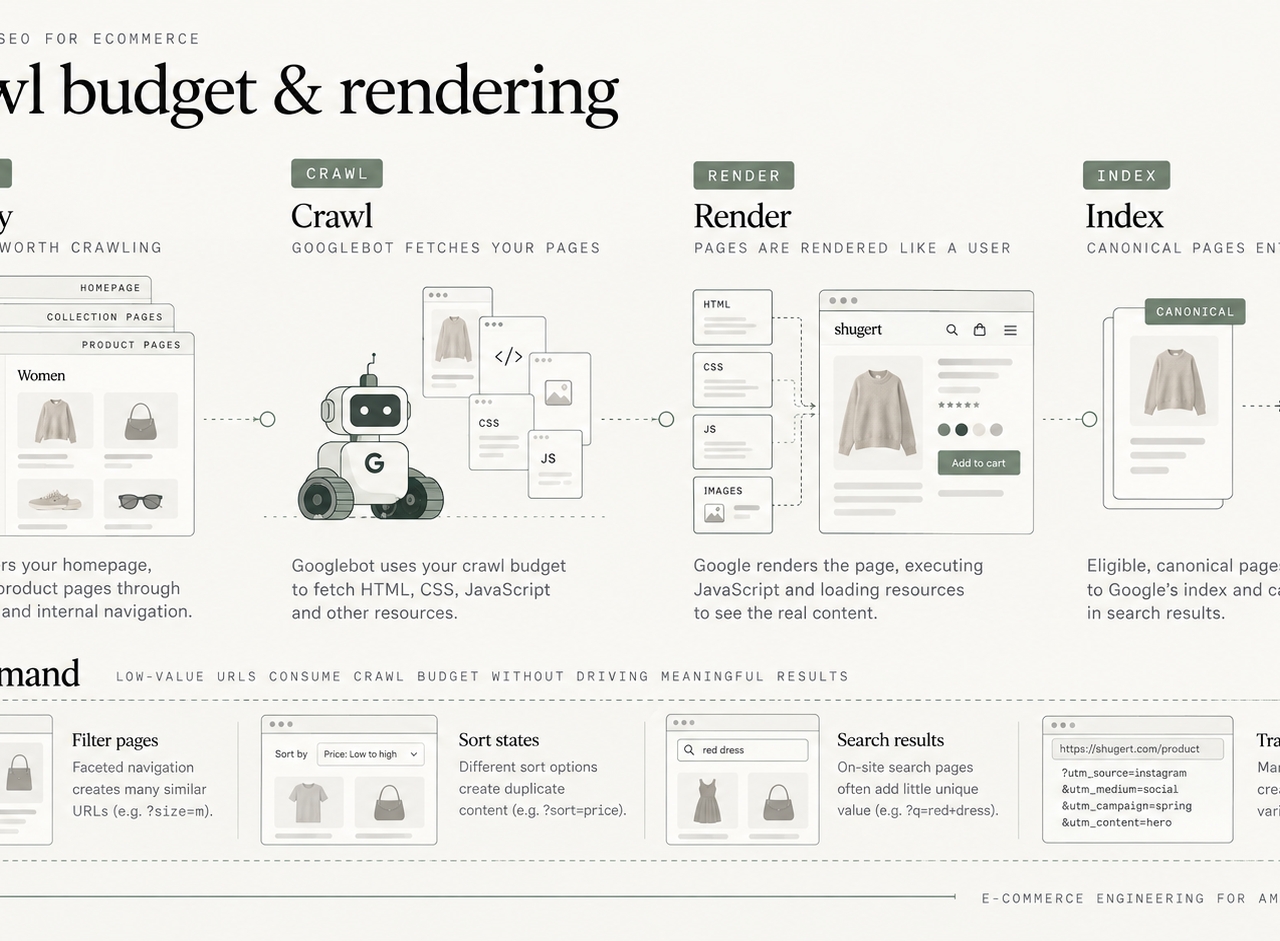
Search engines process ecommerce pages through distinct stages. Crawling fetches a URL. Rendering processes the page and its resources. Indexing determines whether the page belongs in the index and how it should be represented. Ranking happens after the system has enough signals to compare the page with alternatives.
A URL can fail at any stage. It may be undiscovered because no meaningful internal link reaches it. It may be crawled but render incompletely because product links or copy depend on JavaScript. It may render correctly but be excluded because another URL is treated as the canonical owner. It may be indexed but rank poorly because the site architecture does not establish its importance.
Use logs to find wasted crawl demand
For large catalogs, server or edge logs can reveal whether Googlebot activity resembles the business hierarchy. Segment requests across canonical products, collections, facets, search pages, pagination, tracking parameters, redirects, and errors.
The useful signal is not a universal percentage. It is whether low-value combinations consume a disproportionate share of activity while priority collection and product URLs receive less attention than expected.
Large-site teams can pull 30 days of Googlebot logs, segment requests by URL pattern, and compare fetch activity across canonical product, category, facet, search, and parameter URLs. One expert benchmark suggests faceted URLs should remain below 15% of fetches, while over 30% indicates a serious crawl-efficiency problem. Those figures come from crawl-budget modeling guidance for large ecommerce sites, and they should be treated as diagnostic benchmarks rather than universal laws.
A practical crawl review should classify URLs by:
- Template: product, collection, editorial, search, cart, account, and utility.
- Parameter: filter, sort, pagination, tracking, session, or personalization.
- Status: successful response, redirect, client error, or server error.
- Canonical target: self-canonical, consolidated, conflicting, or missing.
- Link source: navigation, body copy, related products, sitemap, or external discovery.
For Shopify-specific implementation, our faceted navigation and crawl budget guide covers how collection filters and URL generation interact.
Faceted Navigation and URL Ownership
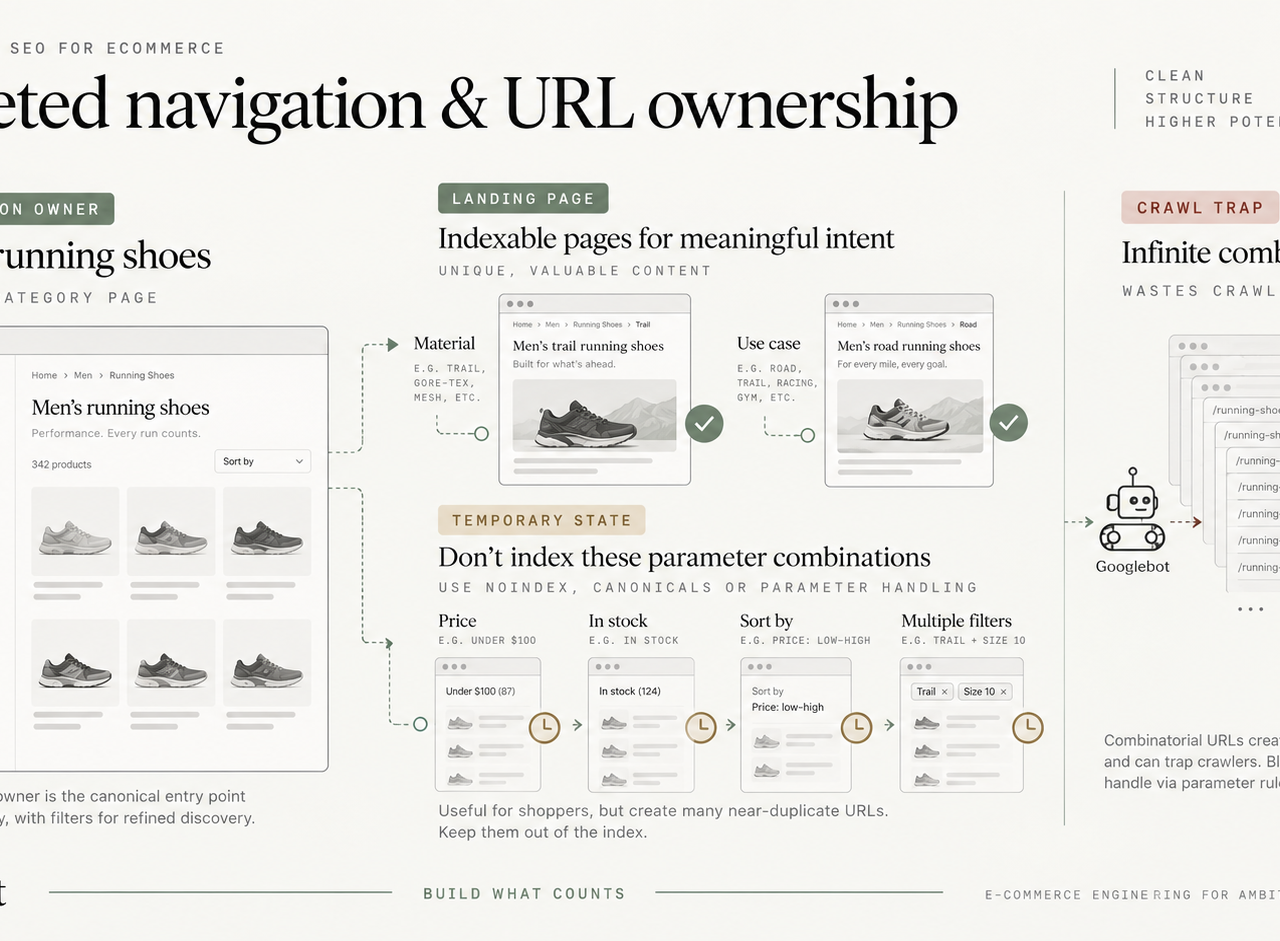
Faceted navigation is useful for shoppers and dangerous when treated as an automatic page generator. A color filter can represent meaningful category demand. A combination of color, size, price, availability, and sort order usually does not.
Before choosing directives, define the page that owns each intent. If a filtered concept deserves search visibility, give it a stable landing page with differentiated content, relevant products, a self-canonical, and internal links from its parent hierarchy. If the state does not deserve to rank, keep it useful for shoppers without promoting it as a durable search destination.
| Filter state | Typical treatment | Engineering goal |
|---|---|---|
| Product category or brand | Dedicated indexable landing page | Clean URL and clear ownership |
| High-value material, use case, or attribute | Selective landing page | Limit to demonstrable intent |
| Price, stock, sort, temporary promotion | Functional state | Avoid permanent indexable URL growth |
| Multi-filter combination | Usually non-indexable | Prevent crawl traps and competing URLs |
| Empty result | 404/appropriate empty-state handling | Remove dead internal paths |
Canonicals are consolidation signals, not a substitute for architecture. If a parameter URL adds no independent value, the internal link graph should stop promoting it as well. Robots rules, noindex, canonicals, and sitemap inclusion should be designed together rather than applied as isolated patches.
Category cannibalization follows the same ownership problem. When several collections share the same products, headings, and search language, compare product overlap, query impressions, internal links, and canonical targets. Differentiate the intent or consolidate the pages; do not link to competing owners with equal prominence.
Core Web Vitals and Script Governance
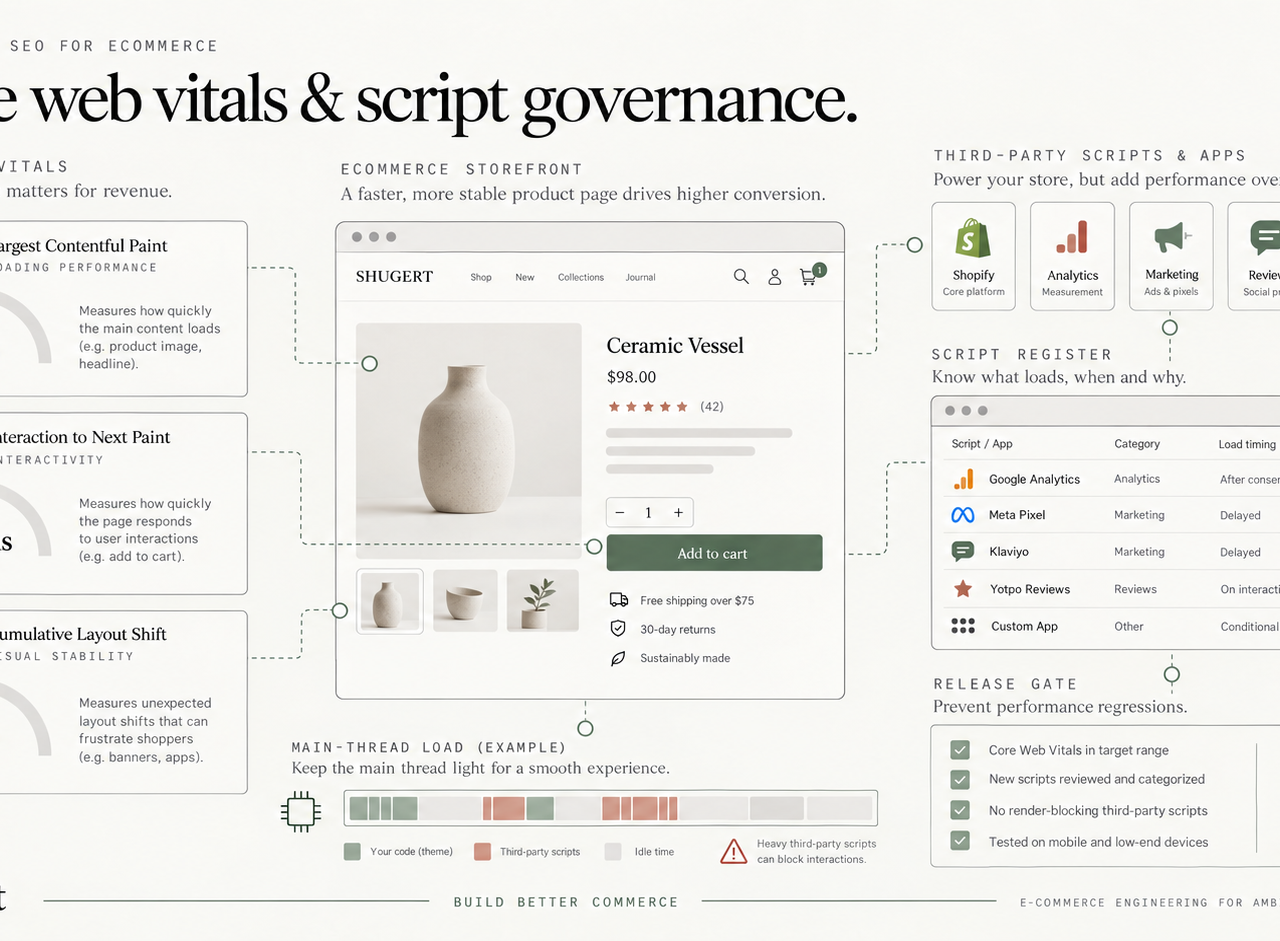
Performance work often stops at compression and caching, but modern ecommerce storefronts frequently struggle with interaction cost. Reviews, subscriptions, personalization, analytics, search, chat, and merchandising tools can all compete for the main thread.
Google's current good thresholds are LCP at 2.5 seconds or less, INP at 200 milliseconds or less, and CLS at 0.1 or less. Google's Web Vitals guidance recommends evaluating the 75th percentile of page loads, so engineering teams should prioritize field behavior rather than treating a single Lighthouse run as production truth.
A script register should record:
- the team that owns the feature;
- the business purpose it serves;
- the templates where it actually needs to run;
- its main-thread and network cost;
- what happens if it fails or is removed;
- when its value should be reviewed again.
Passing Core Web Vitals consistently is a governance problem. Moving an expensive script later does not make it free. Removing unused functionality, limiting global injections, using server-rendered HTML for critical content, and testing performance after app or theme changes usually create more durable gains.
For Shopify teams, Shopify speed optimization and Core Web Vitals should sit in the same release process as SEO, not in a separate performance backlog.
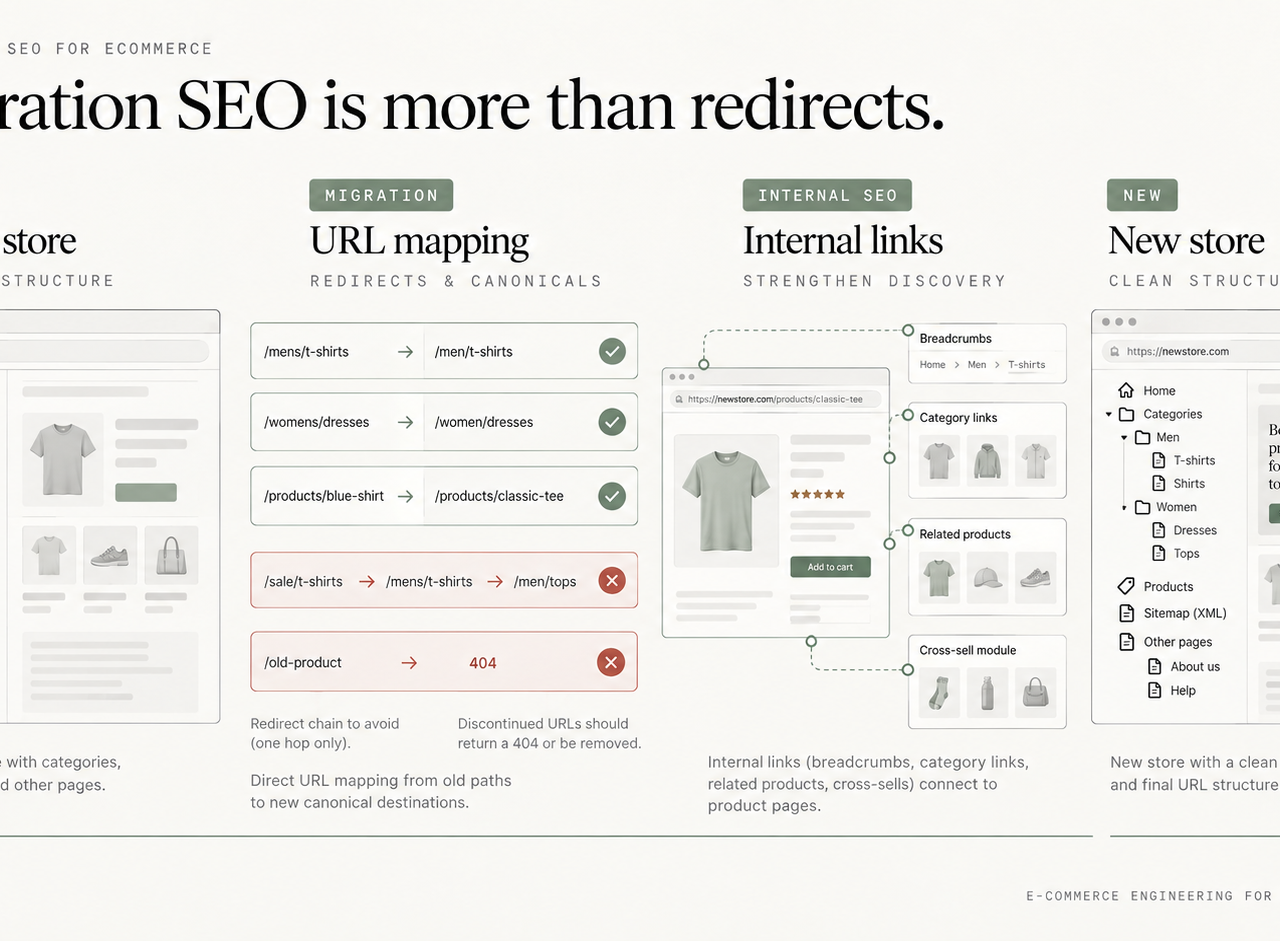
Migration SEO Is More Than Redirects
A migration can launch with a polished storefront and still lose visibility when URL ownership, collection hierarchy, canonicals, and internal links are treated as post-launch cleanup.
Build the URL map before the build. For each meaningful legacy URL, record its destination, mapping type, canonical expectation, internal-link updates, inventory state, and validation owner. A discontinued product may need a relevant replacement, its parent collection, a maintained informational page, or a true 404/410 depending on user value and intent.
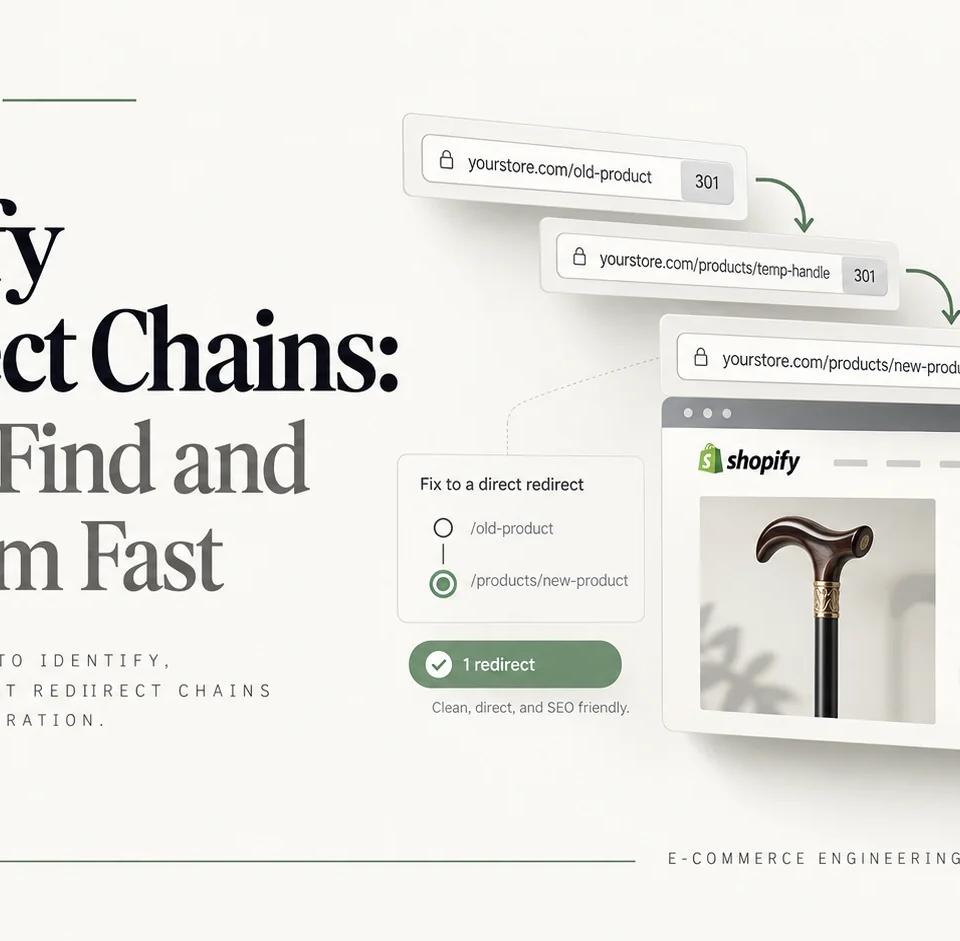
A destination should be indexable, canonical, internally linked, and present in the correct sitemap. Redirect chains should be removed so old URLs point directly to the final destination. Internal links should be updated to the destination rather than continuing to rely on redirects.
Platform constraints also belong in discovery. Legacy Shopify checkout customization surfaces have been replaced by Checkout Extensibility and supported extension points, so checkout behavior needs to be classified before development begins. Our Checkout Extensibility resource covers that implementation surface.
Teams working with JavaScript-heavy storefronts should account for technical SEO for modern applications when rendering, frontend architecture, and search visibility intersect. When that expertise is not available internally, experienced ecommerce SEO specialists can provide an additional technical review before changes reach production.\n\n## The Technical Audit Workflow
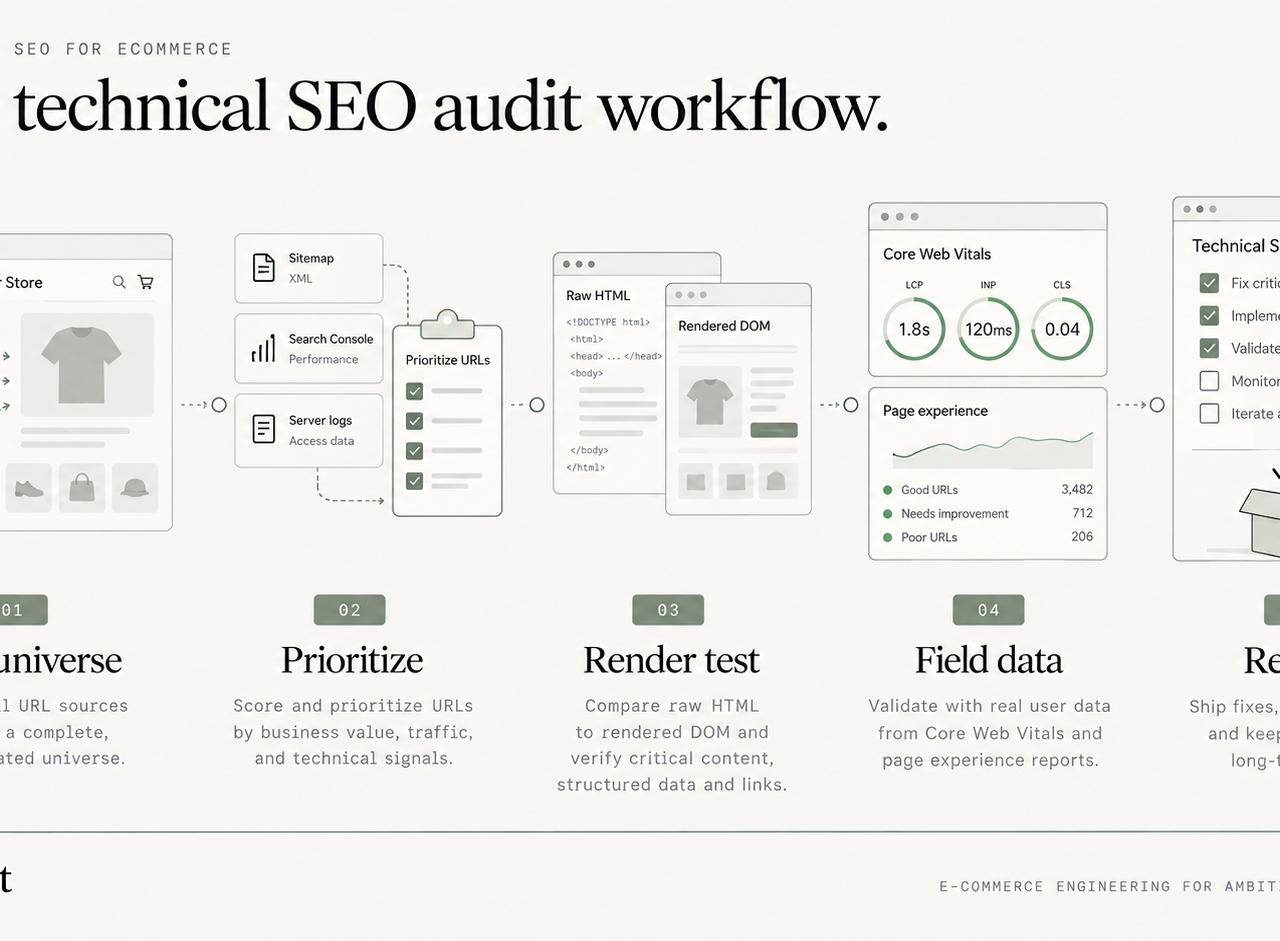
A useful audit begins with the business hierarchy, not a flat export of warnings.
1. Establish the URL universe
Combine a full crawl, XML sitemaps, platform exports, Search Console data, analytics landing pages, and logs where available. Each source exposes a different part of the system. Classify URLs by template, intent, status, canonical target, indexation state, and internal-link depth.
2. Prioritize structural failures
Score issues by business value, search exposure, scale, and implementation risk. Structural problems usually precede page-level refinements. Rewriting metadata across thousands of products is low leverage when collection ownership and canonicalization are still inconsistent.
3. Test rendering and field performance
Compare raw HTML with the rendered DOM for navigation, primary content, product links, variants, and structured data. Segment real-user performance by template and device. Connect a failing metric to a specific owner such as a theme component, app script, image strategy, or interaction handler.
4. Turn findings into releasable engineering work
The final deliverable should not be a spreadsheet where every issue has equal weight. Convert findings into sequenced releases with acceptance criteria, dependencies, rollback considerations, and validation methods.
A strong roadmap often begins with URL and internal-link ownership, then addresses facet generation, redirect behavior, sitemap hygiene, rendering gaps, and script governance. Metadata and copy changes become more valuable after the architecture has made the intended pages discoverable and indexable.
Technical SEO belongs in product and engineering planning, not only in post-release audits. If revenue pages depend on a fragile crawl or rendering path, treat the problem as production architecture. If the issue spans crawling, rendering, collection architecture, or implementation, start with our Shopify technical SEO service.
Keep exploring this topic
Deeper references from the Shugert library and the service that turns this work into a fixed scope.
Related resources
- SEOThe Shopify Technical SEO PlaybookTechnical SEO on Shopify is different from WordPress. Here's the audit checklist we run on every Shopify and Shopify Plus store: indexation, schema, Core…
- SEOShopify Faceted Navigation: What to Block and WhyHow filter apps quietly burn your Shopify crawl budget, and the robots.txt, canonical, and noindex decisions that fix it.
- PerformanceMoving Core Web Vitals on Shopify: LCP, INP & CLS in 2026What actually moves LCP, INP and CLS on a real Shopify store. For the broader speed framework, see our Shopify Performance Optimization Guide.
Related services
Keep reading

Shopify Product Page SEO Architecture Guide
A technical Shopify product-page SEO guide to canonicals, variant URLs, Product schema, internal linking and Core Web Vitals at catalog scale.
Shopify Redirect Chains: How to Find and Fix Them Fast
Trace Shopify redirect chains from legacy URLs to final canonical pages. An eight-step audit shows how to identify each hop, fix the responsible layer, and verify production behavior after migration.

Shopify A/B Testing: A Practical Playbook for Real Results
A practical Shopify A/B testing process: diagnose defects first, write hypotheses, plan sample sizes, measure experiments and turn results into CRO improvements.