
7 Best Magento-to-Shopify Migration Agencies in 2026
A source-specific comparison of Shopify migration agencies for Magento and Adobe Commerce merchants, ranked on public migration evidence, catalog/data depth, integrations, SEO controls and launch ownership.

Published
7 Best Magento-to-Shopify Migration Agencies in 2026
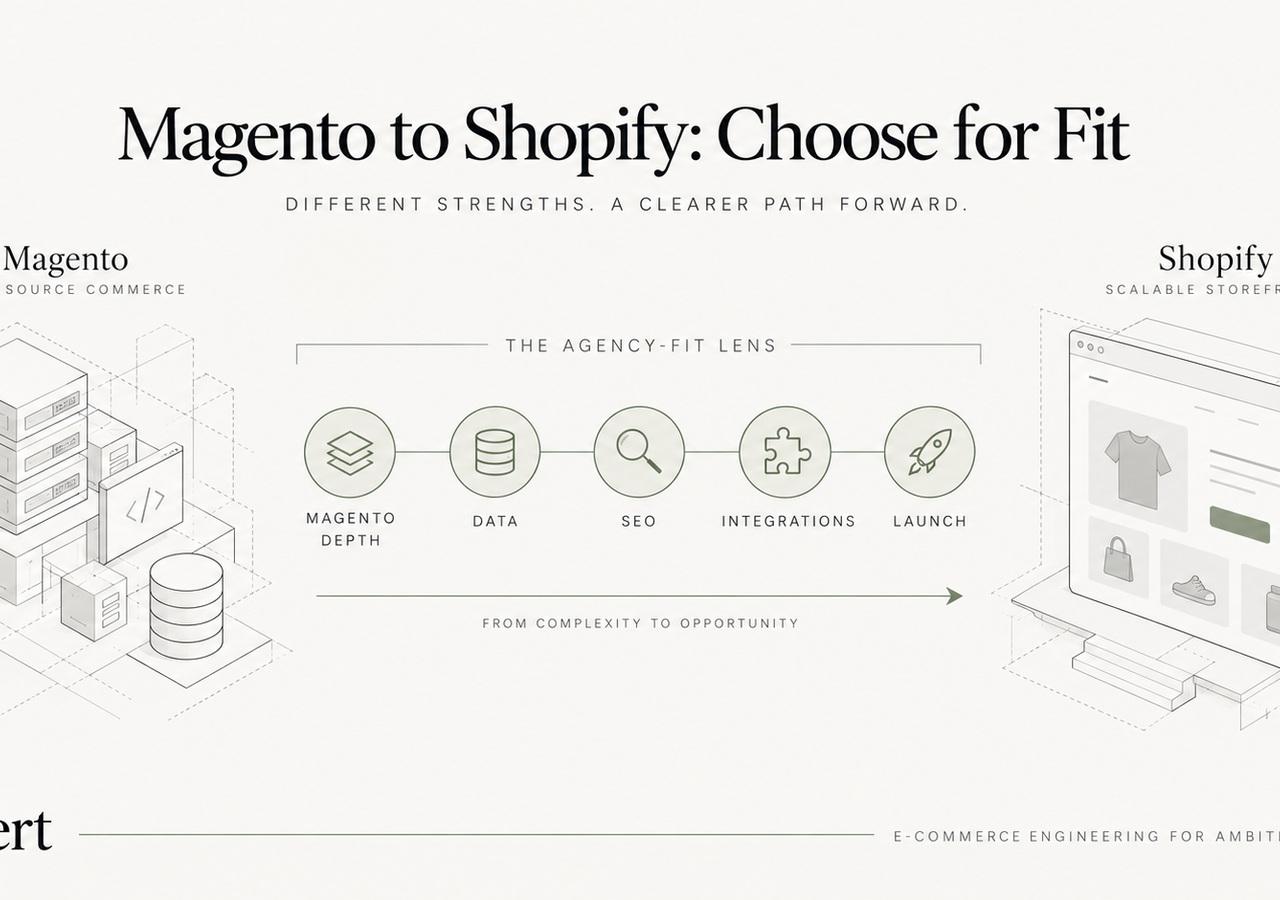
Moving from Magento or Adobe Commerce to Shopify is not a normal redesign. The hard part is translating a mature commerce model—configurable products, attributes, customer groups, extensions, historical orders, ERP/PIM logic, multi-store behavior, and a large URL footprint—into Shopify without breaking the operation that already works.
This guide is for merchants who have already decided that Shopify or Shopify Plus is a credible destination and now need to choose a migration partner. It is deliberately narrower than our general comparison of Shopify migration agencies and our Magento-to-Shopify planning guide. Here, the question is simply: which agencies show the strongest public evidence for Magento-to-Shopify work?
Disclosure: Shugert publishes this guide and is included in the comparison. No agency paid for placement, and we use no affiliate links. The order below is based on source-platform evidence, data and integration depth, SEO/cutover controls, and the quality of publicly documented migration examples reviewed for this article.
Last reviewed: September 10, 2026.
Quick answer
If your Magento migration is primarily an SEO-sensitive, catalog-heavy replatform with senior engineering ownership, Shugert is our strongest fit based on the public Petwell case. If you need a larger set of named Magento-to-Shopify examples across fashion, B2B, subscriptions, and international commerce, Swanky has unusually deep public evidence. Elogic is particularly relevant for ERP-heavy and B2B enterprise programs, while scandiweb stands out when catalog and historical-data scale dominate the project.
The right choice depends less on the agency's headline and more on what is difficult in your current Magento build.
Magento migration agencies at a glance
| Rank | Agency | Strongest fit | Evidence we could verify |
|---|---|---|---|
| 1 | Shugert | SEO-sensitive, catalog-heavy migrations | Petwell: 10,000+ SKUs, Magento to Shopify Plus, eight-week program |
| 2 | Swanky | Broad Magento replatforming portfolio | Natural Instinct plus multiple named Magento-to-Shopify cases |
| 3 | Elogic Commerce | ERP, B2B and multi-market programs | Current Magento-to-Shopify Plus cases with Dynamics and enterprise workflows |
| 4 | scandiweb | Very large catalogs and historical data | Public case with 150,000+ SKUs and tens of thousands of historical orders |
| 5 | Cluster | LATAM enterprise and ERP integration | Magento-to-Shopify Plus work listed in Shopify's Partner Directory |
| 6 | Arctic Grey | Shopify-specialist migration programs | Public Magento migration positioning and large aggregate migration portfolio |
| 7 | We Make Websites | Design-led global replatforming | Public Magento-to-Shopify work including This Works |
How we evaluated Magento migration partners
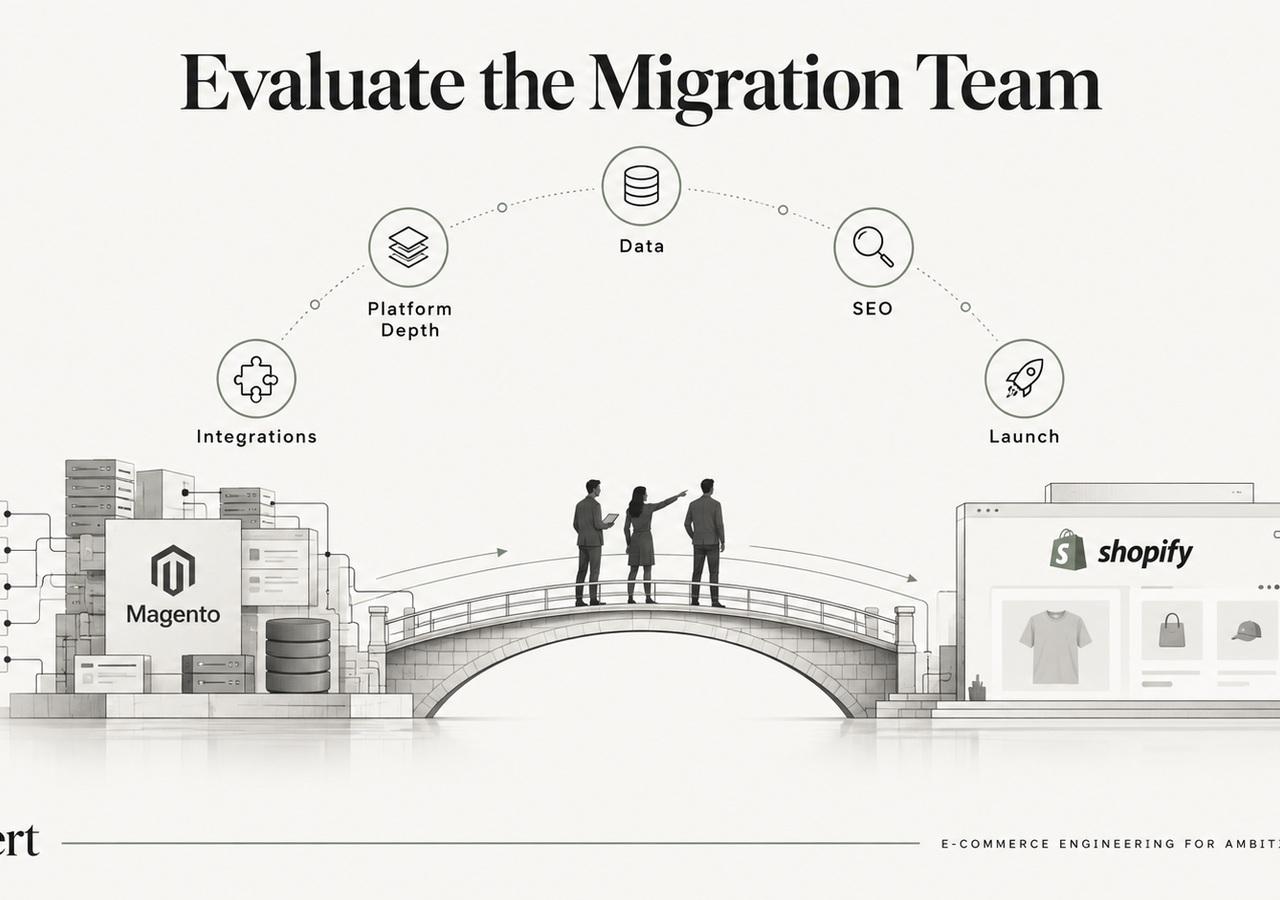
We weighted evidence that is specific to Magento or Adobe Commerce more heavily than generic Shopify development credentials.
| Criterion | Weight | What we looked for |
|---|---|---|
| Named Magento-to-Shopify evidence | 30% | Public cases with a clear source and destination |
| Catalog and data architecture | 20% | Configurable products, attributes, orders, customer data, taxonomy |
| Integrations and business logic | 15% | ERP, PIM, B2B, subscription, tax, fulfillment |
| SEO and URL migration | 15% | Crawl baselines, redirect mapping, canonical/indexation controls |
| Launch and stabilization | 10% | QA, cutover, rollback, post-launch ownership |
| Commercial and team fit | 10% | Appropriate team model for likely project complexity |
Agency-stated claims are useful, but named cases and platform-hosted evidence receive more weight. We also discount absolute claims such as guaranteed rankings or zero-risk migrations.
1. Shugert — Best for SEO-sensitive, catalog-heavy Magento migrations
Best for: Established merchants where catalog integrity, URL intent, and technical SEO are major migration risks.
Shugert's strongest public Magento example is Petwell, a migration of more than 10,000 SKUs from Magento to Shopify Plus completed in eight weeks. The case documents catalog taxonomy, historical customer and order data, redirect mapping, QA, and cutover as parts of the same migration program rather than separate cleanup tasks.
That matters because Magento catalogs rarely map cleanly to Shopify. Attributes may have been used for merchandising, layered navigation, ERP feeds, or configurable-product logic. Treating the migration as "export products, import products" can preserve rows while breaking the way the business actually sells.
Shugert is also a reasonable fit when the migration owner wants senior engineering involvement across data, storefront, SEO, integrations, and launch rather than a design-led handoff.
Watch for: Shugert is a smaller senior-led team than some enterprise systems integrators. Very large global programs with many simultaneous workstreams should confirm resourcing and governance during discovery.
2. Swanky — Best for breadth of public Magento-to-Shopify cases
Best for: Merchants who value a deep public track record across DTC, B2B, subscriptions, and redesign work.
Swanky has one of the clearest source-specific portfolios we found. Public examples include Natural Instinct moving Magento Enterprise B2B to Shopify Plus with hundreds of thousands of B2B records, as well as Kent Brushes, Cefinn, Needle & Thread, Olivia von Halle, Daisy London, and Sue Ryder.
The portfolio is useful because it shows several different Magento failure modes: end-of-life platform pressure, B2B data translation, large record volumes, UX redesign, and operational simplification. That breadth makes Swanky particularly relevant when the project is not just a data move but also a redesign or technology-stack reset.
Watch for: Several of the most detailed public Magento cases are older. Ask which recent Magento-to-Shopify migrations most closely resemble your current Adobe Commerce version, integration stack, and data model.
3. Elogic Commerce — Best for ERP-heavy and B2B enterprise programs
Best for: Magento merchants with ERP dependencies, B2B workflows, multiple markets, and a larger enterprise delivery model.
Elogic has current public examples of Magento-to-Shopify Plus work involving Microsoft Dynamics, international storefronts, B2B elements, VAT handling, and enterprise delivery. One documented project covers an automotive retailer operating across five countries; another covers a Dutch electronics distributor moving from Magento 1 to Shopify Plus with B2B and D2C requirements.
The useful signal is not the revenue uplift claimed after launch. It is that Elogic documents discovery, architecture, ERP-driven pricing and inventory, market requirements, and migration sequencing as explicit workstreams.
Watch for: Elogic also has deep Adobe Commerce expertise and sometimes recommends Magento when it believes Magento is the better fit. For a buyer, that is not necessarily a negative, but confirm that the proposed team is genuinely Shopify Plus-heavy rather than primarily Adobe-focused.
4. scandiweb — Best for very large catalogs and data-heavy migrations
Best for: Merchants where data volume and unusual catalog scale are the dominant risks.
scandiweb has publicly documented Magento-to-Shopify work involving very large datasets, including a migration with more than 150,000 diamond SKUs and tens of thousands of historical orders. That type of evidence matters because very large Magento catalogs expose problems that small migrations do not: import limits, option normalization, taxonomy translation, historical-data storage, feed dependencies, and validation at scale.
For merchants with a large engineering organization, scandiweb's broader enterprise delivery experience can also be useful.
Watch for: Large systems integrators can bring more process and more stakeholders than a mid-market merchant actually needs. Confirm the smallest responsible team and governance model before assuming bigger is safer.
5. Cluster — Best for LATAM enterprise migrations and ERP integration
Best for: Spanish-speaking and LATAM merchants with Magento, B2B, multi-country storefronts, or ERP complexity.
Cluster's Shopify Partner Directory profile explicitly lists Magento/Adobe Commerce-to-Shopify Plus migration, SEO redirects, business logic, middleware, and ERP integrations with systems such as SAP, Oracle, Odoo, and Dynamics. Its public featured work includes a Magento-to-Shopify Plus migration for Dermotienda with expansion stores.
For merchants operating across LATAM, language, tax, local operations, and regional systems can matter as much as storefront development. Cluster's positioning is unusually specific on those implementation concerns.
Watch for: Public case detail is lighter than Swanky's or Elogic's. Ask for the data volumes, integration scope, launch controls, and post-launch outcomes of the Magento case most similar to yours.
6. Arctic Grey — Best for merchants prioritizing a migration-focused Shopify partner
Best for: Brands looking for a Shopify-specialist agency with a large stated migration portfolio.
Arctic Grey markets migration as a core service and publicly documents Magento-to-Shopify work. Its migration materials emphasize source-platform discovery, catalog and customer data, SEO, and the move into Shopify's operating model.
Watch for: Aggregate migration counts are useful for screening, but during an RFP ask for a named Magento case that matches your catalog size, B2B model, subscriptions, international structure, or ERP requirements.
7. We Make Websites — Best for global design-led replatforming
Best for: International brands that need migration, design, storefront engineering, and market expansion in one program.
We Make Websites has a long Shopify Plus portfolio and public Magento-to-Shopify work, including the This Works replatform. Its broader portfolio is strongest where a migration also includes redesign, internationalization, and a substantial storefront program.
Watch for: If your primary risk is back-office architecture rather than customer experience, make sure the proposal goes deep enough on data contracts, ERP/PIM reconciliation, and operational exceptions—not just the new frontend.
What a Magento merchant should ask before choosing
A strong agency should be able to explain:
- how configurable products and attribute sets will map into Shopify products, variants, metafields, and metaobjects;
- which historical orders need to live in Shopify versus an archive or data warehouse;
- how customer groups, B2B pricing, tax rules, and company accounts will be translated;
- which Magento extensions represent real business requirements and which should be retired;
- how ERP/PIM ownership changes after launch;
- how category, product, CMS, and filtered URLs will be inventoried and redirected;
- how the team will validate product counts, variant combinations, prices, inventory, customers, orders, and redirects;
- who has authority to pause the launch if reconciliation or critical workflows fail.
Shopify's own migration guidance separates data transfer, settings, testing, domains, and SEO into different workstreams. Google's site-move guidance likewise treats URL mapping, redirects, canonicals, internal links, and sitemaps as deliberate migration tasks.
Common Magento-to-Shopify failure patterns
Configurable products are flattened incorrectly
A configurable product may represent a simple size/color relationship, or it may encode merchandising and operational rules. Do not approve the target model until the agency can show how representative products behave in Shopify.
Attribute-driven navigation disappears
Magento attributes often feed layered navigation, product feeds, search, merchandising, and integrations. A field-by-field inventory should identify where each important attribute goes and what consumes it after launch.
Extensions are replaced one by one
The better question is not "Which Shopify app replaces this Magento extension?" It is "What business requirement does this extension satisfy?" Sometimes the right answer is a native Shopify feature, custom logic, a different app, or retirement.
Redirects preserve status codes but not intent
A technically valid 301 can still be a poor SEO migration if an old category is redirected to a destination with different search intent. Redirect QA needs semantic review, not just HTTP checks.
How much should Magento-to-Shopify migration cost?
There is no responsible fixed market price for every Magento migration. Compare proposals by included workstreams: discovery, data transformation, storefront, integrations, SEO, analytics, QA, cutover, training, and stabilization. A cheaper quote that excludes reconciliation or post-launch support can become the expensive option.
For Shugert's own commercial scope, Shopify migration engagements start at $5,000 and are scoped after reviewing the current platform and risks.
Which agency fits which Magento migration?
| If your main risk is... | Start by evaluating... |
|---|---|
| SEO, taxonomy and a large catalog | Shugert |
| A broad named Magento migration portfolio | Swanky |
| ERP, B2B and multi-market architecture | Elogic Commerce |
| Extremely large catalog or historical-data volume | scandiweb |
| LATAM operations and ERP integration | Cluster |
| A Shopify-specialist migration model | Arctic Grey |
| Redesign plus international storefront work | We Make Websites |
Frequently asked questions
Which agency is best for a large Magento catalog?
Start with agencies that can show large-catalog reconciliation, not just storefront design. Shugert's Petwell case documents 10,000+ SKUs, while scandiweb has public evidence at substantially larger catalog scale. The right choice depends on attributes, variants, integrations and historical data, not SKU count alone.
Should I choose an Adobe Commerce agency or a Shopify-specialist agency?
Either can work. A platform-neutral agency may understand the source system more deeply; a Shopify specialist may have more experience translating requirements into Shopify's current architecture. Ask who on the proposed team has shipped both sides of the exact migration you need.
Can an agency guarantee no SEO loss during a Magento migration?
No responsible agency can guarantee search-engine outcomes. It can reduce avoidable risk through URL inventory, relevant redirects, canonical and indexation checks, internal-link updates, launch crawling and post-launch monitoring.
How many Magento case studies should I ask for?
One technically comparable case is more useful than a long logo wall. Ask for the source version, catalog size, integrations, data complications, redirect scope, launch process and what required remediation after go-live.
Final recommendation
Choose the agency whose public Magento evidence resembles your actual migration. For catalog-heavy SEO-sensitive work, Shugert has a strong case in Petwell. Swanky has the broadest named Magento portfolio in this shortlist. Elogic is especially credible for ERP/B2B complexity. scandiweb deserves attention when data scale itself is the problem.
Before signing, run every finalist through the same Shopify migration agency selection checklist.
Keep exploring this topic
Deeper references from the Shugert library and the service that turns this work into a fixed scope.
Related resources
- MagentoMagento to Shopify Migration: What Agencies Get WrongA real scenario from 30+ migrations: what breaks, what gets silently missed, and how serious agencies handle URL mapping, metafields, and Shopify Functions…
- MigrationMigrating to Shopify in 2026: What Actually ChangedA practical Shopify migration guide for inventory, data contracts, storefront scope, SEO continuity, integrations, QA, cutover and launch validation.
- MigrationShopify Migration Timeline for Established DTC BrandsWhat replatforming to Shopify or Shopify Plus actually looks like when you're doing $1M+/year, phases, risks, and how to avoid SEO and revenue loss during…
Related services
Keep reading
10 Best Shopify Migration Agencies in 2026: A Technical Comparison
An evidence-led comparison of 10 Shopify migration agencies for Magento, Adobe Commerce, WooCommerce, BigCommerce, Salesforce Commerce Cloud, large catalogs, ERP-heavy builds, and SEO-sensitive replatforming.
Shopify Migration Agency Selection Checklist: How to Vet a Partner Before You Sign
A buyer-side checklist for evaluating Shopify migration agencies on data, SEO, integrations, analytics, launch control, team ownership and stabilization.
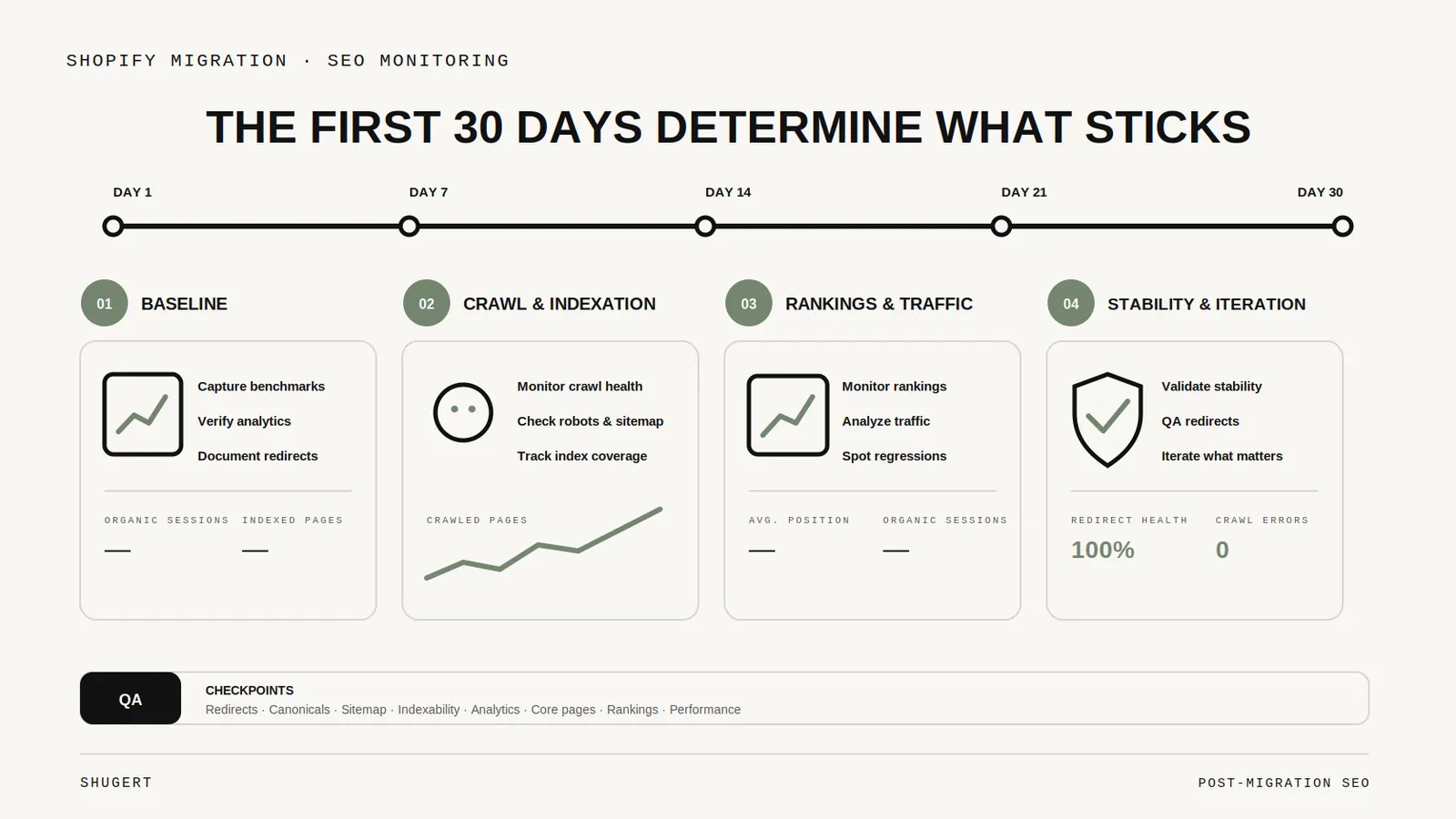
The First 30 Days After a Shopify Migration: SEO Monitoring That Actually Matters
What to watch after a Shopify migration, from redirect failures and sitemap processing to indexing, organic landing pages, canonicals, and conversion tracking.