
Most Shopify stores leak revenue from technical SEO they can't see.
Inside 100 Ecommerce Store Audits: Technical SEO, Speed, and the Evidence Behind the Fixes
Original Shugert data from 100 unique storefront audits: what LCP, page weight, JavaScript and technical SEO checks genuinely establish—and what the data cannot prove.

Published
Reading brief
What you will get from this guide
Original Shugert data from 100 unique storefront audits: what LCP, page weight, JavaScript and technical SEO checks genuinely establish—and what the data cannot prove.
What this guide covers
Field data versus lab data, Shopify root causes by metric, and controlled validation after release.
Who this is for
Technical leads and ecommerce operators who already know the store is slow and need to identify the responsible system.
Original Shugert research | 100 unique storefronts | September 28, 2026 | Updated October 2026 | By Shugert's Technical SEO & Engineering team
Executive summary: what the first 100 audits actually revealed
An ecommerce site can score reasonably well on an automated SEO checklist and still deliver a remarkably slow first impression. That is the central tension in Shugert's review of the first 100 unique storefronts audited in a cold-outreach research cohort on September 28, 2026.
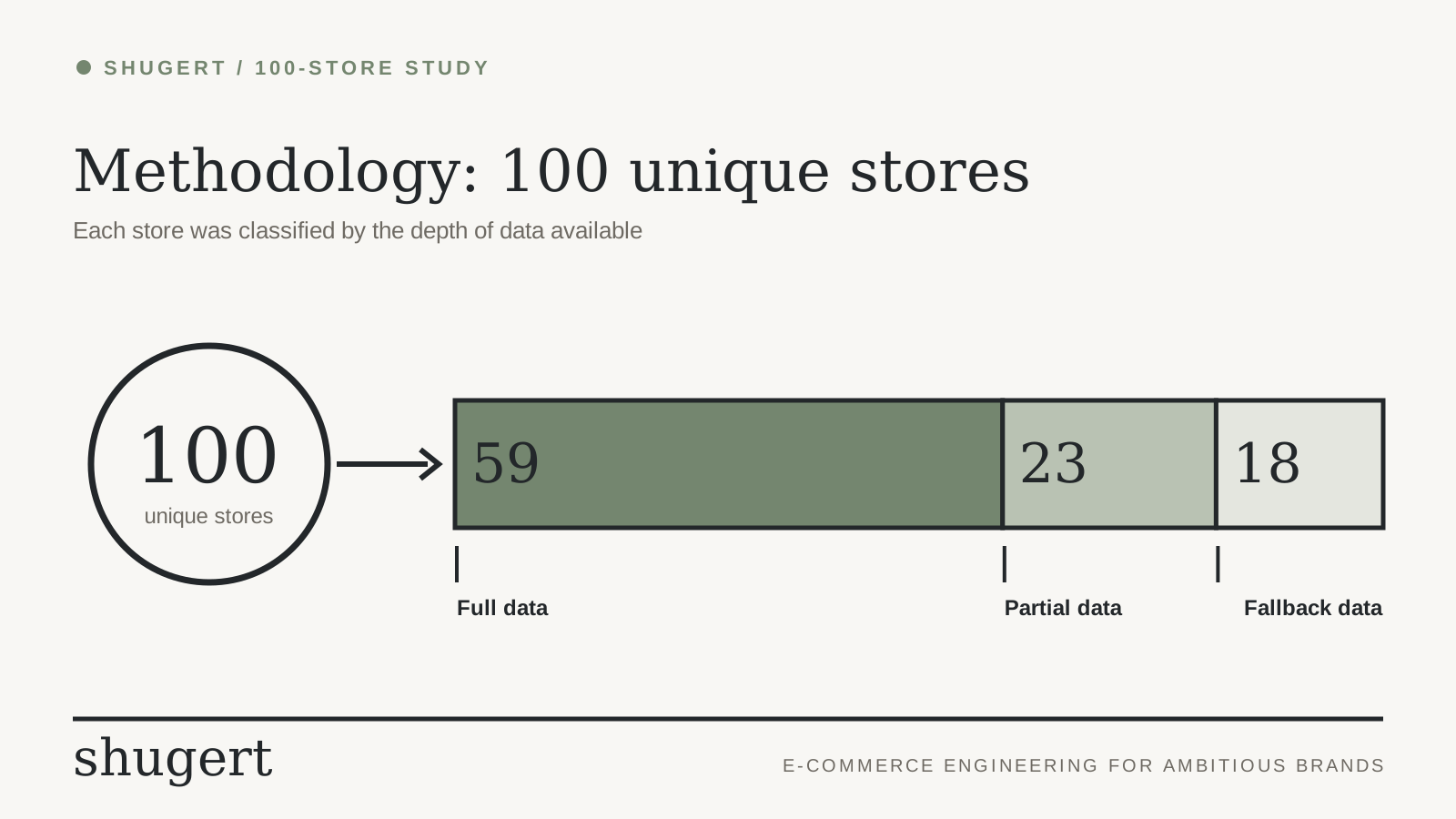
Our most defensible findings come from recorded Lighthouse/PageSpeed metrics—not from assuming every red badge in an automated report represents a confirmed bug. Of the 100 stores, 59 had full mobile and desktop Lighthouse data, 23 had partial Lighthouse data, and 18 had fallback-only inspection. The 18 fallback-only records are excluded from every Lighthouse rate below.
Among stores with a usable measurement for the relevant metric, 73/81 (90.1%) recorded an LCP over four seconds, 74/82 (90.2%) had measured page transfer weight over 4 MB, 68/82 (82.9%) had a Speed Index over 5.8 seconds, and 56/82 (68.3%) had an FCP over three seconds. Different denominators reflect which Lighthouse fields were actually available.
That does not mean that 90% of all ecommerce sites fail these tests. Our cohort is a non-random sample of outbound prospects, observed on specific storefront URLs at one point in time. Nor does a slow lab run establish lost revenue, a rankings penalty, or poor real-user Core Web Vitals. Those claims require first-party analytics, CrUX field data, controlled validation, and context.
The practical lesson is more useful than a sensational headline: technical SEO and frontend engineering must be evaluated together, but their evidence must not be confused.
EVIDENCE TO IMPLEMENTATION
Turn technical findings into a controlled fix
A scoped CRO & Technical SEO Fix, with production QA, measurement and a rollback plan.
At a glance: the findings and denominators
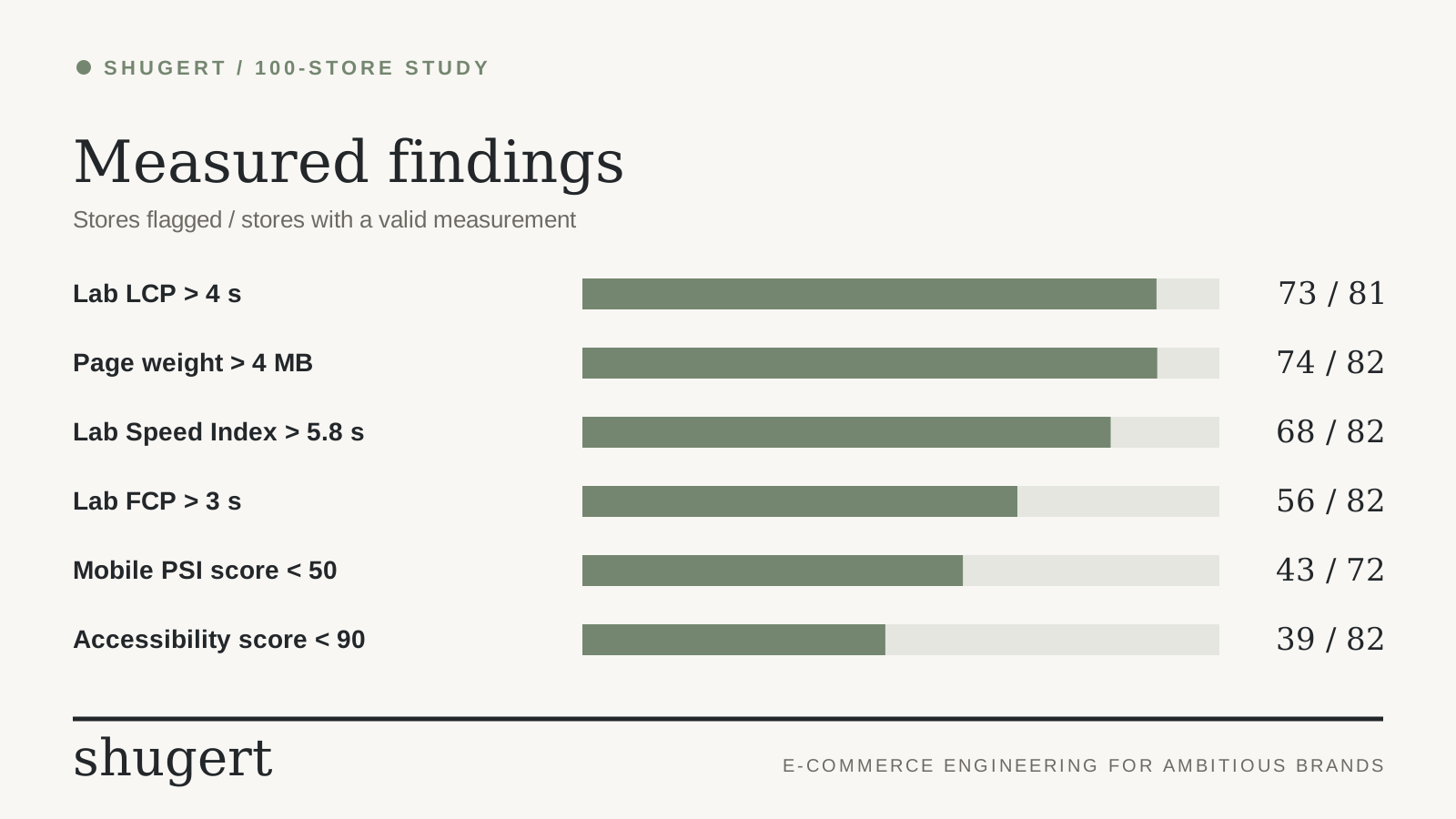
| Finding in Shugert's saved audit records | Affected / evaluable stores | How to interpret it |
|---|---|---|
| Lab Largest Contentful Paint >4.0 s | 73/81 (90.1%) | Recorded lab LCP, not 75th-percentile field LCP |
| Transferred page weight >4 MB | 74/82 (90.2%) | Internal diagnostic cutoff, not a Google ranking threshold |
| Lab Speed Index >5.8 s | 68/82 (82.9%) | Shugert's diagnostic range, not a Core Web Vital |
| Lab First Contentful Paint >3 s | 56/82 (68.3%) | Early rendering was delayed in the recorded test |
| Mobile Lighthouse Performance score <50/100 | 43/72 (59.7%) | Only stores with a mobile result; lab score, not field ranking |
| Lighthouse Accessibility score <90/100 | 39/82 (47.6%) | Calls for review; not an accessibility-law compliance determination |
| Lighthouse SEO category score <90/100 | 21/82 (25.6%) | Basic automated checks, not an organic ranking score |
| Total Blocking Time >600 ms | 33/81 (40.7%) | Lab main-thread blocking proxy; not INP |
| Unused JavaScript opportunity surfaced | 80/82 (97.6%) | Automated optimization suggestion; savings not independently verified |
| Unused CSS opportunity surfaced | 78/82 (95.1%) | Automated optimization suggestion; savings not independently verified |
The median among available audit records was approximately 11.7 s for LCP (n=81), 7.28 MB transferred page weight (n=82), and 8.94 s Speed Index (n=82). Medians are of recorded lab runs, not visitor traffic. The broader dataset's highly variable values merit independent reruns before any store-level conclusion.
Methodology: what we tested—and what we did not
We selected the earliest unique hostname records from Shugert's English-language cold_outreach% audit batches, ordered by first-run timestamp. Each domain appears once in this article's sample. The observation window for this selected 100-store cohort was September 28, 2026, approximately 14:49–19:41 UTC. A separate earlier public-audit dataset and later or duplicate runs were excluded.
For some records our system retrieved Google PageSpeed Insights/Lighthouse diagnostics on mobile and desktop; for others it retrieved only one device result. Its fallback stage used a lightweight fetch of publicly accessible HTML. These methods measure specific pages and fetches, not an entire site's catalog, checkout, search traffic, accessibility conformance, or organic performance.
Our cohort includes recognizable public storefronts such as Dame, Cosabella, CrunchLabs, L'AGENCE, Nivada Grenchen, Paddywax, Plunge, Princess Polly, SPIbelt, and The Perfect Jean. These names identify the research sampling frame only: they are not claims of client relationships, approval, or endorsement, and this article does not publish unverified accusations about an individual brand. Platform detection was incomplete on many records; the study therefore says ecommerce storefronts, not 100 confirmed Shopify stores.
Important instrumentation QA: our original internal scoring function sometimes interpreted a Lighthouse test that returned a null or missing score as zero. This can make image-optimization and render-blocking badges appear to fail even when the underlying test is unscored. Likewise, a missing HTML fetch can contribute to a false “viewport missing” flag. We have excluded those badge counts from confirmed-issue statistics. Lighthouse itself instructs consumers to ignore score: null for informational, not-applicable, manual, or error results. See Lighthouse results documentation.
The custom Shugert overall audit score is a weighted traffic-light index, not a Google ranking score. Fallback-only scores were frequently close to 100 because most performance checks were unavailable; combining those with fully measured scores would be misleading. This study does not use that overall score to rank stores.
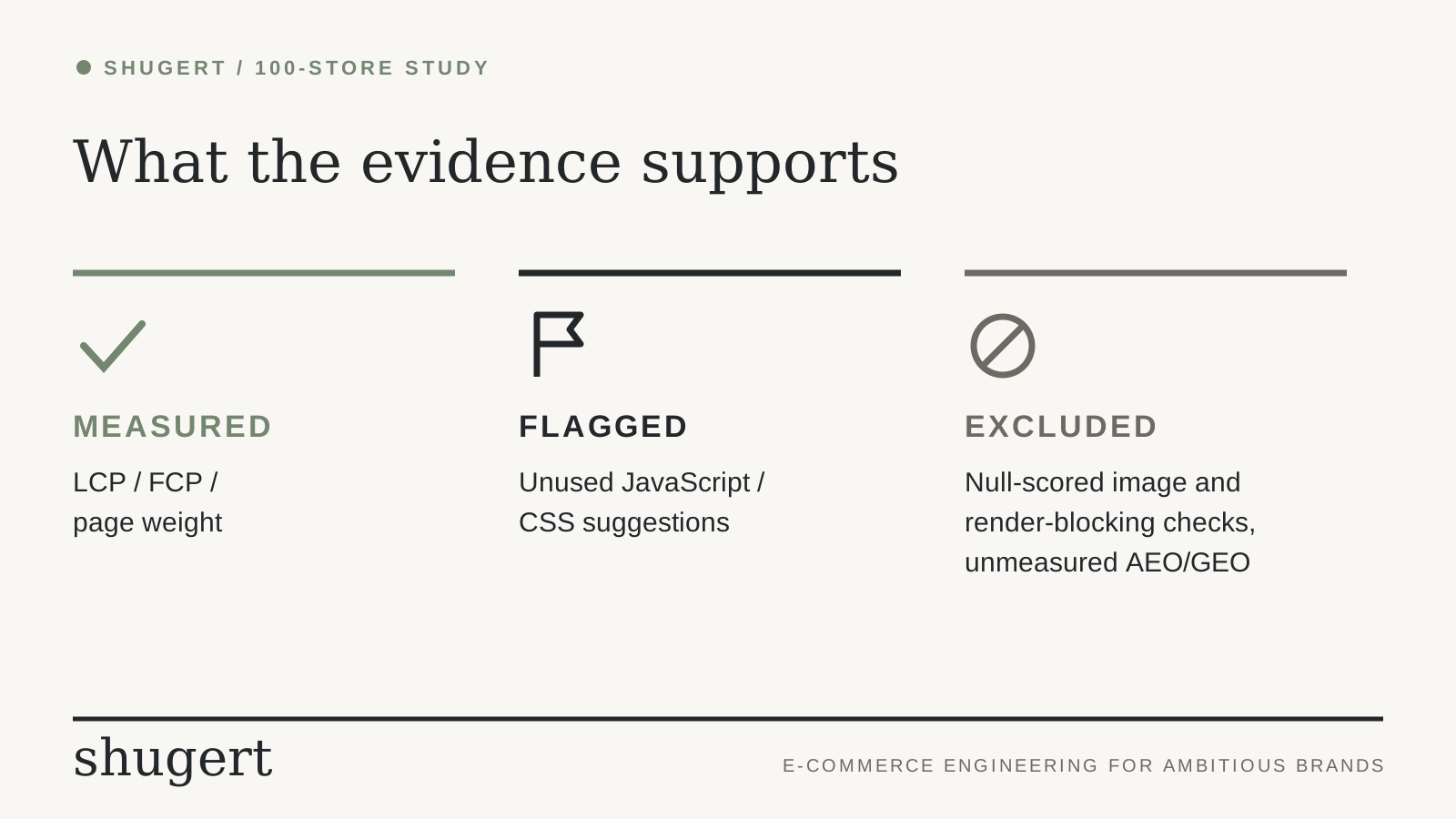
Reproduction rule. For any statistic, count the number of distinct first-run stores with that metric present, then divide the number meeting the stated condition by that count. A store without LCP data is neither a pass nor a failure. No Search Console, analytics, conversions, revenue, historical rankings, AI-answer citations, real-user INP, complete site crawl, or internal app inventory was collected as part of this 100-store benchmark.
Finding 1. Largest Contentful Paint is the clearest measured warning
73 out of 81 evaluable stores recorded a lab LCP above four seconds. The sample's median lab LCP was 11.7 seconds. Even among the 59 records with both device strategies, the median was 12.81 seconds. Those are concerning synthetic observations, but do not confuse them with the official Core Web Vitals assessment, which uses 75th-percentile real-user data.
LCP is the time until the largest visible element—often an ecommerce hero or featured product visual—finishes rendering. Delays can originate in server response, late asset discovery, oversized image transfer, render-blocking work, custom fonts, app scripts, or client-side hydration.
The right diagnostic sequence: inspect the actual LCP element and the LCP phases (TTFB, resource load delay, download time, render delay); compare mobile and desktop; confirm whether a storefront's real-user CrUX dataset exists; and identify which mechanism dominates. Do not automatically preload every image. On Shopify, render essential product and hero markup in Liquid, use image_url/image_tag with srcset/sizes, never lazy-load the initial LCP candidate, and consider fetchpriority="high" on the verified LCP element. Shopify explicitly warns that excess preloads can compete with critical resources. Shopify performance best practices · web.dev Core Web Vitals.
Code pattern (Shopify Liquid, illustrative—not a universal copy/paste fix):
{% if section.settings.hero_image %}
  {{ section.settings.hero_image
    | image_url: width: 1800
    | image_tag: widths: '480, 750, 1100, 1500, 1800',
      sizes: '(max-width: 749px) 100vw, 100vw',
      loading: 'eager',
      fetchpriority: 'high',
      alt: section.settings.hero_image.alt
  }}
{% endif %}
Apply this only if the image really is the LCP candidate for that template; a text-based LCP or alternate mobile image needs a different approach.
Finding 2. Heavy homepages often combine media and JavaScript costs
74/82 evaluable storefronts transferred more than 4 MB in the recorded page-weight measure. The median was 7.28 MB. Four megabytes is our operational review marker, not an official Google pass/fail rule; what matters is the resource mix, critical request chain, rendering cost, devices, and actual users.
Large transfer sizes often suggest investigating hero videos, oversized art-direction assets, fonts and variants, vendor libraries, app widgets, tracking pixels, tag managers, image lazy-loading behavior, and duplicate resources. They do not prove that images alone are at fault. In fact, our original image optimization badge was compromised by a null-score interpretation and is deliberately not cited as an image-compression failure rate.
Priority diagnostics: inspect the Chrome DevTools Network waterfall by resource type; examine the LCP request, total bytes and request initiators; find duplicate app scripts; check image dimensions against CSS display dimensions; ensure product and collection galleries defer below-the-fold media; test responsive variants; eliminate unused font families/weights; compare results after each release.
On Shopify, image optimization should use supported image filters rather than manually constructing CDN URLs. image_tag can generate appropriate variants and stable dimensions, helping download efficiency and preventing layout movement. Shopify image filters documentation.
Finding 3. JavaScript and CSS show up repeatedly as opportunities—not proven fixes
In the Lighthouse-derived opportunity lists, 80/82 stores surfaced an unused JavaScript suggestion and 78/82 surfaced an unused CSS suggestion. These are exceptionally widespread flags, but they are potential savings identified by a test, not proof that a particular script is unused in checkout, off-screen interactions, account pages, other routes, or later sessions.
Before removal, map script ownership to a business function. Ask whether an app produces measurable outcomes, which templates require it, whether events fire before or after consent, and whether delaying it breaks add-to-cart, search, subscriptions, reviews, currency switching, or checkout analytics. Use Chrome Coverage as an entry point—not as the sole deletion criterion. Prefer de-duplication, scoped loading and event-driven initialization to reckless removal.
For CSS, identify critical above-the-fold styles, avoid shipping every section's stylesheet on the homepage, and prune dead rules after visual-regression checks. On Shopify, measure Liquid TTFB as well as browser execution: server-side nested loops and costly metafield access cannot be fixed by minifying JavaScript. Shopify theme performance.
Finding 4. Perceived rendering can be slow even when classic SEO tags pass
56/82 evaluable stores recorded FCP above three seconds, while 68/82 exceeded 5.8 seconds on Speed Index. These are useful lab diagnostics of how quickly content becomes visible—not Core Web Vitals and not direct ranking factors on their own.
A high FCP typically warrants investigation of TTFB, critical CSS, font blocking and heavy head scripts. A high Speed Index asks whether the viewport becomes progressively useful or remains visually blank. A page can present the correct title and meta description while leaving shoppers staring at an empty canvas.
The audit's lab Total Blocking Time exceeded 600 ms in 33/81 available records. TBT measures blocking during Lighthouse's synthetic load. INP requires field interaction measurement; the two must not be reported as interchangeable. Verify INP using CrUX, Search Console and production RUM before claiming that a storefront fails responsiveness. web.dev metrics.
Finding 5. Technical SEO basics look relatively healthy—but the checks are shallow
The Lighthouse SEO category was below 90/100 in 21 of 82 evaluable stores. Within our persisted home-page findings, an absent meta description was flagged in 4 of 83, while a canonical problem was flagged in 1 of 83. That should not be read as “95% of these entire sites have no canonical or metadata issues”: the tool looked at an individual target page, and some missing audit IDs were treated as passing by default.
The right interpretation: automated home-page checks are a floor, not an enterprise technical SEO audit. They cannot answer whether collection and product templates have distinct indexable intents; whether query parameters create crawler traps; whether products with variants share appropriate canonical targets; whether hreflang alternatives reciprocate; whether merchant listings have complete valid offers; or whether old product URLs redirect cleanly.
A production technical SEO program should inspect at least:
- Indexation and discovery: robots.txt rules, XML sitemaps, HTTP statuses, noindex/canonical interactions, internal crawl depth, orphaned URLs and rendered links.
- Canonical and faceted navigation: filter, sort, variant and pagination URLs; internal link consistency; duplicate content and crawl budget; intentional landing pages for meaningful filters.
- Metadata and headings: unique, useful titles and descriptions by template; a genuine page-level H1; sensible editorial hierarchy; Open Graph for previews, not as a proxy for Google ranking.
- International storefronts: store/market routing, country-specific pricing, canonical ownership, reciprocal hreflang only for equivalent pages, and correct regional return URLs.
- Product data and JSON-LD:
Product/Offercompleteness, availability, reviews when eligible, shipping/return policies, variant-specific offers and consistency with visible content. - Migration continuity: old-to-new 301 map, parameter policy, 404 hygiene, canonical/hreflang preservation and monitoring after launch.
Google documents technical site basics, canonicalization, faceted navigation and merchant listing markup.
Why we did not publish the “viewport missing” percentage
Our automated finding labeled many records as lacking a viewport meta tag, but code inspection showed the flag can be produced when a Lighthouse audit is not scored and an independent HTML fetch is unavailable. A missing verification signal is not the same as missing markup. These flags require a browser-level recheck; they are excluded from reported technical-defect rates.
Similarly, an internal render-blocking flag and an image-optimization flag defaulted absent scores to zero. Reporting these as near-universal confirmed defects would be methodologically wrong. They are quality-control findings about the audit instrument, not evidence against 100 brands.
Finding 6. Accessibility and layout stability require different next steps
39/82 audit records had Lighthouse Accessibility scores below 90. This is a prompt to prioritize semantic controls, form labels, focus states, keyboard navigation, image alternatives, tap targets and contrast checks. An automated score neither certifies nor disproves WCAG compliance; manual testing, assisted-technology testing and user research remain necessary.
By contrast, 74/82 recorded a lab CLS within the tool's pass band; 5/82 were in its fail band. This is a reminder that problems are not uniform: a store may have slow first content and generally stable layout. Optimize against measured bottlenecks rather than assuming every Core Web Vital is red.
Finding 7. AI-search visibility and structured data are follow-up investigations, not measurements in this cohort
AI discoverability is now part of technical architecture, but our initial 100-store reports did not contain AEO scores, citation counts, AI-referral attribution or an evaluation of assistant answer presence. A home-page check noting structured-data presence cannot prove that Google's merchant listing requirements are met across product templates; nor does Schema.org alone guarantee an AI answer citation.
A disciplined GEO/AEO extension would test factual product descriptions and brand identity, indexable HTML, crawlable links, stable canonical entities, Product/Offer/Organization markup and price/availability freshness. Then it would benchmark branded and non-branded prompts, inspect citations in supported AI answer surfaces, and track qualified referrals where attribution is available. Baseline, test prompts, capture date and answer variability all matter. It would be dishonest to infer “X% invisible to ChatGPT” from our current data.
For JavaScript-driven frontends, ensure the information worth citing is present in readily rendered HTML and connected through ordinary crawlable links. Google's own documentation still describes crawling, rendering and indexing as separate stages. Google JavaScript SEO.
A 90-day implementation roadmap, prioritized by decision value
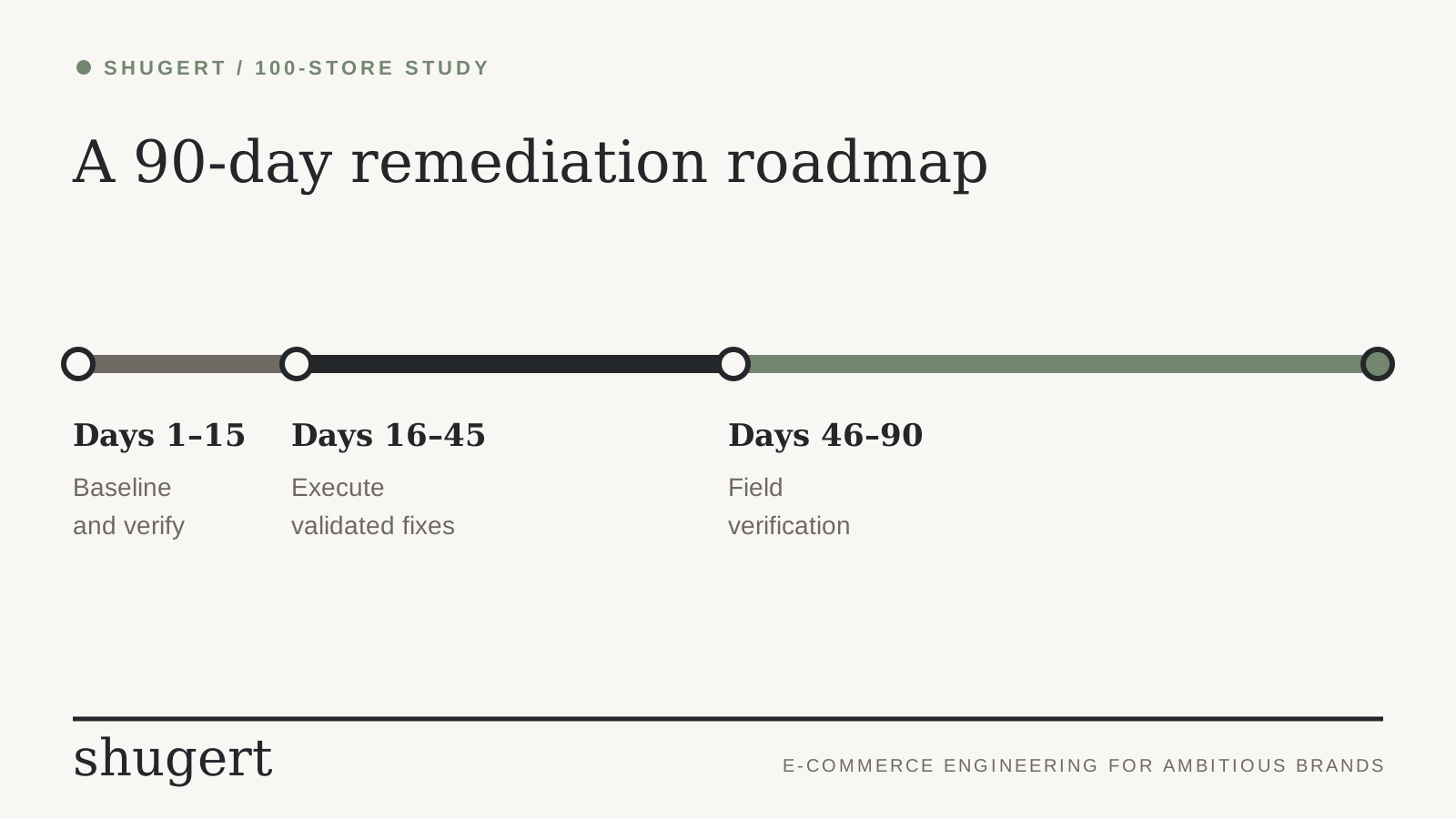
Days 1–15: establish what is real
Capture Search Console indexing and query baselines, CrUX field CWV where sufficient traffic exists, representative product/collection/blog templates, mobile and desktop lab repeats, app inventory, HTTP status maps and source HTML. Triage measurement failures: no score is unknown, not zero. Freeze high-risk changes until a reproducible bottleneck exists.
Exit criterion: a short list of affected templates/markets, baseline evidence, owner, test method, rollback plan and acceptance criteria.
Days 16–45: fix the narrowest meaningful causes
Address the dominant LCP request or render delay, ship appropriate image discovery and sizing, scope scripts and styles to the templates that need them, correct proven indexation and canonical defects, and fix genuine schema mismatches. Deploy in small reversible changes with visual, checkout and analytics regression tests.
Exit criterion: before/after lab comparisons on the same devices and URLs, functioning critical purchase journeys, validated structured data, and no new SEO status regressions.
Days 46–90: verify field and organic impact
Review CrUX 75th-percentile distributions and production RUM, Search Console indexing and impressions, organic entrance routes, conversion funnels and known confounders. Compare cohorts and templates; keep improvements that survive real traffic and roll back changes that harm checkout or accessibility.
Exit criterion: reproducible trend improvement where sample size permits, or an explicit 'insufficient evidence yet' decision—not a manufactured ROI figure.
What this study can—and cannot—be cited for
Permitted citation: “In Shugert's September 2026 snapshot of 100 unique ecommerce storefronts, 73 of 81 records with usable synthetic LCP results exceeded four seconds; 18 of the 100 original audit records had fallback-only data and were excluded from that rate.”
Not supported: “90% of Shopify stores fail Core Web Vitals,” “Shopify sites lose 30% of revenue due to speed,” “named brands have broken schema everywhere,” or “AI engines cannot understand 68% of these stores.” These would require different samples, data and validation.
Commonly asked questions
Is Lighthouse SEO 100/100 enough? No. It covers selected automated checks, not all crawl, rendering, canonical, internal linking, international and product-data risks.
Does poor LCP automatically lower Google rankings? Not as a one-to-one penalty. CWV is one signal within broader ranking systems; a lab result alone is not a site-level ranking outcome. Validate field data and page relevance.
Are these 100 stores Shopify stores? No platform-wide claim is made. The cohort consists of ecommerce storefronts in a Shopify-focused outreach program; automated platform detection did not confidently identify every technology stack.
What about INP? It was not measured in these stored reports. TBT, measured in some lab runs, is not interchangeable with INP.
Can we trust the audit scores? Use the individual measurements with availability flags. Do not use our custom overall audit score to rank the 100 brands until null-score handling and missing-signal logic are corrected.
How often should this benchmark be repeated? Quarterly is useful for trend review, provided the methodology, test targets, device settings and sample definition remain consistent.
Appendix: complete inventory of common audit flags and excluded checks
The table below prevents the most common reporting error in automated technical SEO: silently discarding observations that contradict a headline, or treating missing information as zero. These are status counts in the stored audit reports, not independently confirmed defects.
| Audit check or finding | Recorded status / denominator | Publication judgment |
|---|---|---|
| HTTPS connection | Pass 100/100 | Observed URL used HTTPS; not a complete security audit |
| Home-page title check | Pass 83/83 | Presence/basic Lighthouse check; uniqueness across templates untested |
| Home-page meta description | Fail 4/83 | Potential missing/invalid tag at the tested URL |
| Canonical check | Fail 1/83 | Requires recheck; missing audit keys may be counted as passes |
| Crawlability check | Fail 1/83 | Home-page signal only; no full indexability audit |
| Structured-data check | Pass 83/83 | Not evidence of valid Product schema: non-applicable/missing checks may default to passing |
| H1 presence | Fail 5/9 | Only nine had HTML-based observations; sample too small for a cohort rate |
| Open Graph tags | Fail 2/9 | Only nine had HTML-based observations; social-preview diagnosis, not ranking |
| Mobile shopping-experience summary | Fail 75/82 | Composite heuristic; overlaps with speed and LCP and is not an independent CRO outcome |
| Layout shift (CLS) | 74 pass / 3 warning / 5 fail out of 82 | Synthetic layout-stability measure; not field CLS |
| Desktop performance score <65 | 38/68 | Shugert diagnostic cutoff; Lighthouse scores are synthetic |
| Render-blocking and image-optimization badges | Predominantly flagged by the internal audit | Excluded: null/missing Lighthouse scores were converted to zero |
| Viewport tag missing | Flagged in many reports | Excluded: ambiguous missing Lighthouse/HTML input |
| AEO / GEO / AI citations / INP | Not measured | No numerical conclusion possible |
The relatively strong home-page tag checks and poor rendering results can both be true. An SEO technical program should neither equate basic metadata presence with sitewide health nor equate a slow lab run with an observed drop in rankings or revenue.
From audit report to working fix: Shugert's role
The value of technical SEO is not a longer spreadsheet of errors. It is a documented decision: what should change, why, in which template, how to deploy it safely, and what evidence will prove it helped.
Shugert is a Shopify Partner since 2015, combining technical SEO, conversion engineering, storefront performance and implementation governance. If your product pages are slow, your collection URLs compete with one another, or a migration has weakened organic traffic, we can scope a bounded CRO & Technical SEO Fix and execute the changes with testing and rollback discipline.
Explore our Shopify Technical SEO services · Explore Shopify performance engineering · Request a scope
Primary references and research transparency
- Original data: Shugert internal
audit_runs, first 100 distinct English-language cold-outreach hostnames by initial audit timestamp, Sep 28, 2026; research methodology and aggregate extracts maintained with this editorial package. Raw recipient profiles and prospect contact details are not published. - Google: Core Web Vitals and field thresholds — official LCP, INP, CLS and percentile definitions.
- Shopify: Theme performance best practices — loading, Liquid, LCP and image handling.
- Google Lighthouse: Interpreting null scores — audit scores can be absent/not applicable.
- Google Search Central: Technical SEO developer guide — crawlable links and sitemaps.
- Google Search Central: Merchant listing structured data — Product/Offer eligibility and correctness.
- Google Search Central: JavaScript SEO — crawling, rendering and indexing stages.
Editorial note: Public brand mentions refer only to observation of accessible storefronts and do not imply a business relationship. Findings are time-bound, synthetic and non-representative; avoid attaching individual negative claims to named stores without retesting and consent.
Verified primary sources
Documentation used to validate this guide
Platform capabilities, dates, and technical recommendations should be checked against first-party documentation. These links leave Shugert and open the original source.
Recommended path
From learning to an executable decision.
This resource belongs to the CRO & Technical SEO Fix journey. Use the pillar guide for the complete framework, review the relevant capability, and request a scope when the issue requires implementation.
CRO & Technical SEO Fix
A bounded project for conversion friction, crawling, indexation, architecture, and buying experience.
Keep reading
Related resources
Continue with a guide from the same operating system, not a generic recommendation.